

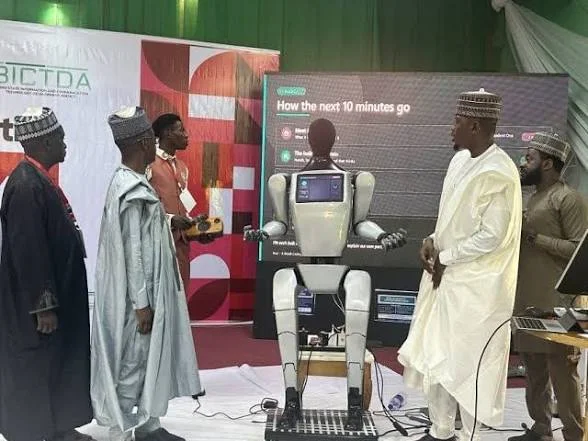
Students in Borno State have developed a humanoid robot teacher designed to support learning and improve classroom education across schools nationwide.
The innovation, named “Max Zulum,” is designed to help pupils, particularly those in hard-to-reach and conflict-affected communities, by providing interactive lessons and step-by-step explanations for difficult subjects such as mathematics and science.
Developers of the project said the robot can recognise spoken questions through its artificial intelligence system and respond with verbal explanations while displaying visual, step-by-step solutions on an embedded screen.
They explained that the technology adapts to each learner’s pace, making it suitable for both classroom and home learning.
The robot was unveiled on Thursday in Maiduguri during the graduation ceremony of the “Empowering Ideas, Empowering Communities” Artificial Intelligence Bootcamp and Data Analytics Fellowship, which marked the completion of a six-month training programme for students from six secondary schools in Borno.
Speaking on the project, the Managing Director of Maxzeeton Technology described the robot as evidence of the students’ rapid progress after six months of intensive training.
“After just six months of intensive training, our students have transformed classroom knowledge into a functional prototype capable of supporting pupils both at home and in school.
“The robot represents local innovation, self-reliance and the immense potential of home-grown artificial intelligence and robotics solutions,” he said.
He added that the company also admitted 100 young people into its Data Analytics, Artificial Intelligence and Robotics Fellowship Programme to prepare them with globally competitive digital skills for the evolving technology-driven economy.
The Executive Secretary of the Borno State Information and Communication Technology Development Agency (BICTDA), Engr. Kabir Wanori, said the state’s digital transformation agenda extends beyond technology adoption to producing innovators capable of solving real-life challenges.
“Max Zulum is only the beginning of what we expect will become many locally developed solutions, not only for education but also for agriculture, healthcare and industry.
“We will continue to support these students through additional training and expose their innovations to the international community,” Wanori said.
One of the student developers, Al-Mustapha Matazu, explained that the humanoid robot stands about 1.2 metres tall and features a display screen on its chest alongside a speaker and microphone system for two-way communication.
According to him, the AI-powered robot can understand complex spoken questions and provide detailed explanations while displaying each stage of the solution on its screen.
“During the demonstration, we asked the robot how it solves mathematical problems, and it guided us through the entire process by explaining every step visually.
“Our training started with basic coding before progressing to advanced artificial intelligence, making this project possible. The robot is a practical solution to a real educational challenge,” he said.
Another participant, Fatima Abdulrahman, who received the bootcamp’s innovation award, said the programme had transformed her perspective on technology.
“The experience has shown me how technology can address challenges in our communities.
“I now believe we can build tools that keep children learning even when schools are disrupted by insecurity,” she said.
Meanwhile, The Guild reports that this innovation comes as Borno’s education sector continues to face pressure from insecurity, displacement and a shortage of qualified teachers.
According to official education data from the Federal Ministry of Education’s Annual School Census, the state records an average learner-to-teacher ratio of 46 students per teacher, while international organisations, including UNICEF, have previously reported significantly higher ratios in some remote and conflict-affected primary schools.