


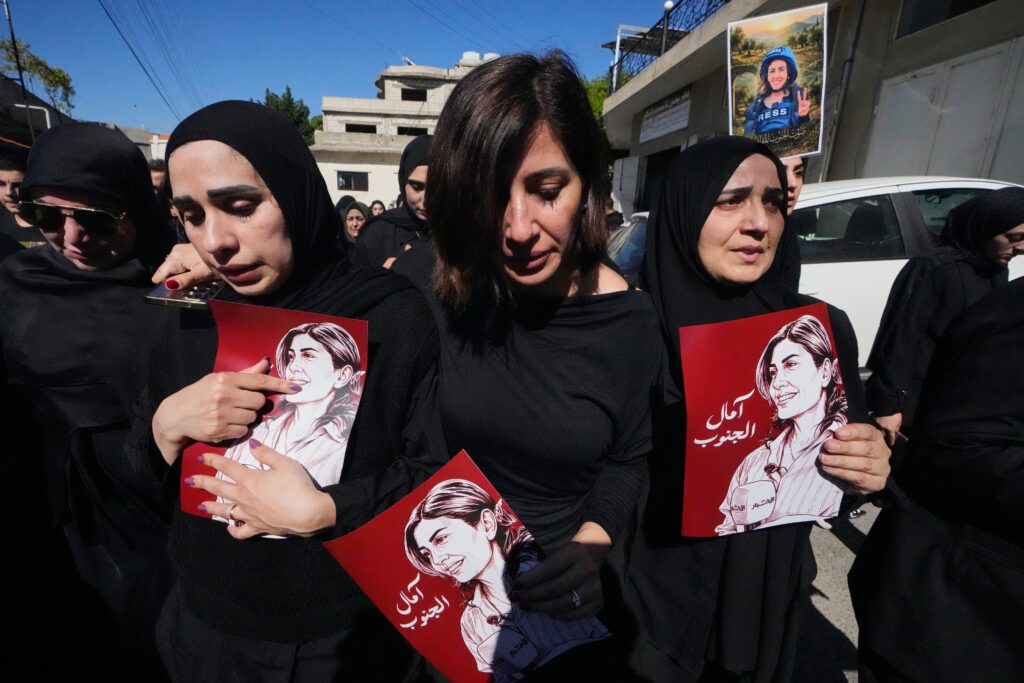
BEIRUT — A leading rights group determined that Israel committed war crimes when it killed journalist Amal Khalil and injured another journalist in an airstrike in southern Lebanon in April.
Human Rights Watch said it reviewed photo and video evidence, witness statements and a request to Israel’s military by the Lebanese Red Cross to access the site on April 22. The evidence, the New York-based group said, indicates that Israel either knew or should have known that Khalil and fellow journalist Zeinab Faraj were civilians.
In a separate report released at the same time, London-based Amnesty International, which conducted its own investigation based on photo and video evidence and witness testimony, called for the attack to be “investigated as a war crime.”
The Israel Defense Forces in a statement sent to The Washington Post Wednesday said it is still investigating Khalil’s death but that two men accompanying her — Ali Nabil Bazi and Mohammed Al-Kourani — were Hezbollah military operatives and the targets of the strikes. Ali was a Hezbollah-backed mukhtar, or local mayor, in a town in southern Lebanon, according to his relatives.
“The IDF does not target journalists and respects freedom of the press and the important role journalists play,” the statement said.
The rights groups said that was not the case. “The Israeli military says it does not target journalists, but the facts and evidence show that it has repeatedly done so. Amal Khalil and Zainab Faraj are the latest victims in a long series of such attacks,” Ramzi Kaiss, Lebanon researcher at Human Rights Watch, wrote in a statement. “Israeli forces’ continued killing of journalists shows a brazen willingness to commit atrocities without any fear of consequences.”
A Washington Post investigation in June found that Israel’s military denied rescuers access to Khalil during a key period when she was still alive.
“The fact that the two journalists were in what Israel has designated a no-return zone does not make them lawful targets,” Heba Morayef, Amnesty International’s regional director for the Middle East and North Africa, said in a statement.
Khalil, 42, and Faraj, 21, were on assignment for the pro-Hezbollah Lebanese newspaper Al-Akhbar to cover the ongoing hostilities between Israel and Hezbollah.
The IDF did not comment when asked about the reason for second and third strikes after the initial targets had already been hit.
Because Israeli surveillance drones were flying overhead, Amnesty International found, “the Israeli military knew, or should have known by then, that the two men it claimed to have targeted for alleged affiliation with Hezbollah had been killed instantly in the initial strike” and should have identified Khalil and Faraj as civilians.
Of the 27 journalists and media workers killed so far in 2026, nine — including Khalil — were killed in Lebanon, according to the Committee to Protect Journalists, and seven were killed in Israel or the Palestinian territories.
The Amnesty International and Human Rights Watch reports fill out the events of the day of Khalil’s killing with details that had not previously been widely reported, including a description of video of the strike and rescuers stalled at a checkpoint, Khalil’s contemporaneous descriptions of the Israeli drone’s movements, and photographs taken from the two journalists’ hiding place.
The reports Thursday are not the first to suggest Israel committed war crimes that day. Reporters Without Borders said in a statement in April that Israel “very likely” committed war crimes. Lebanon’s prime minister, Nawaf Salam, said the attack constituted war crimes.
Nover and Kelly reported from Washington. Suzan Haidamous in Beirut contributed to this report.