

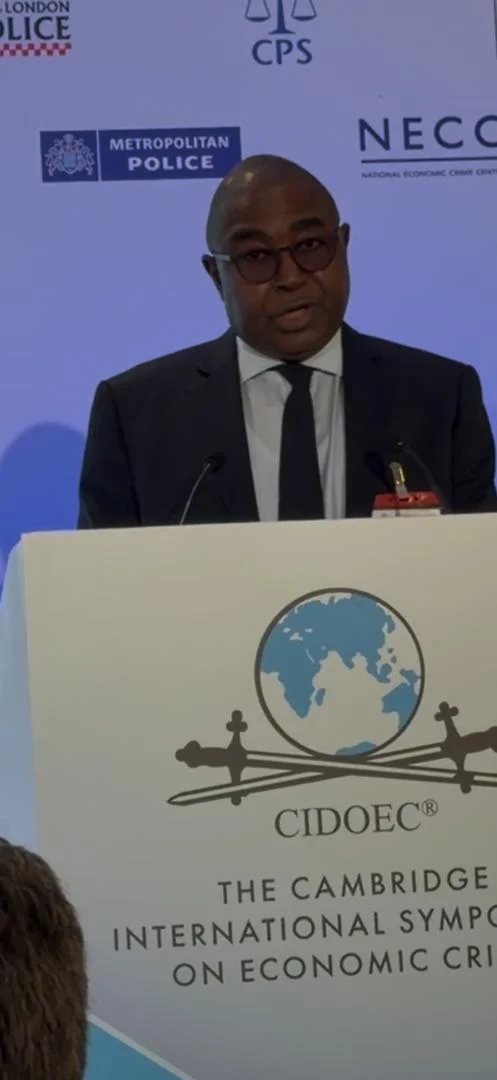
The Chairman/Chief Executive of the National Drug Law Enforcement Agency (NDLEA), Brig. Gen. Mohamed Marwa (Rtd), has said the fight against drug trafficking cannot be won through arrests alone, stressing the need to aggressively target the proceeds of crime.
He said depriving drug traffickers of their wealth is essential to dismantling their operations, as criminals who retain the proceeds of their activities can use the money to finance new operations and sustain their networks.
Marwa made the declaration on Tuesday while delivering a presentation titled “Criminal Property and the Criminal Process: How Can We Make It More Effective?” at the ongoing 43rd Cambridge International Symposium on Economic Crime, organised by the Centre for Geopolitics, University of Cambridge, United Kingdom.
According to him, the effectiveness of the criminal justice process should not be measured only by the number of convictions secured, but also by whether criminals are deprived of the financial benefits of their activities.
“The ultimate objective must therefore be to deny criminals the proceeds of their crime, promptly, and lawfully while preserving the value of the property. Nigeria, through the National Drug Law Enforcement Agency, will continue to strengthen this approach,” he said.
Addressing the session, which was chaired by Honourable Judge Wendy Tien, Marwa said arresting a drug trafficker without dismantling his financial network was similar to “pruning a weed at the stem while leaving its roots undisturbed.”
He warned that criminal wealth could resurface through new fronts and jurisdictions if it was not effectively traced and recovered.
“Such wealth simply resurfaces under a different name, through a different front company, in a different jurisdiction,” he said.
Marwa outlined six practical strategies deployed by the NDLEA to strengthen asset recovery, anchored on the National Drug Law Enforcement Agency Act 2004, the Proceeds of Crime (Recovery and Management) Act 2022 and the Money Laundering (Prevention and Prohibition) Act 2022.
One of the cases he cited was the forfeiture of the Hook Hotel, a property linked to a fugitive drug suspect.
According to him, the property was recovered through non-conviction-based forfeiture and subsequently sold for $4.2 million, with the proceeds paid into the Federal Government’s forfeited assets account domiciled with the Central Bank of Nigeria.
The NDLEA boss said the development demonstrated that a fugitive could not simply evade the criminal process while retaining the proceeds of crime.
Marwa also disclosed that NDLEA investigators and prosecutors are now embedded together from the beginning of cases, a reform he said had shortened the time between arrest and securing restraint orders.
He revealed that in the previous month alone, the agency froze bank accounts worth more than $7 million and secured interim forfeiture orders covering assets worth billions of naira, including filling stations, multi-storey buildings and exotic vehicles linked to a fugitive methamphetamine syndicate.
On the case involving Nigerian billionaire and suspected drug baron Amadi Simon, who was arrested in Switzerland through a joint operation involving the NDLEA, the United States Drug Enforcement Administration (DEA) and authorities in Switzerland, Greece and France, Marwa said three hotels linked to the suspect were placed under professional asset managers rather than shut down.
He explained that the measure was aimed at preserving the value of the businesses as going concerns pending the outcome of the trial.
The NDLEA boss further highlighted the agency’s use of provisions relating to unexplained wealth and living beyond legitimate means as investigative triggers.
He also pointed to the interlocutory sale of perishable and depreciating assets as another measure used to prevent the loss of value before the conclusion of criminal proceedings.
Marwa said the measures had now been institutionalised under Nigeria’s National Drug Control Master Plan 2026–2030, ensuring that the financial disruption of drug cartels remained a sustained national priority rather than a series of isolated operations.
Summarising the NDLEA’s experience, he identified three guiding principles: speed over sequence, preservation of value and institutionalisation.
He, however, acknowledged that challenges remained, particularly delays in mutual legal assistance, limited forensic accounting capacity and the need to balance the rights of accused persons with the government’s responsibility to preserve assets pending trial.
Marwa called for faster international cooperation mechanisms and stronger cross-border recognition of non-conviction-based forfeiture orders.
He thanked the Centre for Geopolitics, the organisers of the symposium and Judge Tien for providing the platform, and reaffirmed the NDLEA’s readiness to deepen partnerships with jurisdictions and institutions committed to dismantling the financial architecture supporting drug trafficking.