

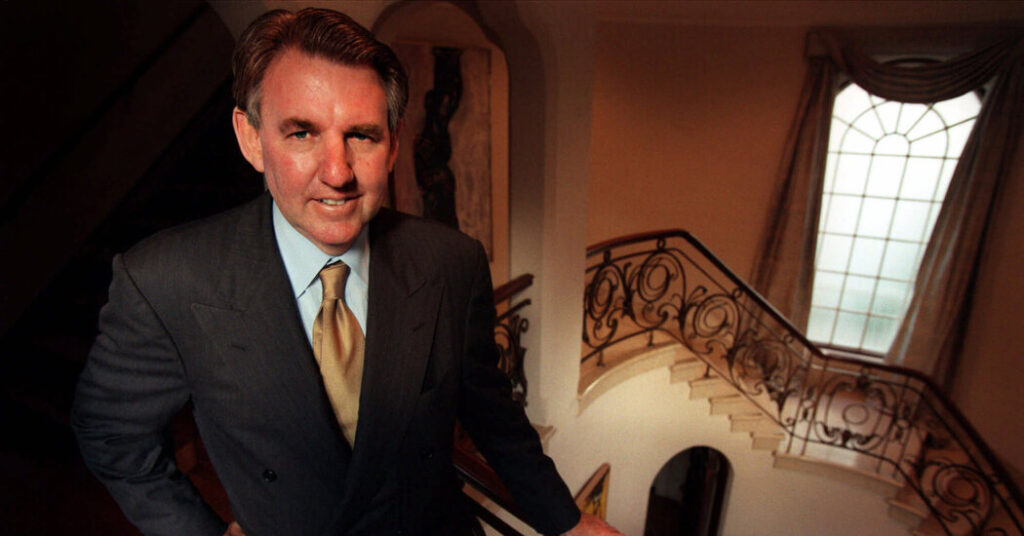
Clint Reilly, a feared and respected political consultant who ran winning campaigns in California, but whose combustible personality sometimes upstaged the candidates he worked for, died on Saturday in San Francisco. He was 79.
His death was announced by The San Francisco Examiner, which Mr. Reilly bought in 2020, two decades after an only-in-San-Francisco feud with the paper’s management. The cause of death, in a hospital, was chronic lung disease, Frank Holland, a family friend, said.
Mr. Reilly advised some of California’s most successful Democrats of the 1980s and ’90s, including Nancy Pelosi, Dianne Feinstein and Barbara Boxer, whose careers all began in the Bay Area. In 1999, he became a candidate himself, running for mayor of San Francisco and finishing fourth after spending $3.5 million of his own money.
The son of a milkman, Mr. Reilly possessed a granular knowledge of voting blocs and an adman’s instinct for distilling a winning message. He was an early adopter of using computers to identify voters by demographics and interests, so they could be targeted individually. His direct-mail and TV ads delivered a visceral punch, often through attacks on opponents.
“The guy’s a genius,” Richard Riordan, a rare Republican client, told The Los Angeles Times after Mr. Reilly guided him to unexpected victory in the 1993 Los Angeles mayoral race.
As the manager of Ms. Pelosi’s first congressional campaign in 1987, Mr. Reilly coined a prophetic slogan for the future House Speaker: “A voice that will be heard.”
But not all of Mr. Reilly’s clients were pleased with his work. In 1989, after managing two successful mayoral races for Ms. Feinstein, he quit her campaign for governor during the Democratic primary while she was recovering from a hysterectomy. Before telling his client, he faxed reporters the news that he was resigning, saying that she wasn’t working hard enough.
“I am free at last,” Ms. Feinstein responded. She went on to win the primary, lose the general election to Pete Wilson, a Republican, and win a U.S. Senate seat in 1992 — all without Mr. Reilly’s help.
Mr. Reilly goaded candidates to spend lavishly to win, with the not-coincidental side effect that his fees were also lavish. After growing up with little, he favored Italian suits, drove a red Jaguar and lived in a three-story house with a view of the Golden Gate Bridge in the upscale Sea Cliff neighborhood of San Francisco.
When Quentin L. Kopp was a San Francisco supervisor, he hired Mr. Reilly to manage his long-shot 1979 mayoral challenge to Ms. Feinstein, the incumbent. Mr. Reilly made his reputation during that campaign, which forced Ms. Feinstein into a runoff. But during the race, he was arrested and charged with driving drunk.
Mr. Kopp’s supporters urged him to fire Mr. Reilly, he recalled in an interview. He refused, and the two remained friends, though he took to jokingly referring to Mr. Reilly as “Satan,” for his volatile temperament. (Mr. Reilly said that he quit drinking soon after the arrest.)
At a holiday party at Mr. Reilly’s home some years later, Mr. Kopp said, “Clint’s mother implored me to stop referring to him as Satan,” which he did.
Mr. Reilly’s purchase of The Examiner followed a long saga in and out of courtrooms, starting in 1993, when he visited the office of the executive editor, Phil Bronstein, to complain about the paper’s coverage of a client and left in an ambulance with a broken ankle.
He sued Mr. Bronstein, claiming that the editor had shoved him; he also sued the newspaper’s publisher, William Randolph Hearst III, who was present during the incident. Mr. Reilly won an undisclosed settlement, and The Examiner expressed regret for his injury.
In 2000, Mr. Reilly was back in court with The Examiner, this time suing its owner, the Hearst Corporation, on antitrust grounds to stop it from buying the rival San Francisco Chronicle.
Lawyers for The Examiner called the suit an attempt to settle old scores, after the newspaper had backed Mayor Willie L. Brown Jr. the previous year during Mr. Reilly’s failed mayoral campaign. A federal judge ruled in favor of Hearst.
Two decades later, after The Examiner had passed through several different owners, Mr. Reilly acquired the newspaper and a sister publication, SF Weekly, for an undisclosed sum. He reinvented The Examiner as a broadsheet that published three days a week, with an accompanying digital site, focused on local news.
After Mr. Reilly left political consulting in 1995, he became a successful commercial real estate investor, starting with his purchase that year of the Merchants Exchange Building downtown for $18 million. He also owned event spaces and hospitality businesses.
Clinton Thomas Reilly was born on Jan. 13, 1947, in Oakland, Calif., the eldest of 10 children of Joe Reilly, who delivered milk for Berkeley Farms, and Bess (Stone) Reilly, who operated a concessions stand at the Oakland Coliseum. He grew up in San Leandro, a working-class city in the East Bay.
At 14, he declared his intention to become a Roman Catholic priest and entered St. Patrick’s Seminary in Menlo Park, earning a bachelor’s degree in philosophy. But after nine years of study, he abandoned his plans, concluding that social justice could be better pursued through politics.
“I think initially, intuitively, I wanted to get involved in politics because that was a place where you could improve people’s lives and make the biggest impact on the direction of the world,” he told The Los Angeles Times in 1994.
His first client was one of his former seminary professors, the Rev. Eugene J. Boyle, a liberal activist who ran unsuccessfully for State Assembly in 1974.
Mr. Reilly married Janet Koewler, a former aide to Mr. Riordan, in 1995. The two met while he was running the Riordan campaign. She survives him, along with two daughters, Jill and Ava Reilly; six brothers, Kevin, Mark, Brian, Joseph, Matthew and Dan; and a sister, Linette Hamil.
Candidates “are not hiring me because they want me to get along with everybody,” Mr. Reilly once told The Los Angeles Times. “The campaign is a war, you know?”