


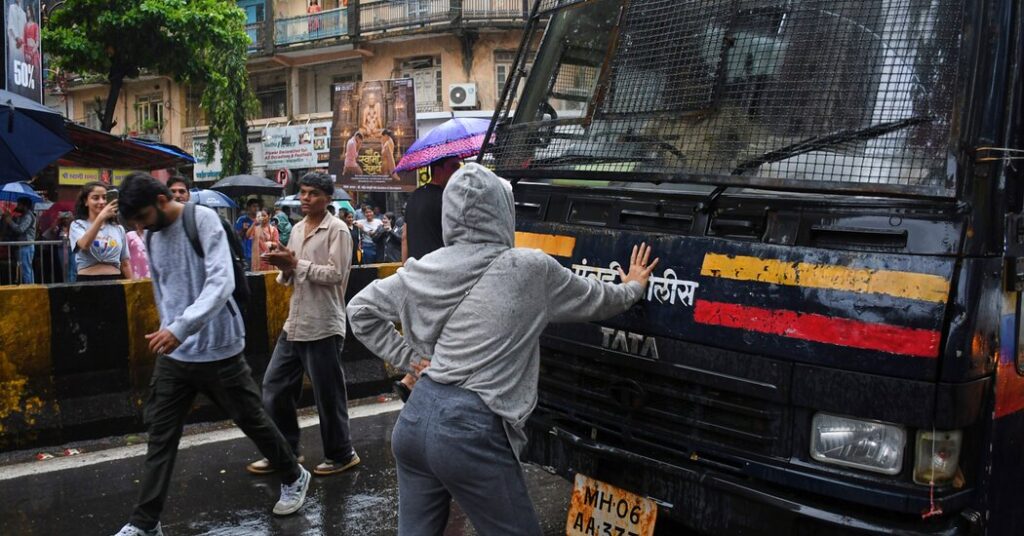
The 27-year-old woman stood alone in front of a police van, hand pressed to the hood, and refused to let it pass until officers released the protesters detained inside.
“It was one girl fighting the system,” said Sohit Mishra, a 33-year-old journalist who is covering the burst of student protests in India. He captured video of the standoff on Wednesday, as rain lashed the busy Mumbai street. After about 15 minutes, he said, amid the honking of cars and the cries of people surrounding the van, the police officers bowed to the woman’s demand and let the protesters go.
The video and photos of the woman, a model named Rhiya Ahir, have gone viral, viewed hundreds of thousands of times on social media, reflecting both how quickly a new protest movement is spreading across India and the resolve of the young people leading it.
“When I confronted them, I was shaking on the inside,” Ms. Ahir told local news media. But, she added, “I knew that what I was doing was right.”
Mr. Mishra said her actions helped unify the protesters, who have faced down a heavy police presence. “When they were released, the entire moment was so electric,” he said. “People were cheering, hugging each other.”
The demonstrations began in New Delhi, India’s capital, where thousands of people have gathered at a protest site near Parliament in recent days, returning even after police cracked down with force. In Mumbai, India’s financial capital, and Bengaluru, the country’s Silicon Valley, young people have staged smaller demonstrations.
By Thursday, the protests were beginning to reach across India, from Hyderabad and Chennai in the south to Lucknow and Jaipur in the north, as the country’s young people try to turn their cause into a nationwide movement. The Cockroach Janta Party, a movement that began as satire, taking its name from an insult, is organizing the protests and said they have reached 30 cities so far.
The C.J.P. has called for nationwide rallies on Friday.
The frustration powering the recent protests erupted in May after leaks of medical school entrance exams forced millions of students to retake their tests. The leaks have become emblematic of India’s troubled education system and the struggle among the country’s young people to find jobs. The movement has been fueled by a wider disaffection with what protesters say is a lack of government accountability for corruption and the mismanagement of the education system.
The protests are posing one of the most substantial challenges to Prime Minister Narendra Modi in his 12 years in power. On Thursday, Mr. Modi made his first direct reference to the protests, saying in a post on X that “Nothing is more important than the welfare and future of our youth!” and promised to fast-track punishments for the exam leakers.
The acknowledgment was rare for Mr. Modi, a strongman leader, and is a sign of the delicate balance he must find between placating young people, a significant voting bloc in India, and ensuring that his ruling party doesn’t look weak.
Many demonstrators say his response is insufficient. Their demands include structural change in education and jobs, as well as compensation for the protesters injured in clashes on Monday.
The protests in New Delhi and elsewhere have been going on for more than a month. But the C.J.P.’s call to march to Parliament on July 20, its first day in session, has given the movement momentum. Thousands of people gathered in the capital for the march, and many have remained camped out at the protest site for days despite authorities’ calls to disperse.