

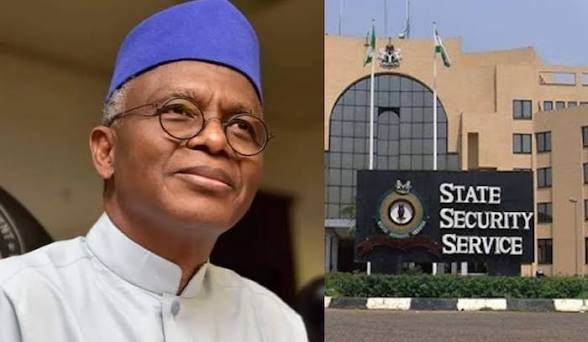
Former Kaduna State Governor, Nasir El-Rufai, has moved to challenge the case brought against him by the Department of State Services (DSS), following the closure of the prosecution’s case at the Federal High Court in Abuja.
The development came on Tuesday after the DSS informed the court that it had concluded its presentation of evidence and would not be calling any additional witnesses in the matter.
El-Rufai is facing an amended five-count charge filed by the DSS over allegations linked to unlawful interception of communications and alleged violations of national security laws.
The charges stem from comments made by the former governor during a live interview on ARISE News Television in February, where he claimed to have intercepted a telephone conversation involving Nuhu Ribadu.
According to the DSS, the statement allegedly suggested that security operatives were planning to arrest him. The agency argues that the claim amounts to a violation of Section 12(1) of the Cybercrimes (Prohibition, Prevention, etc.) Amendment Act, 2024.
At Tuesday’s hearing, counsel to the DSS, Oluwole Aladedoye, formally notified the court that the prosecution had closed its case.
Following that announcement, counsel to El-Rufai, Paul Erokoro (SAN), told the court that the defence would proceed with a no-case submission.
The legal move means El-Rufai’s team is asking the court to dismiss the charges without requiring him to open his defence, on the grounds that the prosecution has failed to establish a prima facie case against him.
The defence argued that the evidence presented so far does not sufficiently connect the former governor to the offences alleged in the charge.
Erokoro requested two weeks to file the application. The prosecution also sought an additional two weeks to study and respond to the filing.
The defence also raised concerns over El-Rufai’s bail conditions, describing them as excessively difficult to meet.
According to Erokoro, the requirements imposed by the court placed an unnecessary burden on the former governor.
He specifically challenged the condition requiring Level 17 civil servants with landed properties in Abuja’s Maitama or Asokoro districts to stand as sureties.
The defence also objected to the requirement for verification and attestation letters from the Kaduna State Traditional Council, arguing that the conditions were too restrictive.
However, the prosecution opposed the request and urged the court to retain the existing terms.
The DSS argued that qualified public servants who met the bail conditions were available and that there was no sufficient reason to alter the terms already granted.
In her ruling, Justice Joyce Abdulmalik dismissed the application for variation of bail conditions.
The judge held that the conditions remained reasonable and maintained that eligible civil servants with properties in the specified areas could serve as sureties.
The court subsequently adjourned the matter until September 22 for the filing of El-Rufai’s no-case submission and further proceedings.