

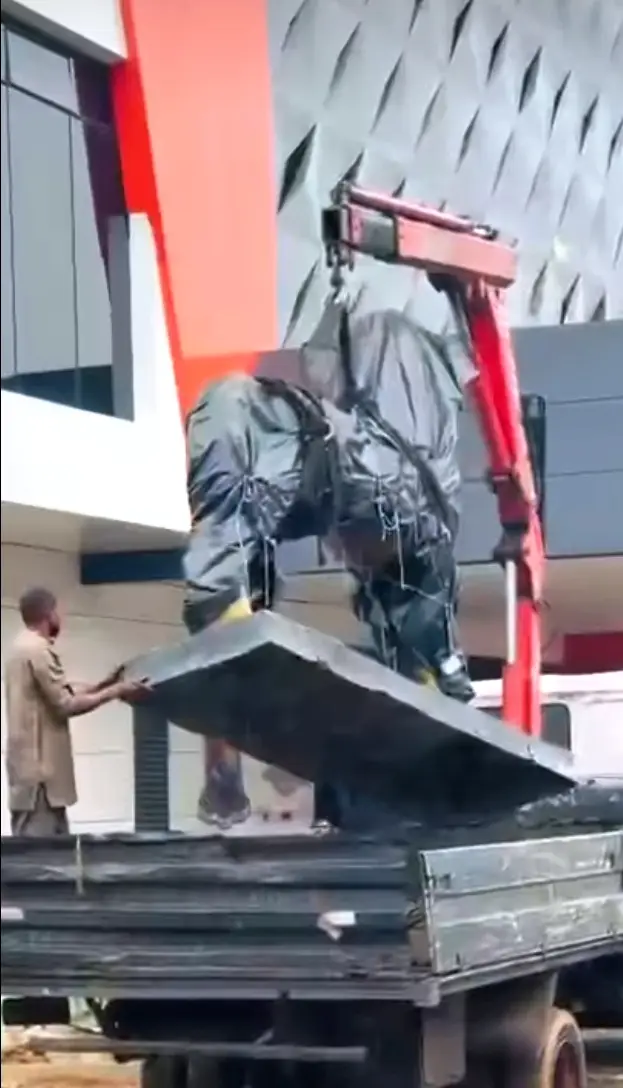
The Lagos State Government has removed the controversial horse statue installed at the Lagos State Geographic Information Service (LAGIS) headquarters in Alausa, Ikeja, following sustained opposition from the monarchs led by the Oba of Lagos, Oba Riliwanu Akiolu, indigenous groups, and senior government officials who argued that the monument did not reflect the cultural identity of the state.
The horse statue had sparked widespread controversy shortly before and after the commissioning of the five-storey facility, with critics questioning its relevance to the history, culture, and heritage of Lagos State.
Documents obtained by our correspondent on Monday revealed that concerns over the monument were raised within government circles with the Special Adviser to the governor, Babajide Sanwo-Olu, on e-GIS and Urban Development, Dr. Olajide Babatunde, even before the official commissioning of the building.
The removal of the monument came barely two and a half months after President Bola Tinubu, represented by Senate President Godswill Akpabio, commissioned the multi-billion-naira LAGIS building as part of efforts to modernise land administration in the state.
In a letter dated April 1, 2026, the Head of Service, Bode Agoro, formally requested the Office of the Special Adviser on E-GIS and Urban Development to replace both the horse inscription and the statue with the official crest of the Lagos State Government.
The Head of Service argued that the horse had no historical affinity with Lagos and Lagosians and that a government facility should be identified with symbols that reflect its official purpose and the identity of the state.
“Kindly note that the horse has no historical affinity to Lagos and Lagosians. Besides, the building is for government business and should be so depicted,” Agoro stated in the correspondence.
Despite the advisory, the monument remained in place, prompting stronger opposition from the Oba of Lagos, Akiolu, indigenous stakeholders, and cultural groups, protesting before the governor.
The resistance gained momentum when the Ibile Eko Summit Foundation, representing interests across the five traditional divisions of Lagos—Lagos Island, Ikeja, Ikorodu, Epe, and Badagry—petitioned Governor Babajide Sanwo-Olu, demanding the immediate removal of the statue.
In a detailed petition dated June 5, the group described the monument as a misrepresentation of Lagos’s history and culture, insisting that horses had no traditional connection to the state’s heritage.
The foundation maintained that Lagos is historically associated with symbols such as the Eyo masquerade, White Cap Chiefs, royal institutions, and its maritime civilisation rather than equestrian traditions.
The group further accused the Office of the Special Adviser on E-GIS and Urban Development of disregarding repeated appeals by stakeholders and traditional institutions to reconsider the installation.
According to the petition, public monuments should reflect the collective identity of the people and not the personal preferences of public officials.
The controversy attracted the attention of the Oba of Lagos, Oba Rilwan Akiolu, who also wrote to Governor Sanwo-Olu expressing concerns over the cultural implications of the monument.
In his letter dated May 1, the monarch acknowledged the importance of the LAGIS project but stressed that the horse statue lacked historical and cultural relevance to Lagos.
Akiolu advised that the monument be replaced with symbols that genuinely represent Lagos heritage, including the Eyo masquerade or the White Cap Chiefs.
“The horse has no traditional or historical relevance to Lagos’s cultural identity,” the monarch stated.
He also urged government officials handling the project to adopt a more inclusive and consultative approach when dealing with matters touching on the cultural heritage of the state.
The removal of the monument is being viewed by many stakeholders as a victory for cultural preservation and public engagement in governance.
While the Lagos State Government has yet to issue an official statement on the development, sources familiar with the matter said authorities acted following mounting public pressure and concerns that the controversy could overshadow the achievements represented by the new LAGIS complex.
The development has reignited discussions on the importance of ensuring that public monuments and state-funded projects reflect the history, traditions, and values of the communities they serve.
The LAGIS headquarters, one of the flagship projects of the Sanwo-Olu administration, was established to enhance digital land administration, improve geographic information management, and strengthen urban planning across Lagos State.