

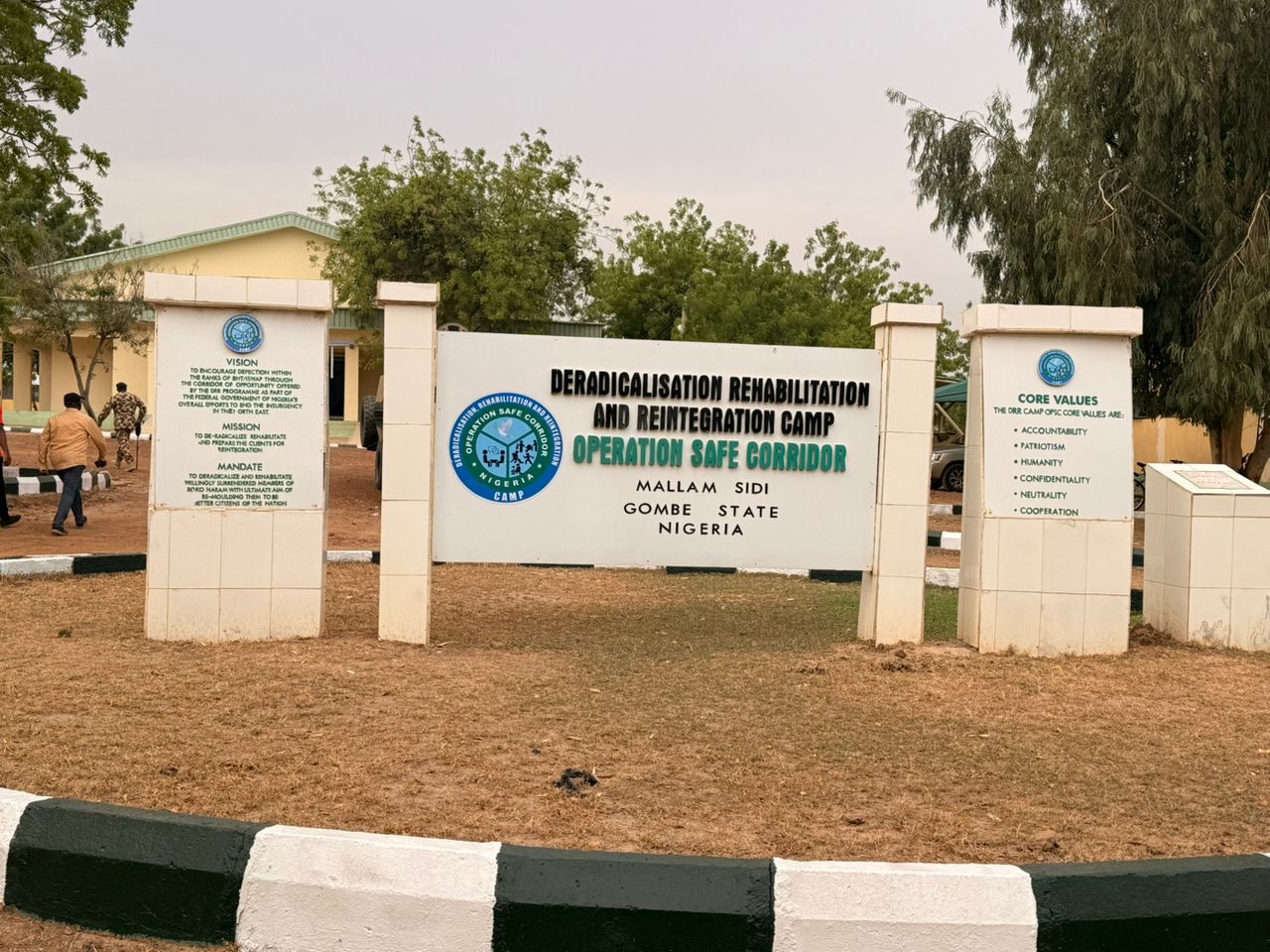
The continuing deradicalisation and integration of former insurgents into the society is alleged to not favour girls who additionally bear the brunt of insurgency. blueprint.ng stories on the necessity for correct inclusivity.
In 24 years, statistics has proven that Boko Haram terrorists have reportedly killed round 50,000 folks with greater than 2.5 million displaced.
Fearful by the event, the federal authorities through the years has shifted its navy deradicalisation ways to non-military strategies like negotiation, amnesty, disarmament, reintegration and empowerment.
Each for female and male insurgents, programmes like vocational coaching, literacy schooling, enterpreneur expertise and life-skills growth have been tailor-made to altering their psyche about terrorism.
Nonetheless, it’s on report that there’s nonetheless a gender hole that displays deeper structural inequalities, thus posing dangers to long-term peace-building.
By the programme in collaboration with UNICEF and Borno state authorities, some surrendered terrorists, largely girls and kids, are presently camped in designated areas in Maiduguri, a scenario that has generated quite a lot of considerations and concern.
This requires rising girls’s illustration in these initiatives; due to this fact, the function of the Ministry of Girls Affairs and different associated businesses can’t be over emphasised in the direction of be certain that their experiences are built-in.
UNICEF reintegration and issues arising
In a latest report, UNICEF in collaboration with the Borno state authorities, sought the help of conventional rulers and the general public in its transfer to reconcile and reintegrate 6,000 members of former non-state combatants and their associates, who’ve laid down their arms and surrendered to troops.
UNICEF Chief of Discipline Workplace in Maiduguri, Ms Phuong Nguyen, in the course of the official launch of a public data marketing campaign in help of reconciliation and reintegration of the surrendered terrorists stated growing companions akin to UNICEF, EU, UN amongst others would do their greatest to help the state authorities below the management of Governor Babagana Zulum, different conventional rulers and non secular leaders in the direction of reintegration for youngsters who had been previously linked to armed {groups} and recruited by non-state actors.
In accordance with her, “These are our youngsters, neighbours, brothers and sisters who had been caught on one aspect of the battle. A lot of them remained in territories previously managed by non-state armed {groups} and exploited as labourers, cooks, armour carriers, spies and farm arms.
“Others had been forcefully married and tortured. There is no such thing as a doubt that through the years, these girls and boys have skilled harrowing instances and subjected to a number of violations of their human rights.”
Contemporary considerations
The scenario has raised contemporary considerations about what to do with the exclusion of girls from the programme.
The hole, in line with stories, displays deeper structural inequalities and poses dangers to long-term peacebuilding.
The programme, generally known as Operation Secure Hall, is designed to rehabilitate and reintegrate repentant insurgents, notably these linked to the battle involving Boko Haram.
Nonetheless, critics say girls, a lot of whom had been forcibly recruited, usually are not being adequately included.
In response, Gender professional, Nationwide Community Coordinator for the West Africa Community for Peacebuilding (WANEP) in Nigeria, Bridget Osakwe described the exclusion as ‘unacceptable’, noting that ladies and women make up a major proportion of these affected by insurgency.
“In these camps, girls usually are not there by alternative. They’re used as intercourse slaves, pressured into marriages and even deployed as suicide bombers; but, when rehabilitation alternatives come, they’re sidelined.”
Whereas some girls are reportedly supported by way of humanitarian businesses such because the UNICEF, stakeholders argue that this response is fragmented and inadequate in comparison with the structured help offered below Operation Secure Hall.
The problem, she stated, goes past coverage gaps and displays broader societal norms that marginalise girls and a deeper reflection of systemic discrimination and the structural abuse of girls in society.
Though the Federal Ministry of Girls Affairs has been recognized because the lead establishment on gender-related points, stakeholders stress that accountability should lengthen throughout authorities and safety businesses.
She stated, “Key amongst them is the Workplace of the Nationwide Safety Adviser which oversees Operation Secure Hall, in addition to different ministries concerned in implementing Nigeria’s commitments below United Nations Safety Council Decision 1325.”
She additionally emphasised the safety and inclusion of girls in battle decision and post-conflict restoration.
Whereas referencing the Beijing Platform for Motion, notably its concentrate on girls and armed battle, to underscore the urgency of addressing the problem, she stated, “There should be intentional inclusion. Leaving this accountability to at least one ministry alone dangers additional marginalisation. All related actors should collaborate to make sure that girls obtain equal entry to rehabilitation and reintegration help.”
She warned that failure to deal with these gaps may undermine nationwide safety efforts and delay sustainable peace, as affected girls stay with out ample help, recognition or pathways to reintegration.
Additionally giving an perception, the nation director, Centre for Democracy and Growth (CDD-West Africa), Dr Dauda Garuba stated the OPSC has thus far met what it was established to achieved which is to supply an exit hall for low-profile insurgents who had been conscripted into Boko Haram.
He nevertheless stated similar to each different programme of disarmament, rehabilitation and reintegration in battle environments, the feminine gender is clearly discounted.
“We should be deliberate in guaranteeing that OPSC programme is inclusive to attain a extra lasting answer to its unique intention.”
Deliberate evaluate by the navy
Navy authorities have signalled plans to evaluate and doubtlessly increase rehabilitation and deradicalisation efforts for people linked to rebel {groups}, together with higher inclusion of girls in structured packages.
Talking on the progress of ongoing rehabilitation initiatives, the Nationwide Coordinator OPSC, Brig-Gen Yusuf Ali at CDD media parley in Abuja, he acknowledged that the programme initially confronted teething issues notably round coordination, transparency and figuring out greatest practices for dealing with feminine individuals.
Nonetheless, he famous that reforms over time have improved accountability and operational effectiveness.
The dealing with of girls and kids, he defined, has largely been overseen by state governments with help from UNICEF, which offers specialised experience of their care and rehabilitation.
Nonetheless, he indicated that suggestions to create extra structured rehabilitation areas for ladies can be thought of by the Nationwide Steering Committee in collaboration with different businesses.
He emphasised that anybody uncovered to extremist environments, whether or not voluntarily or not, requires a scientific rehabilitation course of.
In accordance with him, publicity to violence, trauma and extremist ideology can have lasting psychological results, making psychosocial remedy and deradicalisation vital earlier than reintegration into society.
As a part of transparency efforts, he assured that journalists would quickly be granted entry to look at operations at Camp Malam Sidi. The go to, he stated is to coincide with the commencement of a brand new batch of rehabilitated individuals as coordinated by the Division of Media Operations below directives from the Chief of Defence Employees.
He defined that neighborhood acceptance stays a problem with lingering resentment amongst populations affected by insurgency, including that feelings akin to concern and anger persist, particularly amongst victims.
Overcoming challenges
Nonetheless, he famous that hostility has step by step declined resulting from sustained engagement efforts as he defined that programmes led by organisations such because the Worldwide Organisation for Migration have performed a key function in easing reintegration.
A few of these programmes consists of neighborhood sensitisation campaigns, household tracing and pre-reintegration conferences that reconnect individuals with kin earlier than their return.
He additionally addressed considerations about why people who voluntarily give up are nonetheless detained, explaining that such measures are crucial to supply rehabilitation, together with trauma counseling and deradicalisation, no matter how people entered rebel environments.
In accordance with him, latest reforms embody the introduction of audiovisual counter-narrative instruments designed to problem extremist ideologies in managed settings.
These improvements, he famous additional, are supported by worldwide companions, together with the European Union, that are serving to enhance outcomes. He moted too that there are ongoing discussions about extending the period of rehabilitation programmes.
Regardless of the progress, he recognized misinformation and public notion as main challenges, including that adverse narratives in regards to the programme may undermine its success if not countered with correct data as he harassed that public understanding is important to sustaining each kinetic and non-kinetic efforts in Nigeria’s counter-insurgency technique.
Suggestions
As a part of suggestions due to this fact, it was famous that there’s a want for extra sensible and tangible advice just like the implementation of a women-focused, multifactorial and systematic programmes paired with localised deradicalisation efforts that account for northern Nigerian cultural practices and customs.
It famous, for example, the creation of Operation Secure Hall for ladies, offering a government-led, deliberate technique that acknowledges girls’s roles and experiences in insurgency by guaranteeing sustained peace in northern Nigeria.
Additionally, the Ministry of Girls Affairs in collaboration with different women-focused initiatives must be women-led in the direction of deradicalisation.