

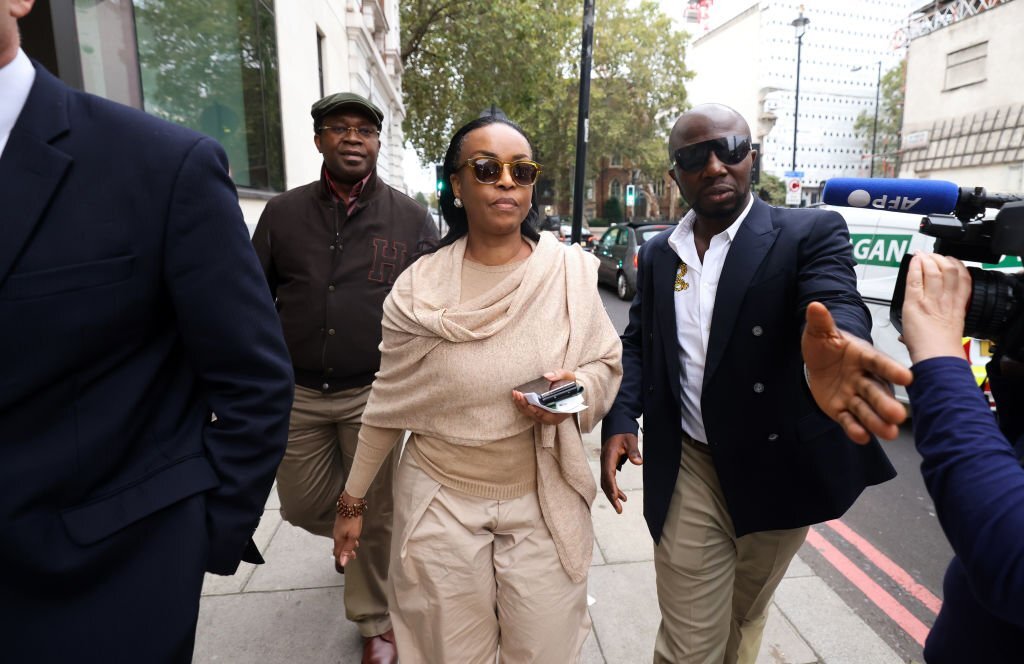
The trial of former Nigerian petroleum minister, Diezani Alison-Madueke, resumed on Day 23 on the Southwark Crown Court docket in London, with the ex-minister telling the courtroom she was unfairly blamed and successfully made a scapegoat for choices taken on the highest ranges of presidency, notably through the fallout from Nigeria’s 2012 gas subsidy disaster.
Testifying underneath cross-examination, Diezani stated she felt “betrayed” by the way through which the subsidy removing was carried out underneath former President Goodluck Jonathan, noting that the abrupt New Yr’s Day announcement triggered nationwide unrest and positioned her, as petroleum minister, on the centre of public outrage.
She insisted that the coverage had been the topic of prior deliberations and that its sudden execution uncovered her to criticism for choices she didn’t solely management.
“I felt betrayed to a sure extent,” she stated, referring to the choice taken underneath former President Goodluck Jonathan.
“I felt like a scapegoat as a result of I used to be finally accountable as oil minister.”
Diezani rejected ideas by the prosecution that she exercised authority over luxurious properties allegedly related to businessman Ben Peters, insisting that her involvement was restricted to providing inside design recommendation.
“I used to be giving recommendation, not directions,” she advised the courtroom, pushing again in opposition to claims that she directed refurbishment works or managed the properties in query.
In keeping with her, communications with contractors and intermediaries have been purely advisory and didn’t translate into possession or decision-making authority.
She additional argued that there was no documentary proof instantly linking her to authorized possession of the properties, sustaining that any inference on the contrary was speculative.
On the problem of her alleged use of a property referred to as Harbour Home, she stated she didn’t keep there and, at most, could have visited as soon as.
At a number of factors through the proceedings, Diezani challenged the credibility of witnesses whose accounts the prosecution relied upon.
She questioned the accuracy of a furnishings vendor’s testimony relating to cost preparations and dismissed makes an attempt to determine her by customer logs underneath a distinct title.
“You might be implying that the black lady is me, and I’m telling you that I’m not the one,” she stated, firmly rejecting the suggestion.
A key plank of her defence was her insistence that she didn’t improperly profit from luxurious items.
Whereas acknowledging that she chosen furnishings and ornamental objects through the interval underneath overview, she maintained that any objects used personally have been paid for.
“There was at all times somebody to pay on the level of buy,” she stated, explaining that whereas third events could have dealt with funds initially, reimbursements have been made in money.
She advised the courtroom that this mirrored the realities of Nigeria’s largely cash-based economic system on the time.
Diezani additionally provided explanations for the motion and storage of things cited by the prosecution, describing them as a part of a standard inside design course of somewhat than proof of private acquisition.
In keeping with her, objects have been typically moved between places or positioned in storage as a part of staging and refurbishment choices.
Addressing allegations {of financial} advantages flowing by associates to her household, the previous minister distanced herself from such transactions and denied prior information of them.
She advised the courtroom she was unaware of donations allegedly made to her brother’s church and had no involvement in its affairs past attending an award ceremony.
“I used to be not concerned in any method,” she stated, including that her brother by no means mentioned such issues along with her.
On funds made by associates for private or family-related bills, together with faculty charges, Diezani framed such gestures throughout the context of Nigerian social norms.
She defined that it was commonplace for rich people to help others financially, and that such actions shouldn’t mechanically be construed as improper.
In a single occasion, she stated her son’s faculty charges in the UK have been paid by Peters after he overheard a dialog in regards to the subject.
She insisted that the cost was unsolicited and in keeping with a tradition of generosity.
“We didn’t ask for it,” she stated, sustaining that there was no intention to derive undue profit.
Diezani additionally addressed questions surrounding her use of a non-public jet, which prosecutors urged mirrored extravagant spending.
She maintained that the flight was necessitated by the urgency of the state of affairs in Nigeria on the time of the gas subsidy disaster.
In keeping with her, she had initially deliberate to return to Nigeria on a business flight however needed to go away earlier as a result of sudden escalation of unrest.
“We have been taken fully without warning,” she stated, explaining that her instant return was required in response to the deteriorating state of affairs.
All through the cross-examination, Diezani often acknowledged that she couldn’t recall particular particulars regarding emails, invoices, and transactions relationship again greater than a decade.
She attributed these reminiscence gaps to the passage of time and the amount of fabric offered in courtroom.
“Madam Prosecutor, I can’t presumably reply that query in 2026, in any case these years,” she stated throughout one change.
The prosecution, nevertheless, continues to argue that the sample of communications, funds, and asset actions kinds a part of a broader scheme through which Diezani benefited from property held within the names of others.
Proceedings are anticipated to proceed with additional cross-examination because the courtroom examines the competing narratives.
Wale Igbintade
Times Nigeria