

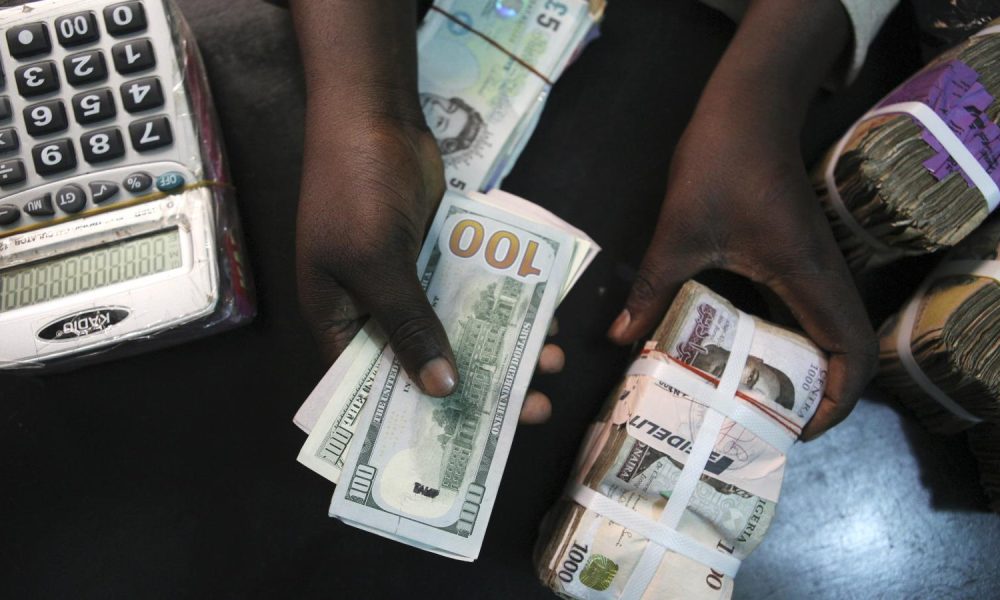
The naira weakened marginally against the US dollar at the Nigerian Foreign Exchange Market (NFEM) on Wednesday, October 7, 2026, even as foreign exchange trading activity remained elevated, with turnover in the market recently crossing the $1 billion mark.
Data from the Central Bank of Nigeria (CBN) showed that the naira closed at N1,332.75/$, compared with N1,331.50/$ recorded at the previous trading session.
The latest movement represents a depreciation of N1.25, or about 0.09 per cent, against the dollar.
During Wednesday’s trading session, the naira traded within a relatively narrow band of N1,330.50/$ to N1,332.99/$, while the weighted average exchange rate stood at N1,331.7679/$.
Despite the marginal weakening, the currency remained broadly within the N1,330/$ range that has characterised the market in recent weeks.
FX turnover crosses $1bn
The latest exchange-rate movement came amid a sharp increase in foreign exchange liquidity and trading activity at the NFEM.
NFEM turnover surged to $1.014 billion on October 6, up significantly from $619.22 million on October 5.
The October 6 figure represented an increase of about 63.7 per cent compared with the previous trading day and was the highest reported NFEM turnover in the October data provided.
Trading activity had also recorded $569.80 million on October 2, indicating considerable fluctuations in daily foreign exchange market liquidity.
For comparison, NFEM turnover stood at $537.97 million on September 30 and $530.44 million on September 29.
The figures point to a market where foreign exchange trading volumes have increased intermittently, even as the naira has remained relatively stable around the N1,330/$ level.
Interbank activity remains active
READ ALSO; Naira gains against Euro, breaks below N1,500 barrier after two years
The CBN had not yet published the total number of NFEM deals for October 7 as of the time of filing this report.
However, 83 interbank transactions were recorded during the session, with a turnover of $72.48 million.
The relatively narrow trading range recorded on Wednesday suggests that increased market activity did not translate into significant volatility in the naira’s exchange rate.
Market participants have continued to monitor the level of dollar liquidity available through official channels, particularly as increased turnover could provide greater depth for foreign exchange transactions.
Reserves strengthen external position
The latest currency data also come against the backdrop of improving Nigeria’s external liquidity position.
Nigeria’s gross foreign exchange reserves rose by $12.76 billion year-on-year to $54.61 billion as of September 14, 2026, according to previously reported data.
The reserve position was also above the CBN’s projected 2026 year-end level of approximately $51.04 billion.
The increase provides a stronger external buffer for the economy and could support the authorities’ efforts to maintain stability in the foreign exchange market.
Higher reserves also strengthen the country’s capacity to meet external obligations and provide liquidity when necessary, although reserve accumulation alone does not determine the naira’s exchange rate.
Economic growth outlook improves
The naira’s relative stability and stronger external position come as international institutions project continued improvement in Nigeria’s economic performance.
The World Bank raised its forecast for Nigeria’s 2026 economic growth to 4.3 per cent, compared with 4.0 per cent recorded in 2025.
The bank also projected average annual growth of 4.4 per cent in 2027 and 2028, reflecting expectations of sustained expansion in economic activity.
The improved growth outlook, combined with stronger foreign exchange reserves and increased activity in the official FX market, provides a more supportive backdrop for the economy.
However, the persistent fluctuations in daily NFEM turnover show that foreign exchange liquidity remains dynamic.
For the naira, the key issue in the coming sessions will be whether increased dollar-market activity translates into sustained exchange-rate stability or whether renewed demand for foreign currency places fresh pressure on the currency.
For now, the naira remains broadly anchored around the N1,330/$ level, despite Wednesday’s marginal depreciation.