

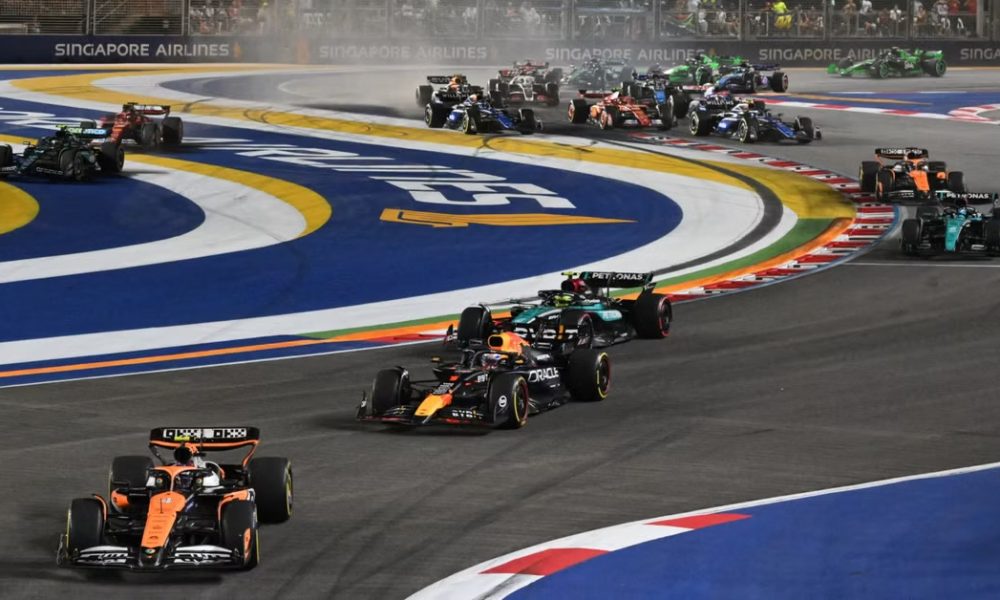
Formula 1 has declared the Singapore Grand Prix a heat-hazard race, marking the second consecutive race weekend and the fourth event this season to receive the designation.
The status allows teams to install approved cooling systems in their cars to help drivers cope with extreme cockpit temperatures during the race.
A heat-hazard declaration is issued when temperatures are forecast to exceed 31°C at some point during the event. The classification was introduced in Formula 1 in 2025.
Singapore is regarded as one of the most physically demanding races on the calendar because of its high temperatures and humidity. In 2024, Mercedes drivers George Russell and Lewis Hamilton required treatment for heat exhaustion after the race.
Although the Grand Prix takes place at night, temperatures are expected to remain around 30°C, while daytime conditions during the weekend typically range between 31°C and 33°C. High humidity and the possibility of rain could add to the challenge.
Drivers are not required to use the cooling system. However, those who choose not to use it must carry an additional 5kg of ballast to prevent them from gaining a competitive advantage.
The system works through a cooling tank and pump, usually positioned in the front of the car, which circulates chilled liquid such as glycol through pipes built into a fireproof cooling top worn underneath the driver’s racing overalls.
However, some teams and drivers have raised concerns about the system. Keeping the liquid sufficiently cool for an entire race can be difficult, particularly in Singapore, which hosts the longest Grand Prix of the season. Some drivers have also found the cooling garment uncomfortable in the confined cockpit.
If the liquid warms up, it can eventually reach temperatures close to those inside the cockpit, which can exceed 40°C.
Mercedes is among the teams that has opted against using the system, choosing instead to focus its development resources on car performance.
Mercedes deputy team principal Bradley Lord said the financial allowance provided by the FIA was not enough to develop a system capable of operating effectively throughout an entire race.
“We didn’t believe that allowance was sufficient for us to be able to develop a solution that would be robust enough to last for the entire race,” Lord said.
Under the FIA’s cost-cap rules, teams can receive an allowance of up to $50,000 (£38,000) to develop a system capable of keeping the cooling liquid cold throughout a Grand Prix, with an additional $75,000 (£57,000) available for improving the comfort of the cooling top.
The Singapore Grand Prix follows the Austrian, Italian and Bahrain Grands Prix as the fourth heat-hazard event of the 2026 season.