

Some partygoers were in sequins. Others in polo shirts. Steve August and TJ Howe were in full costume as park rangers, wandering through the crowd of hundreds of men gathered on the deck of the Boatslip in Provincetown, Mass., asking if anyone had encountered problem bears. They were prepared, they said, to stop bears from eating your dinner.
This year though, the real problem was different. This year, the bears were harder to find.
Howe and August brought their costumed shtick to the final night of Provincetown’s Bear Week, an annual bacchanal at this gay vacation destination on the farthest reaches of Cape Cod.
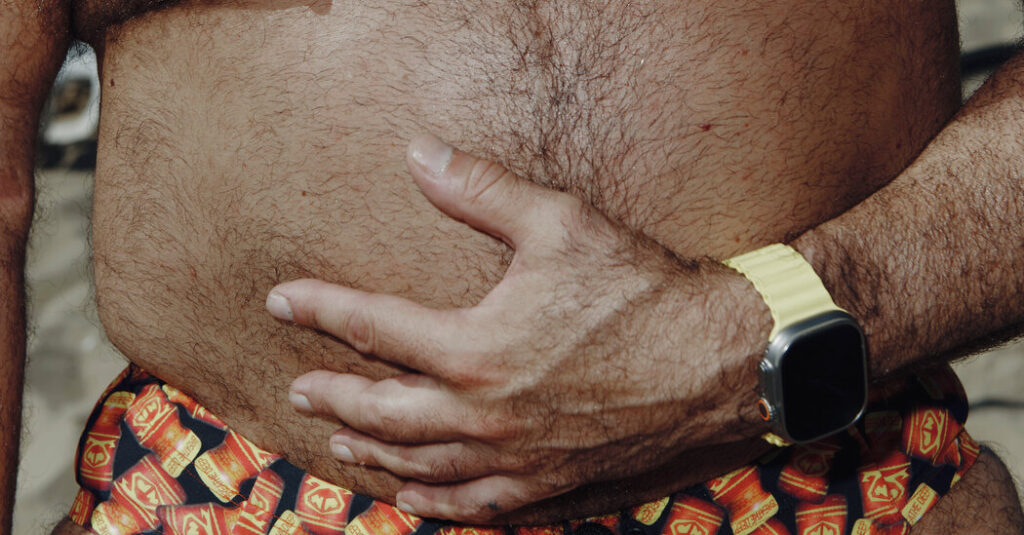
The midsummer festivities are a celebration of bears — a favored term of self-identification for many gay men who are bigger and hairier. It’s a time when the ordinary archetypes of gay male perfection, with their waxed chests and trim waistlines, take a back seat to those with beards and bellies.
But even at Bear Week, a body-positive carnival of self-love and hard-core flirting that celebrated its 25th anniversary this summer, it’s impossible to escape weight-loss drugs — what they change for the 11 percent of Americans now taking them, according to Gallup, and for everyone else too.
Earlier that afternoon, René Alvarez of San Francisco was hanging out on the beach on the west end of town, wearing a Speedo from the fetishwear brand Nasty Pig.
Alvarez, 54, said he had dropped over 150 pounds between GLP-1 medication and three surgeries to remove extra skin, a common side effect of extreme weight loss.
“If you look here, you’ll see the scars from the surgery,” he said, lifting his arm to show one that went from his rib cage to the center of his back. “It looked like I had flapjacks.”
When it was done, he said, he approached dating with new confidence. “It’s a completely different kind of Bear Week,” he said.
Howe and August, the pretend rangers, had heard rumblings of other changes too.
“People have been telling us that some of the bears are not spending as much, because they’re trying to lose weight,” August said. “We have a friend who has a cupcake shop and they are ordering the small cupcakes and not the big cupcakes.”
The bakery to which he was referring is ScottCakes, which was located a few blocks east, on Commercial Street. The friend he was speaking about is Scott Cunningham, its owner.
Cunningham did not seem eager to discuss the fraught topic of the disappearing bear.
After all, bears have been embracing their girth in Provincetown during this official week of festivities for 25 years: before the term “body positivity” existed in the popular lexicon, and when it still seemed impossible for many to lose significant weight without surgery.
Bear Week is now one of the most profitable weeks of the year for local businesses, according to Nina Cantor, Provincetown’s director of tourism.
“The bears,” Cunningham added, “put me on the map.”
He first arrived in Provincetown in 2009. Back then, Cunningham was an actor. He was here to perform in a play, then decided after six weeks to stay put.
He started selling his signature cupcakes off a cart on Commercial Street.
The gays who descended on the town for the Fourth of July tended to have flatter stomachs and smaller appetites.
The bears, by contrast, rolled up with ample amounts of hunger and good will.
This year, Cunningham said, Bear Week business had been roughly flat compared with last year, but was coming disproportionately from the heterosexual day-trippers.
“The other day, someone came in and said: ‘I lost 65 pounds. My doctor is so happy,’” Cunningham recalled. “Then he ordered a mini.”
Stephen and Michael, a couple from East Hampstead, N.H., who were milling around the Boatslip as well, had also encountered a changed landscape.
Stephen, 56, who was wearing a straw hat, no shirt and a pair of loose shorts, is a bear in the classic sense.
Michael, 48, who was wearing a gold lamé harness and matching shorts, is considerably smaller.
They have an open relationship and asked that their last names be omitted out of concern for the professional ramifications of discussing their personal lives publicly.
Stephen, by virtue of not going on GLP-1s and remaining a typical bear, said that he was finding himself in higher demand this year. He was the picture of what brought guys to Provincetown in the first place — a prototype in ever shorter supply now that many bears have lost weight.
Michael, in search of guys who physically resemble Stephen, said he was having a tougher time.
“If people feel better, good for them,” Michael said of GLP-1 users. “I’m just not going to bed with skinny guys.”
Over conversations with dozens of attendees, it became clear that GLP-1s had transformed life, or at least this week of summer vacation, even for people who had decided not to take them.
As medical weight-loss options proliferate and being a traditional bear becomes more of a choice — at least for those with money and insurance — many men in attendance seemed to be grappling with questions that were both pragmatic and philosophical.
They wondered how they might feel about themselves as they took up less space. They questioned what would become of the pool of people who were attracted to them because of their weight.
As one man at the Boatslip said: No one wants a skinny Santa.
Julian Cyr, 40, is a state senator representing the Cape.
At 5-foot-11 and 235 pounds, he counts himself as being a member of “the bear family, for sure.”
He spent much of Friday afternoon at the pool by the Provincetown Inn.
His shorts were short and lavender, his shirt was off, and his baseball cap said “Donuts After Dark,” which, as much as being a life philosophy for some present, is the promise of an actual doughnut shop on nearby Martha’s Vineyard.
“At 16 or 18, these drugs would have felt like the wish I was praying for,” he said, recalling how he developed an eating disorder in college.
“I couldn’t be gay and be heavy,” he said. “So having Bear Week really became a space of affirmation and validation, a rejection of body standards that didn’t work for me.”
So far, he is not using weight-loss drugs, though he thinks the ability to redefine being a bear and do it more healthfully — maybe with medication — isn’t a bad thing. And others pointed out that even in the Ozempic era, there remain ample numbers of classic bears at Bear Week. Moreover, bear subcategories had been expanding the definition of the term long before the drugs came along.
Charlie Nuttall, 39, is a cub, the term given to baby bears. Or at least on Instagram, he is studlycub.
Riding down Commercial Street around dusk, he was shirtless in his jean shorts.
He is 6-foot-5 and weighs around 240 pounds, having lost 215 pounds through bariatric surgery and GLP-1s.
Nuttall openly discussed how, at his peak weight, he could no longer travel on planes without getting another seat. He performed in porn as a bear, then went on his weight-loss regimen that ultimately helped him appear in more mainstream pornography.
Overall, he said, the attention he is receiving now “feels better.”
But he knows something is different. “I feel like I lost my tribe,” he said.
Nearby, Al Parker of Raleigh, N.C., was handing out flyers for “bear boat cruises” that were headed to the British Isles and to Alaska. (One of the planned activities involves seeking out actual bears.)
Parker, in khaki shorts and a black T-shirt, said he was 5-foot-10 and weighed 215 pounds.
“I’m on Zepbound,” he said. “I was on Ozempic but I kind of plateaued.”
As he told it, his “maximum gravitational pull” had been 250.
“I was not ashamed of having that body,” he said, “but one thing I enjoy now that I’m smaller is being able to buy clothes.”
Later that evening, at a party at the Crown & Anchor, one of the town’s biggest bars, a D.J. played vintage Chaka Khan and Deee-Lite. Bears of the muscled and non-muscled varieties danced, mingled and got frisky.
Kevin Healy, an investment banker from New York, was outside with his bike. Relatively trim thanks to the aid of GLP-1s, Healy has recently been writing a screenplay.
About what?
“Bears on Ozempic,” he said. “It’s a horror movie.”