

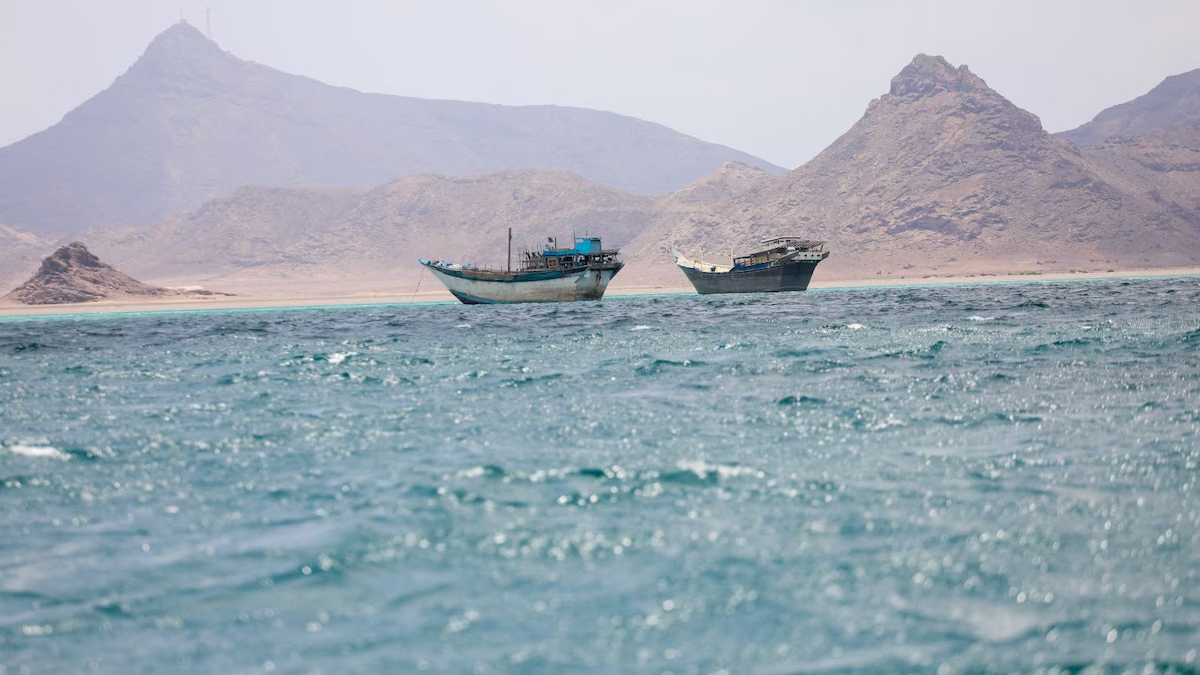
The Aframax Rodos, chartered by Mangalore Refinery and Petrochemicals Ltd (MRPL), is one of two tankers carrying Saudi crude for Indian refiners that reportedly switched off their tracking systems while navigating the Bab al-Mandeb Strait after Yemen’s Houthis announced a blockade on Saudi shipments.
A New Mangalore Port Authority official confirmed to CNBC-TV18 that Rodos anchored at the port around midnight on August 1. Cargo operations are expected to begin on August 3.
The second vessel, Suezmax tanker Amazon, chartered by Indian Oil Corp, is carrying one million barrels of Saudi crude oil. According to Chennai Port Authority data, Amazon is expected to reach the Chennai port by August 4.
The arrival of Rodos marks the completion of a closely watched journey through one of the most volatile shipping routes at a time when tensions between Saudi Arabia and Yemen’s Houthis are once again on the rise.
The situation notably escalated on July 20th, when the Houthis announced that they were imposing a naval blockade on Saudi Arabia. In a statement, the Houthi Armed Forces declared a “maritime embargo” on the “Saudi enemy.” The group subsequently also sent an email to shipping companies warning them against loading or discharging cargo at or from Saudi Ports.
The two India-bound vessels had left Saudi Arabia’s Yanbu port around July 20th. But soon after the blockade was announced, they were forced to reverse their course in the Red Sea and briefly turned towards the Suez Canal. However, Reuters reported that on July 22nd, the tankers switched off their Automatic Identification System transponders. Once their movements were no longer available on public tracking systems, the vessels headed south, transiting incognito through the Bab el-Mandeb Strait, exiting the Red Sea.
Several vessels tend to shut off their transponders as a precautionary measure to navigate the blockade, the report said, but this was the first case of an India-bound vessel carrying Saudi oil going dark to exit the Red Sea since the blockade was announced.
The mounting threats to vessels in the Red Sea come amid broader escalations between Saudi Arabia and the Houthis.
Also Read: F-35B stealth fighter crashes near San Diego air base; pilot ejects safelyGrowing tensions between Saudi Arabia and the Houthis
Since announcing the maritime blockade, the Houthis have claimed responsibility for strikes on three Saudi oil tankers which the group said, “violated the blockade.”
The first attack came on July 22. The Houthis launched ballistic and cruise missiles and drones “targeting two Saudi oil tankers that violated the blockade imposed by the Armed Forces in the Red Sea. One tanker was named ‘ENCELIA’ and the other is ‘LAYLA’,” Yahya Saree, the spokesperson of the Houthi Armed Forces, said. The Saudi Press Agency confirmed the safety of all crew members onboard ENCELIA, stating that the attack resulted in a fire on the bow of the vessel.
These attacks fuelled suspicions of a new front in the US-Iran war and pushed crude prices to $100 a barrel, the highest since May.
Then, on July 28, the 50,000 DWT NCC Ghazal, another Saudi vessel, was struck in the Red Sea. The Houthis claimed the attack, saying the vessel “violated the maritime navigation ban.”
Attacks by the Ansar Allah group haven’t been confined to vessels. The Houthis also targeted Saudi Arabia’s energy infrastructure pipeline. In a statement, Saree said the group struck ARAMCO refining complexes in Jizan and Yanbu, “using dozens of ballistic and cruise missiles and drones.” The attack was the first direct hit on Saudi oil infrastructure since 2022, marking a major escalation.
The attack followed reports of airstrikes in Houthi-controlled Hodeidah and Kamaran Island, which the group blamed on Saudi Arabia.
With the Strait of Hormuz already disrupted, the latest confrontations are raising fears of disrupting yet another vital shipping chokepoint. Attacks in the Red Sea have forced several vessels to retreat and reroute. Kpler data reveals that in the six days since the attacks on ENCELIA and LAYLA, Saudi-loaded crude from Yanbu dropped to nearly 50% of its pre-strike volume.
The deteriorating security situation has also prompted Indian refiners to alter how they procure and transport crude from West Asia.
MRPL, in its latest tender, said it would purchase crude only if it was transported through routes avoiding both the Red Sea and the Strait of Hormuz. Indian refiners have also increasingly shifted towards purchasing Middle Eastern crude on a delivered basis.
Also Read: Trump administration pushes tougher English rules for Mexican train crews crossing into US