

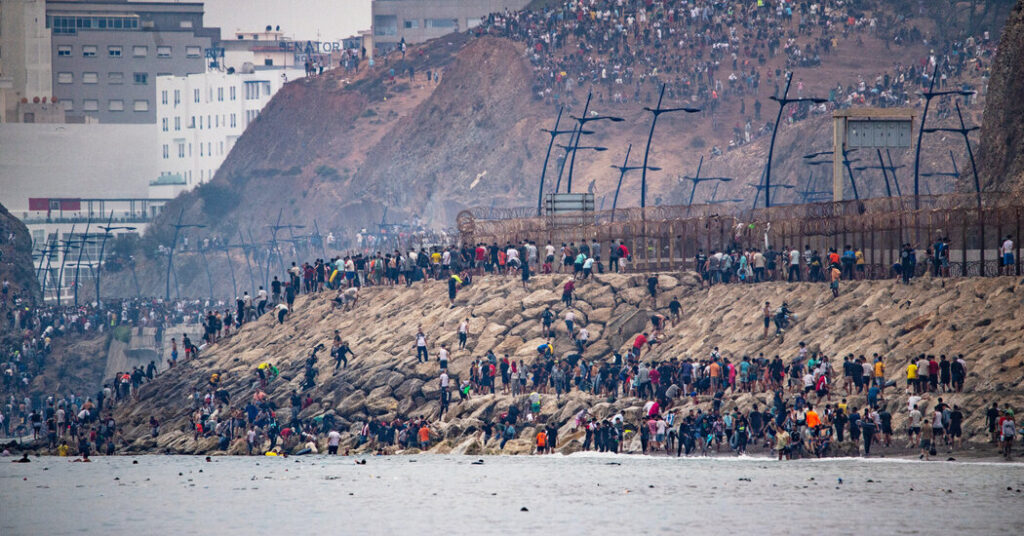
Tens of thousands of migrants streamed into a Spanish territory at the tip of North Africa, igniting a refugee crisis and a political firestorm in Europe on Friday that pitted Spain’s liberal pro-immigration government against right-wing critics across the continent.
Pedro Sánchez, Spain’s prime minister, rushed on Friday to Ceuta, the autonomous Spanish enclave contiguous with Morocco, and said 400 additional security forces had been sent to the border. By Friday afternoon, the Spanish authorities said 48,300 people — the majority of the estimated 50,000 or 60,000 migrants who had flooded into Ceuta since Thursday — had returned to Morocco.
Three dozen migrants died attempting the journey into the Spanish territory, the authorities said. Migrants described swimming past the bodies of the dead.
Questions lingered about what would happen to the many thousands who remained in Ceuta and whether some would make it to the European mainland a dozen miles across the Strait of Gibraltar.
“I don’t want to live in Morocco, I want to live in Europe,” said Zakaria Lahmer, 23, a migrant who spoke through what he described as pangs of hunger. But he said he was determined to reach Spain. “I want a job, I want happiness.”
Although Morocco posted its strongest economy growth in a decade in 2025, unemployment for those under 24 remained high at around 22 percent, according to the World Bank.
News footage and social media feeds were filled with images of young men in shorts and T-shirts clambering over fences and swimming toward the Spanish territory’s beaches. Juan Jesús Vivas, the head of Ceuta’s government, called the situation “absolutely unsustainable.” The territory’s population of 83,000 residents was overwhelmed by the influx, he said.
Photographs of the chaotic scenes showed flip-flops and articles of clothing floating in the Mediterranean Sea. Many of the migrants were Moroccan and young men.
Ceuta and another Spanish exclave in Morocco, Melilla, are part of both the European Union and the Schengen Area, which allows freedom of movement among member states. But the two cities operate under a special exemption that involves passport or identity controls for travel to mainland Spain and the rest of the E.U. So far, no onward movements have taken place for the recent migrants to mainland Spain or other E.U. member states, a senior E.U. official said on Friday.
There were seemingly contradictory accounts and explanations for what prompted the surge of migrants, who burst into Ceuta in droves on Thursday and Friday. A recent Spanish Supreme Court decision may have played a role in addition to the welcoming signals of the Spanish government on immigration. And some migrants said the Moroccan authorities had encouraged them to leave.
“They just kept saying, ‘Go that way, go that way,’” said Youssef Alaoui, 26, referring to police officers who he said pointed them in the right direction. He swam across the maritime border, he said.
Some Spanish observers suggested that the Moroccan authorities could be using the crisis to send a message to Spain and may have loosened border restrictions.
Mr. Sánchez made an official visit to Algeria earlier this month, and the two countries agreed to hold a high-level summit this fall, where they will discuss immigration, combating terrorism and cultural exchanges, among other things. The countries have also reportedly been in talks to increase Algeria’s natural gas supply to Spain.
Morocco and Algeria are longstanding adversaries, and some experts think that Spain’s strengthening of ties with Algeria may have angered Morocco.
“For me, that plays a fairly central role,” said Lorenzo Gabrielli, a senior researcher at Pompeu Fabra University in Barcelona who researches migration in Ceuta.
Yet photos taken near the border with Ceuta showed images of Moroccan police and security forces deployed near the town of Fnideq, close to the border, confronting large groups of young men and spraying them with water cannon. Mr. Lahmer, the 23-year-old migrant, showed burns on his right leg and said the Moroccan police had beaten him when he was trying to leave the country.
At points across Morocco on Thursday and Friday, the authorities appeared to be trying to prevent people from reaching Ceuta. In Rabat, the capital, security forces on Thursday stopped some passengers from boarding trains heading north. Some local trains had been canceled and members of the country’s auxiliary forces were seen monitoring travelers.
The Moroccan government had yet to make a statement on Friday evening about the surge of migrants and did not respond to a request for comment.
There were indications that social media posts had helped create a kind of flash mob of young men aspiring to leave the country for Europe. Many migrants interviewed in Ceuta on Friday said they had recently seen social media posts claiming the border was open.
Abdullah Abaakil, a representative for the Moroccan Unified Socialist Party, an opposition party, said there had been a flurry of social media messages in Morocco in recent days about a ruling by the Spanish Supreme Court last month that, under certain conditions, bars the summary return of migrants intercepted at sea while they attempt to reach Spain.
Adding to the potential lure of migrating to Spain are the current Spanish government’s pro-immigration statements and policies. Bucking the trend in Europe and the United States toward curtailing and cracking down on immigration, the Spanish government this year said it would allow more than a million migrants to apply to formalize their status.
Mr. Sánchez is a rare outlier, cultivating an image in recent years as a pro-immigration liberal and one of the most prominent European critics of the Trump administration’s hard line against migrants. But Mr. Sánchez pushed back against the notion of him supporting open borders on Friday, noting that unauthorized migration in Spain had been lower over the last half-decade than in Italy and Greece.
“This is not the time for division,” Mr. Sánchez wrote on social media on Friday afternoon. “It is time to keep building a strong and united E.U.”
The exodus from Morocco carried echoes of the 2015 immigration crisis in Europe, when hundreds of thousands of migrants fled civil war in Syria.
But this time, leaders across Europe quickly called for the influx to be stopped. Prime Minister Giorgia Meloni of Italy called for Spain’s membership in the Schengen treaty to be suspended. She said images from Ceuta were “shocking and demonstrate, once again, that uncontrolled illegal immigration poses a real threat to the security of Europe’s borders.”
The French interior minister said he had issued orders to “immediately step up controls at the Spanish border.”
Far-right politicians across the continent were quick to call for broader immigration restrictions.
“Borders must now be closed and refusals rigorously enforced. 2015 must not repeat itself!” Alice Weidel, co-leader of the Alternative for Germany party, wrote on social media.
Marine Le Pen, the far-right leader in France who polls show is a front-runner in the country’s presidential election next year, wrote on social media that she would “stop this craziness” if elected.
The White House, which has repeatedly accused Europe of having lax immigration policies, seized on the Spanish crisis. “President Trump has long warned Europe what would happen if they continue to implement far-left, globalist policies, including enabling mass migration,” Anna Kelly, a White House spokeswoman, told Fox News in a statement.
The migrant themselves had more immediate concerns than global politics.
“You ask why everyone came — because there’s no work in Morocco,” said Ajoub el-Arrot, 24, a Moroccan man wearing a beat-up Gucci cap and who was standing among the thousands wandering on a beach in Ceuta Friday.
Soufiane ez-Znafry, 26, a sous-chef in the Moroccan port city of Tangier, said he and other migrants were famished and could not find any food in Ceuta. “We have not eaten in two days,” he said.
Reporting was contributed by Aida Alami, Jorge Mitssunaga, Samuel Granados, Elisabetta Povoledo, Patrick Kingsley, Jeanna Smialek, Michael D. Shear, Ségolène Le Stradic, Katie Rogers, Koba Ryckewaert and Monika Cvorak.