

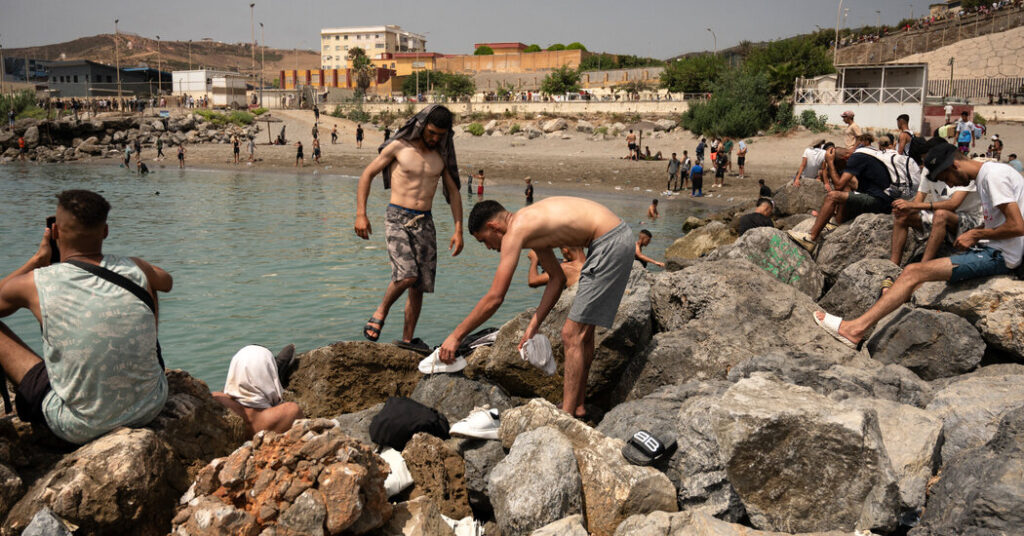
They swam across a narrow channel to arrive in the tiny Spanish territory of Ceuta. They jumped over a border wall. They were mostly men, mostly Moroccan. Their underlying motives were familiar, but what prompted them to pour into Ceuta over a two-day period remained unclear, beyond the encouragement of a crowd.
“You ask why everyone came — because there’s no work in Morocco,” said Ajoub el-Arrot, 24, a Moroccan man wearing a beat-up Gucci cap and standing among thousands who were wandering on a beach in Ceuta Friday.
It helped, he said, that the Moroccan authorities had let them through. “They opened the border and let everyone go by,” he said.
Several migrants in Ceuta said they had been motivated to come by social media messages claiming that the Spanish border was open. The origin of those social media messages remained unclear on Friday.
Some carried satchels and plastic bags. Others washed at a beach shower and drank from it too. Spanish authorities provided no food, no water.
That was one reason a majority of the 50,000 to 60,000 who came, according to local and national authorities, turned around and went back to Morocco by late afternoon on Friday. “All these people are hungry because we have not eaten in two days,” Soufiane ez-Znafry, 26, said. His own stomach was “growling” by then. The supermarkets in the area were closed.
Mr. ez-Znafry’s journey didn’t seem to involve a lot of advance planning. A sous chef, he had left Tangier on Thursday after friends said they were heading to Spain. In the rush, he did not tell his parents that he was leaving. “I did not want to worry them,” he said.
He had brought a bag containing clothes and some prized possessions, including a fake Rolex. Spanish police officers took the bag, he said. He was left with mismatched flip-flops on his feet.
As the sun was setting, the center of Ceuta regained some calm. More residents stepped out of their homes after staying in most of the day.
Thousands of Moroccans had left the city, but groups of young men still lingered with empty water bottles and darting eyes in hidden corners. Every time a Spanish soldier spotted one of them, he shouted in Arabic and points toward the border. The boys, confused and hungry, usually complied.
A helicopter circled overhead. A Spanish naval ship was visible in the distance.
Zakaria Lahmer, 23, said he was hungry too, but he was determined to stay. “I don’t want to live in Morocco,” he said. “I want to live in Europe.” He said the Moroccan police beat him when he was trying to leave the country.
Morat El-Halloufi, 13, cried on a bench on one of Ceuta’s main streets as he recounted how a group of people had attacked him on Friday afternoon. A Spanish soldier offered him a small bread roll and a yogurt, which Mr. El-Halloufi devoured. He said he had not eaten in three days and had entered Ceuta a week ago.
Mr. El-Halloufi, holding his ribs in pain, told a Spanish soldier in Arabic that a group of hooded people had set upon him, punching him in the stomach and stomping on his back. The assailants had arrived on a scooter. Some spoke Spanish, others Arabic, the boy said. That was all he could remember before losing consciousness.
“They beat me for no reason,” Mr. El-Halloufi, from Tangier, told the soldier. An ambulance took him to the hospital.
Others said the Moroccan authorities had encouraged them to cross the border into Ceuta. Youssef Alaoui, 26, said that as he approached the border on Thursday, along with a group of others, the police pointed them in the right direction. “They just kept saying, ‘Go that way, go that way,’” Mr. Alaoui recalled.
He swam across the maritime border, he said, past the corpses of others who had tried and failed.
Mohammed Ahmidho, 37, said he had heard about Thursday’s influx into Spain on social media. When he neared the border, he said, Moroccan police officers had encouraged him, saying “come to Spain.” His sojourn was short lived. By Friday, he was headed back to Morocco. There was nothing to eat or drink, and no place to sleep. He was going home.
One business owner in the Moroccan town of Fnideq, which borders Ceuta, said Friday many people who had crossed in the last two days were returning.
“Some come back because they’re hungry and thirsty,” said the merchant, Nabil, 35, who asked to be identified only by his first name for fear of reprisals against his business.
The town had virtually shut down. “Business owners are scared of being looted or attacked,” Nabil said.