

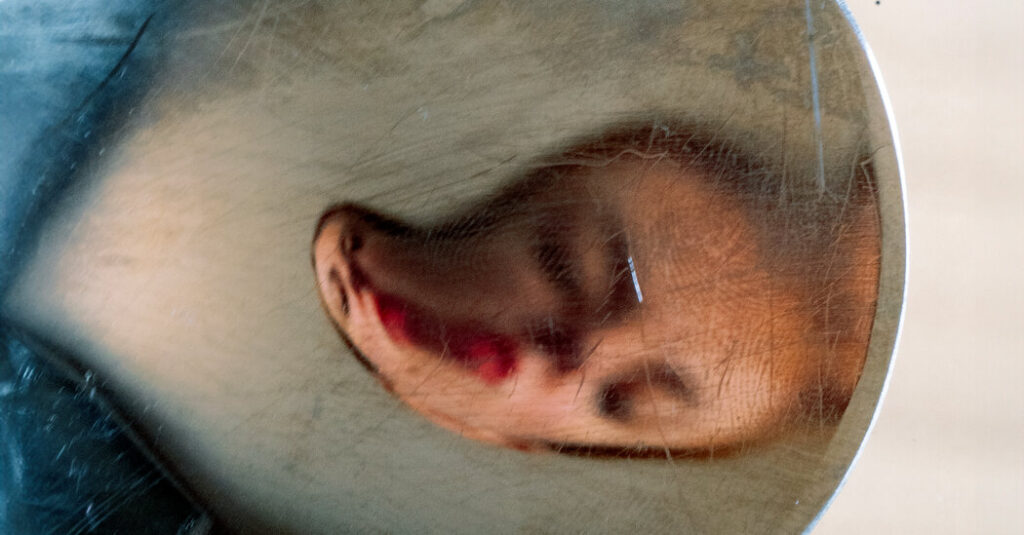
Everything is strange. We work from home. We socialize online. Our private lives are increasingly public. People pretend to be brands; brands pretend to be people. We optimize our bodies until they break. And the more we know, the less secure we feel.
In this inverted world, we seek to understand what is real and what is true. To know the truth of ourselves, we begin at what feels like a natural place: the mirror. We wish to see ourselves as others do, and modern life gives us countless opportunities.
We are constantly confronted with our own image, whether we like it or not: on our phones, front-facing videos, selfies, public spaces (the communal mirrors in Aritzia’s dressing rooms come painfully to mind), our social media profiles, Zoom calls, FaceTime, Ring doorbells. But we can forget that mirrors both duplicate reality and reverse it. None show you exactly as you are. Everything is strange.
The historian Christopher Lasch wrote that “for the narcissist, the world is a mirror.” Almost 50 years later, this remains a tidy diagnosis, but it doesn’t quite capture the extent of the spiritual crisis that we’re now facing. I believe the room of mirrors that constantly surrounds us conjures something unsettling, something dark. It is a spiritual trap in which the imagined displaces the real: We choose a fantasy of ourselves over the reality of others. And that trap is baited and facilitated by technology.
To see what I mean, we need only to imagine our online behavior in real life, without the platforms that blur the boundaries of what’s acceptable.
Picture yourself at a cocktail party — one you’re dreading, one for work. A colleague approaches you. Beside him, there is a large mirror, and as you converse with him and answer his invasive personal questions, you do not look at his face. Instead, you look at yourself, at your own reflection. You watch yourself talk and laugh, you see the face you pull when he asks if you’re going to have another kid soon. You monitor your reflection, correct your posture, exaggerate your “I’m listening” face. In person, this would be utterly bizarre. People would probably ask if you need to sit down. But this is what we do, all day long, on Zoom.
Or imagine a so-called skinfluencer taking us through a haul of her summer favorites — but without her phone. For six minutes straight, she stares into her own eager eyes, in the bathroom mirror, speaking to her reflection. She taps the products, murmuring about — I don’t know — the benefits of snail mucin. You would call the police. Or at least whoever is casting the new Ari Aster movie.
There is something eerie about being both the speaker and the watcher, performing one’s own identity for oneself, rather than simply living it. When we take on the roles of actor, audience and critic all at once, it’s going to cause some psychic strain.
Historically, we humans have had very little access to our own image, as much as we’ve always wanted it. The copper and bronze mirrors of ancient Egypt, Greece and Rome — cultures obsessed with beauty — were luxury objects produced for the wealthy. During the Renaissance, commissioned oil portraits were for the aristocracy and were notoriously unreliable. Any fan of Tudor history has heard the tale of Anne of Cleves catfishing King Henry VIII with a portrait so inaccurate, he claimed he could not bring himself to consummate the marriage.
Mirrors were not common household objects until the mid-1800s, and then came still images of ourselves, moving images of ourselves, and the pervasive smartphone camera that combines all three, while also making these images accessible anywhere, by anyone. For most of our ancestors and almost all of human history, we were not gazing into our own eyes, and we certainly weren’t watching ourselves on a loop on Instagram Stories, boomeranging Bellinis at a bachelorette brunch.
Let’s be honest: I shouldn’t know what I look like taking out the trash. But I do, because my Google Home security camera recently alerted me that there was a “Person Seen — Back Camera.” “Person” is a generous term for what I saw, which was a beleaguered, ghostly figure — greasy hair pulled back, hunched over a bag of trash like an old witch.
We are recorded constantly: in public, by the government, by private companies trying to sell us things, even by strangers. I shudder when I think about all the incidental pictures of myself that live on strangers’ phones. In my own personal horror film, there I am, eating a bagel, and some 17-year-old tourist zooms in on my pixelated face, screenshots it, and sends it to the family group chat — “this woman’s face lol” — and I become the inside joke that defines that New York City holiday for years to come.
It’s curious, especially given how little we looked at ourselves in the past, and how rare and imperfect mirrors were for thousands of years, that traditional wisdom teaches us to be wary of the act of regarding the self. The three major American faiths — the Abrahamic religions of Judaism, Christianity and Islam — all warn against the dangers of mirrors, vanity, pride and excessive concern with the self.
Mirrors are covered during shiva, the Jewish seven-day mourning period, both to encourage contemplation of the relationship between God and man and to discourage vanity and self-concern. The Book of Proverbs teaches that pride is spiritually deleterious: “Pride goes before ruin, / Arrogance, before failure.”
Many Christians believe pride is not only a sin, but the original one, and the worst of them. It is demonic, “the complete anti-God state of mind,” as C.S. Lewis wrote in “Mere Christianity.” Pride is a turning away from God, and an exultation of oneself. The mirror is a symbol of pride and vanity, but it also symbolizes our incomplete, earthly knowledge. As the apostle Paul wrote about God in his first letter to the Corinthians: “For now we see through a glass, darkly; but then face to face.”
Islamic prophetic tradition (hadith) discourages the depiction of living beings in religious contexts. In Islamic mysticism, however, a smudged mirror is a metaphor for the human soul. It is only when the ego is annihilated, and the surface is polished clean, that the divine becomes visible. The Quran is also explicit about pride and social vanity: “Do not turn your nose up to people, nor walk pridefully upon the earth.”
The message is clear: Self-obsession is spiritually dangerous and we need to keep our guard up. In all three faiths, the mirror is a poor, incomplete way of seeing. It is covered, dark and smudged. It does not reveal God, truth or even ourselves as we are. It is only through private contemplation, face-to-face encounters and an inner spiritual transformation that we come to know truth.
If only it were that easy. Like Narcissus, we are easily seduced by our own reflections, by our imagined, idealized selves. Every day, we are encouraged in this self-seduction. But seducing oneself is frankly not how seduction should work.
Mainstream psychology, and nearly every feature of modern life, puts a strong emphasis on the healthy ego. It’s a comforting, whole-wheat kind of idea, an essential part of any balanced personality. We all know we can have too little self-love, too little self-care. By all means, put yourself first, set the boundaries, don the moisturizing face mask. The opposite message, that there is such a thing as too much self-love or self-concern, is not widely circulated on TikTok. But obviously, everything has its limits.
What happens when the limits are off? Bad things, I’m sorry to say. Frightful things. The reflected self is rarely reassuring for long. Across cultures, mirrors have been used by soothsayers, sorcerers and witches for scrying, divination and attempts to peer beyond the visible world. In folklore and occult practice, the mirror is not merely reflective but permeable — a portal where something might appear, or someone may return.
Even the postmodernists have their own warnings. In 1967, Michel Foucault darkly described the mirror as a kind of threshold, a mix between a fantasy world, a utopia and some weird other place on the margins — which he called a “heterotopia.” The mirror is one such strange place because we discover our presence and our absence at the same time. “I see myself there where I am not,” he wrote, “in an unreal, virtual space that opens up behind the surface.”
Some other heterotopias, according to Foucault, include the honeymoon trip, psychiatric hospitals, vacation villages, prisons, the theater, the cinema, museums, libraries, brothels and the cemetery. In these settings, the normal order of things breaks down and certain truths are exposed. Each of these places could serve as an apt metaphor for the screens, monitors and social media applications that relentlessly reflect us back to ourselves. This technology is a mirror, but it is also a museum, a theater, a prison.
Inhabiting this mirrored, dual realm, this doubled existence, doesn’t feel natural. It doesn’t even feel neutral. Something is off, and when something is off, Freud has probably attempted to explain it. He called this “the uncanny,” a concept that by its very nature resists a clean definition, though if you’ve seen a David Lynch movie, you’ve experienced it firsthand.
Castration complexes and womb-fantasies aside, Freud does a pretty good job: The uncanny, according to his 1919 essay by the same title, “is that class of the terrifying which leads back to something long known to us, once very familiar.” It is easy for something new or unknown to frighten us, but the feeling of uncanniness relies on its being known to us in some way.
The uncanny is a dark twist on the familiar. It emerges when the boundary between imagination and reality begins to blur, when hidden mechanisms seem to be at work beneath the surface, and when something appears alive that should not be. (Or vice versa, in the case of influencers, who can have that dead sharklike look in their eyes.) It is marked by repetition, by a sense of something fateful and inescapable. Freud noted that the uncanny is often and easily produced when a symbol begins to take on the full force of the thing it represents. It is difficult to imagine a more precise description of life online.
The psychological effects of prolonged self-viewing are uncanny, indeed. A 2010 study from the University of Urbino, in Italy, found that when healthy young adults gazed at their own faces in a mirror, under low illumination, the results were immediate and disturbing. Participants reported seeing huge deformations of their own faces, an unknown person, even fantastical and monstrous beings. Some saw an animal face — such as that of a cat, pig or lion. Some saw their parents. All experienced a form of dissociation. Some subjects felt that the other face in the mirror was the one watching them.
Closely tied to mirrors and the uncanny is the idea of the double, or doppelgänger, a theme long explored in literature and film, from Dostoevsky’s novella “The Double” to Jordan Peele’s horror movie “Us.” In German and Eastern European folklore, the doppelgänger is an omen, a usurper, the shadow self, and a sign that identity is unstable. The self is split, haunted, mimicked and stalked by its own likeness.
Today, we treat our own image — both in the mirror and online — as something psychologically protective: a way of stabilizing our identity, managing our reputations and securing a coherent sense of self.
But all of this suggests the opposite possibility: The more we try to stabilize ourselves through repetition, doubling, self-observation and — I’ll say it — posting to the grid, the more uncanny and fragile we become. A preoccupation with the stable self produces instability. These days, we don’t approach our doubles with caution; we invite them, and go so far as to curate them.
It’s like an inverted version of “The Picture of Dorian Gray.” In the novel by Oscar Wilde, Dorian keeps his beautiful public image, while his portrait bears his inner corruption and ugliness. Under modern image culture, we attempt the reverse operation: We present a perfect digital double at the cost to our real selves, who are left to absorb the discomfort and tension between the two. If you post the good picture, it hardly matters that you feel sad inside.
The situation is worse than vanity, darker than narcissism. The mirrors all around us, especially the technological ones, divide us against ourselves — and this is destabilizing, even dangerous. As more and more of our lives take place in a virtual realm, and we increasingly identify with the fantasy of our digital doppelgängers, we begin to dehumanize ourselves, and when we do this, it is undoubtedly easier to dehumanize others.
One small way this happens every day: the general disappearance of manners. In New York City, I often encounter someone walking on the sidewalk toward me, head down in their phone, until they sense the presence of another thing coming upon them, which in this case is me, a human being. This unbearable game of chicken might have something to do with how we’ve been conditioned to view each other: as things, not people. We see other people as obstacles to what we want, on sidewalks and elsewhere. Or as things we can use to get us the things we want. So much of technology treats us as things to be manipulated; “users” to be used. We grow accustomed to this, internalize it, and return that treatment to those around us.
When we look at ourselves, we are seeking something. We want to be known, seen and understood. But we are looking in the wrong place. The mirror shows us our own self-critical and self-exalting gaze — the gaze of pride, pleasure and ego. This fantasy is powerful, even mesmerizing, but unreliable. When we look solely at ourselves, we fail to encounter anything that resists us; there are no contradictions, no interruptions. We need the honest gaze: the gaze of others and the gaze toward others. To see ourselves clearly, we don’t use mirrors. We use relationships.
Before I had a child, I was under the impression that I was a very patient person. I thought I would wipe scrambled egg off the floor without any frustration, read “Owl Babies” for the umpteenth time without growing exhausted of Sarah, Percy, Bill and their unnamed Owl Mother. But my beautiful son has exposed my inadequacies with alarming clarity. (I’m working on it.) In our loving relationships with others, we are drawn out of ourselves and into the world.
Mirrors encourage us to choose the fantasies of ourselves over the realities of others. It’s best we look away.
Catherine Shannon is a writer of essays, fiction and a newsletter on Substack. Lydia Roberts is an artist and photographer based in the South of France.
The Times is committed to publishing a diversity of letters to the editor. We’d like to hear what you think about this or any of our articles. Here are some tips. And here’s our email: [email protected].
Follow the New York Times Opinion section on Facebook, Instagram, TikTok, Bluesky, WhatsApp and Threads.