

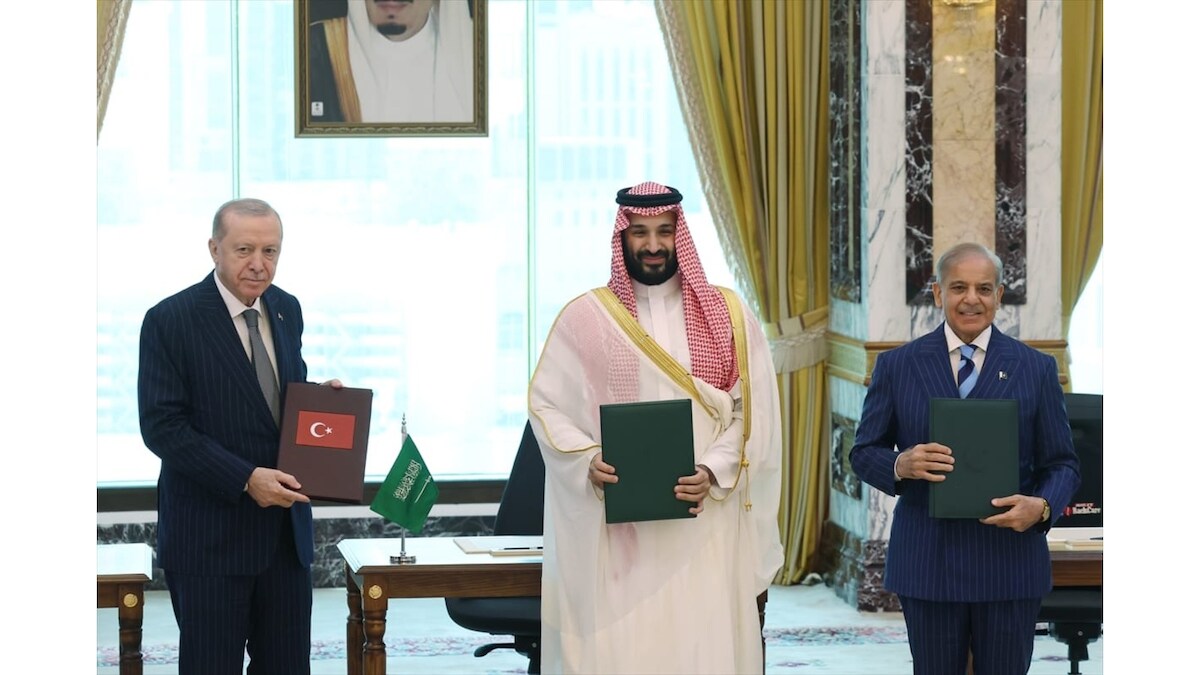
Saudi Arabia, Turkiye and Pakistan on Friday signed the “Makkah Joint Defence Agreement,” under which an armed attack against any one of the three countries will be regarded as an attack against all three.
The agreement was signed in Mecca on August 7 by Saudi Crown Prince Mohammed bin Salman, Turkish President Recep Tayyip Erdogan and Pakistan Prime Minister Shehbaz Sharif. Pakistan’s army chief, Field Marshal Asim Munir, was also present at the summit.
According to a joint statement, the agreement builds on the three countries’ historical ties, shared strategic interests and longstanding defence cooperation. It is intended to strengthen collective security and deterrence while promoting regional peace and stability.
“The agreement is intended to strengthen collective deterrence against any act of aggression, and stipulates that any armed attack against any one of the three states shall be regarded as an attack against them all,” the statement said. “It further provides for the enhancement of all aspects of defence cooperation among the three states.”
The language lends to the agreement a mutual-defence character, inviting comparisons with NATO’s Article 5. However, with little public information about the text of the deal, it is unclear what the military or operational obligations of such an agreement would look like.
Saudi Arabia, however, has sought to distance the pact from suggestions that it represents the formation of a new military bloc or carries a nuclear dimension.
Saudi Arabia’s Deputy Minister for Public Diplomacy, Ambassador Dr Rayed Krimly, said the agreement did not “represent any orientation toward building a military axis or a sectarian or denominational bloc,” and was not linked to “nuclear endeavours or an arms race.”
Instead, Krimly described it as a framework for defence cooperation and the development of sustainable, self-reliant capabilities.
“The Makkah Joint Defence Agreement enables the three signatory countries to develop joint defence capabilities, strengthen strategic deterrence, enhance readiness, and further develop and integrate their respective defence capabilities to jointly address any threats to their safety and security,” he said on social media site, X.
Krimly added that the pact neither supersedes nor replaces Saudi Arabia’s existing bilateral or multilateral agreements.
Significance amid regional turmoil
Reports of a trilateral framework involving the three countries had been circulating since Saudi Arabia and Pakistan signed their Strategic Mutual Defence Agreement in September 2025. That agreement, concluded shortly after an Israeli strike on Qatar, similarly declared that aggression against either country would be considered aggression against both.
Pakistan’s Minister for Defence Production told Reuters in January that talks on a separate trilateral arrangement involving Turkiye were underway. Friday’s agreement formally shapes the framework with Ankara after almost a year of negotiations.
Its signing comes at a particularly sensitive moment for Saudi Arabia, which is contending with the fallout of the wider US-Israel-Iran war as well as renewed hostilities involving Yemen’s Houthi group.
On July 20, the Houthis announced a naval blockade targeting Saudi Arabia, blocking Saudi and Saudi-linked vessels from crossing the Red Sea. The group has since claimed missile and drone attacks against Saudi energy infrastructure, including Aramco facilities in Jizan and Yanbu. It has also claimed attacks on eight Saudi-linked vessels and said 29 Saudi oil tankers were forced to alter course. Saudi Arabia has not commented on this.
Fighting inside Yemen has also intensified, with strikes reported between the Houthis and the Saudi-backed internationally recognised government. Recent attacks have killed at least 30 from the government forces.
Separately, the spokesman for the Saudi-led coalition said 11 people, including a four-year-old child, were injured in a Houthi attack on Saudi Arabia’s southern Najran region.
Against this backdrop, the agreement brings together three countries with distinct strengths in an unpredictable region. Saudi Arabia contributes considerable financial resources, energy influence and a strategic position in the Gulf and Red Sea.
Turkiye has NATO’s second-largest military and a rapidly expanding defence industry. Pakistan brings a large military and nuclear capability, although Saudi officials have expressly said the new pact has no nuclear orientation.
(Edited by : Ajay Vaishnav)