

Another month, another trade surplus of more than $100 billion for China.
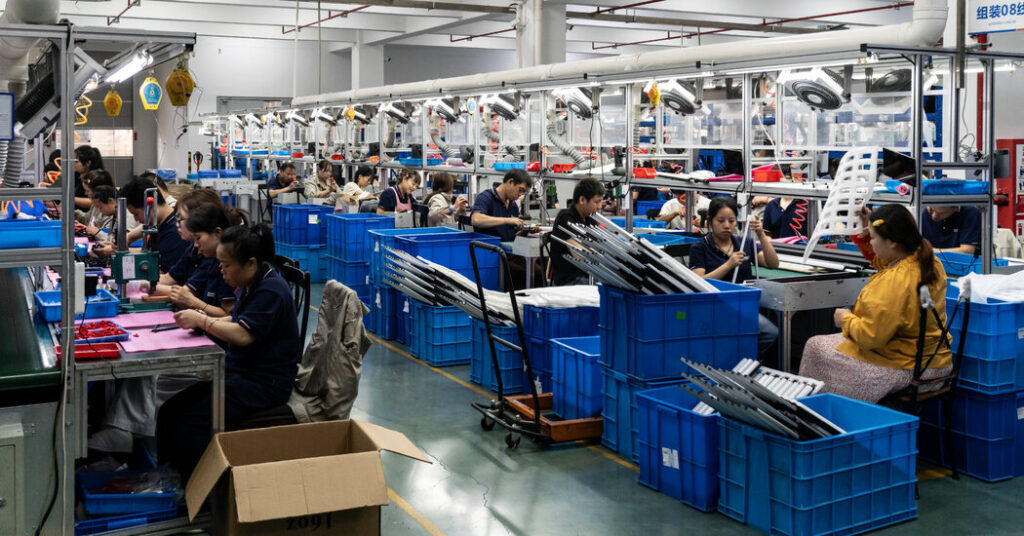
Even as countries around the world move to curb the flood of Chinese goods, China’s export machine continues to steam ahead. The country posted a trade surplus of $112.5 billion in July, according to data released Friday by the General Administration of Customs.
It was the third straight month in which China’s exports exceeded its imports by more than $100 billion — a staggering sum that puts the country on pace to surpass last year’s record $1.19 trillion trade surplus. In July, China’s exports rose 23.9 percent in U.S. dollar terms, while imports climbed 27.5 percent in July.
The figures show that the “boom in Chinese trade” is “still going strong,” Julian Evans-Pritchard, head of China economics for Capital Economics, a research firm, said in a research note.
The war in Iran has disrupted oil and gas shipments through the Strait of Hormuz, helping spur demand for Chinese electric vehicles and renewable-energy products. China’s manufacturers, hurt by overcapacity and relentless price competition that have squeezed their profits, have sought growth abroad by inundating overseas markets with low-cost goods.
The widening trade surplus has intensified frustration in the West over the growing dominance of Chinese companies across a range of industries. The European Union has imposed tariffs on electric vehicles imported from China, arguing that state subsidies give Chinese manufacturers an unfair advantage over European rivals.
China’s export strength also masks persistent weakness in the domestic economy, which continues to suffer from the lingering effects of a yearslong property downturn and stubbornly weak consumer spending. In the second quarter, the economy grew at its slowest rate in three years.
Despite threats from President Trump at the start of his second term, China has weathered its trade confrontation with the United States and emerged in a position of relative strength. Last month, the Trump administration imposed a tariff rate of 12.5 percent on Chinese goods, roughly in line with the rates applied to dozens of other countries. In July, Chinese exports to the United States rose 17 percent.
But in the past few weeks, there have been signs of an escalation in trade tensions between Beijing and Washington ahead of an expected visit by Xi Jinping, China’s top leader, to the United States in September. Last month, the United States announced a ban on new Chinese humanoid robots, citing national security concerns. China responded by announcing a series of retaliatory measures, including export restrictions on drone technology.
Chinese exports are also benefiting from the global spending spree for artificial intelligence. Shipments of electronics tied to A.I., including semiconductors and data-center equipment, have surged.
A.I.-related spending, alongside higher prices for raw materials and commodities, also helped lift imports.
China’s oil imports rebounded in July from the previous month when shipments fell to decade lows. Typically the world’s largest importer of oil, China slashed purchases in the spring as prices jumped and flows from the Persian Gulf slowed significantly.
Oil imports rose 22 percent in July from June, though they remained nearly 25 percent below their level a year earlier. The pullback in purchases underscored both the scale of China’s stockpile of oil reserves and the progress it has made in reducing its reliance on fossil fuels.
Meanwhile, China’s exports of refined petroleum products rose for a fourth straight month in July, reaching their highest levels this year. China imposed controls on refined-fuel exports around March to protect domestic supplies, but has eased those restrictions in recent months.
Li You contributed research.