

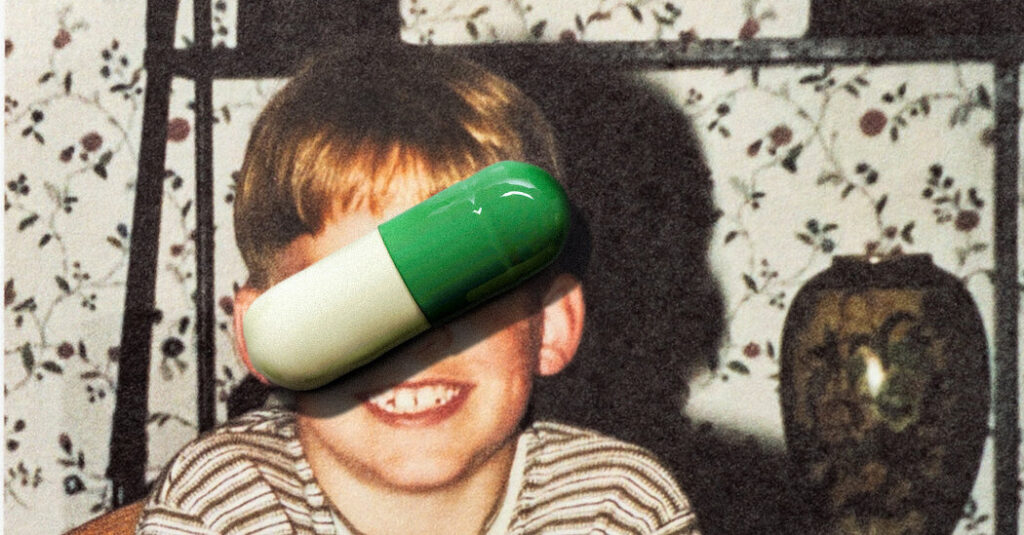
When Cameron LaBar was a kid, he was a towhead with bright blue eyes and big feelings. He seemed to sense things more strongly than other children. His family lived in Southern California, and when Cam was at the beach or playing in the yard, they’d put him on a double layer of towels so he wouldn’t scream when he got sand on his hands or was poked by the grass. Susan LaBar, Cam’s mother, called him the flip-top baby. He’d build up to a certain pressure, then erupt in tears.
Around the age of 5, Cam’s face and body began repetitively twitching in ways he couldn’t control. Susan bought books on Tourette’s syndrome and started highlighting things she recognized — until she was almost coloring in whole pages. In fourth grade, Cam’s teacher called Susan and said that Cam had gotten overwhelmed with instructions on an assignment and froze at his desk. Susan took Cam to a pediatric neurologist, who diagnosed him with Tourette’s syndrome, O.C.D. and generalized anxiety disorder.
Out of her five children, Susan thought, Cam was the most like her: anxious and sensitive. “He can’t take a deep breath,” she told the doctor. “He’s so knotted up.” The doctor suggested that Paxil, an antidepressant in the category known as S.S.R.I.s, could level things out for Cam. He told Susan that Paxil would adjust what was going on in Cam’s head so he could do what he needed to do: relax, sit down in class and complete his homework.
Giving her son psychiatric medication at 9 years old was not a decision Susan took lightly. She thought about it every night for a week, then called the doctor and asked him to prescribe the lowest dose that would help Cam get unstuck from inside his own head.
More than 20 years later, as an adult, Cam would look back on that moment with ambivalence and regret. It was the start of a prolonged pharmaceutical spiral that kept him on medication without egress. He believes that the years he spent on antidepressants kept him from feeling the full range of his emotions — from living a full authentic life, even. He was not alone: When he described his experience online, he encountered a multitude of others who had a similar story.
The release of Prozac, the first S.S.R.I. antidepressant, in 1988 was hailed as a revolution in psychiatric treatment. S.S.R.I.s were safer, with less burdensome side effects, than previous kinds of antidepressants; in the coming decades Prozac, Zoloft, Lexapro and other drugs were readily prescribed to tens of millions of Americans. Far less thought, however, was given to how to take patients off them.
For some patients, trying to stop medication provoked withdrawal symptoms even more debilitating than the depression or anxiety they’d set out to treat. The doctors and nurse practitioners who prescribed their drugs provided little guidance on how to prevent these symptoms beyond staying on the drugs. Bewildered and angry, patients congregated in Facebook groups and internet forums to seek help from one another.
Now, the MAHA-inflected health regime of Robert F. Kennedy Jr. has moved into this rift between patient and doctor, promising to free the mental health of Americans from a dependence on pills. The public attention has finally moved the psychiatric profession to take steps to address deprescribing. But the medical system that puts people on these medications will need radical changes to carefully and safely lead people off. The question for patients is whom they will trust for guidance.
On Paxil, Susan remembers, Cam was himself again. He unwound, he could function at school. Cam remembers fifth grade as the best year of his life. He had spiky hair, he was popular, a girl on the soccer team had a crush on him. But the symptoms of Tourette’s syndrome can intensify during puberty, and that was the case with Cam.
Susan and Cam tried a sequence of medications throughout his teens to suppress the tics. In sixth grade, he started Risperdal and promptly gained 20 pounds. In seventh grade, he took Seroquel, which made him so drowsy he’d fall asleep during first period in a puddle of drool. In eighth, ninth, 10th and 11th grades he took Abilify, Orap and then Clonidine and increased his dose of Paxil. He hid cans of Rockstar energy drink in his backpack to help him stay awake during school.
The pattern was to take a medication until the side effects grew harder to bear than the tics, then switch to another. By senior year, the tics calmed down, and Cam was taking only Paxil. With that one, the neurologist’s attitude seemed to be: If it ain’t broke, don’t fix it.
At the time, Cam didn’t question the suggestion to stay on his S.S.R.I. The explanation he had been given from his doctor for why he needed to take medication was that he had a chemical imbalance in his brain, and the medication would fix it. The phrase “chemical imbalance,” popularized by pharmaceutical marketing and widely repeated by doctors, was comforting because it appeared tidy and scientific. But the complicated truth is that the brain and its dysfunctions remain mostly a mystery.
Uncertainty over the origins of mental illness doesn’t have to be a problem for care; most clinicians would say that a full understanding of what’s happening in their patients’ brains is less important than recognizing which practical treatments make them feel better. Studies and clinical experience have shown a significant portion of people do better on antidepressants than off, at least in the short term. But in the meantime, the effects of these drugs on the people who take them long term, and what happens when they stop, have gone woefully underexamined.
For patients, one result of the “chemical imbalance” story was that if you believed your brain had a disorder that needed regular chemical intervention, there would be no reason to stop the pills even after you got back on your feet. You would just keep taking them, and in many cases your doctor wouldn’t suggest otherwise. Doctors receive far more training on prescribing psychiatric medications than on stopping them, and for a patient already doing well on a drug, many doctors will opt to keep it rather than cut it.
By now antidepressants are one of the most common prescription medications in the United States — one out of every six adults takes them. Data from the 2000s and 2010s put the median duration of use in the United States at five years, with a quarter of users taking them for 10 years or more. If you were one of the earliest people to take Prozac, you could have been taking antidepressants for almost 40 years.
When he was 29, Cam moved to Boise, Idaho, for a new job and promptly fell apart. He was working from home and knew almost no one in the city. And he was getting terrible, inexplicable mood swings. He’d feel OK for a few days, then get hit with hopelessness and dejection.
The backyard of his apartment in Boise looked right out onto the river, and in an effort to change his mood, Cam would submerge himself in the frigid water. It gave him a lift that lasted hours, and he started an Instagram account to talk about the mental health benefits of cold plunging. The account took off. Cam would wake up in the middle of the night to see 30,000 new followers, and get up in the morning to 10,000 more.
Despite a good job, a thriving influencer side hustle and a river in his backyard, Cam was feeling extremely down about his life. All of his other siblings had married. His younger brothers had children. And yet he, in his early 30s, did not know what love even was. “I keep seeing it, and I keep hearing about it, and I don’t know what anybody’s talking about,” he told his older sister Lara LaBar.
One girl he dated in graduate school was pretty, hard-working and funny. They dated for eight or nine months, then Cam did an internship out of state for a couple of months, and upon his return he felt completely indifferent to seeing her again. Oh, well, he thought. She’s not the one. But the same thing happened with his next relationship. He would be interested in someone, but the feeling never grew, and after an initial phase of excitement it faded into indifference. He even stopped caring about sex. “Is this what life is?” he asked his sister on the phone.
Cam started seeing a therapist who helped him trace the mood swings back to when they started, and he realized that they began around the time he was taking Klonopin regularly. A nurse practitioner handed him a prescription some years earlier after he’d had a panic attack, and while in Boise his usage had crept up to almost every day. “It’s the meds,” he thought.
He resolved that he would start tapering off the Klonopin and his antidepressant, Lexapro, which he’d switched over to. He learned about emotional blunting, a common side effect of S.S.R.I.s that leaves people feeling detached and numb. He wondered if that could explain his mood swings, apathy and indifference to romance.
Cam remembered an episode in his 20s when he tried to stop taking Paxil, and was hit within a few days with intense, panicky anxiety. He’d quickly reinstated the medication, supposing that the resurgence of anxiety was proof enough he needed it. This time, willing himself to try again, he posted on Instagram that he was thinking of stopping his meds. One of his followers sent him a YouTube interview with Dr. Mark Horowitz, an associate professor of psychiatry at Adelaide University in Australia who had become a prominent advocate in the deprescribing movement.
Cam watched the three-hour video straight through. “Because doctors and the public don’t understand the risks of these drugs,” Dr. Horowitz said in the interview, “a lot of harm is being done to people with long-term treatments.” He outlined a method for coming off medications called hyperbolic tapering, where the medication was reduced at a slower rate as the dose approached zero. This approach can take months or even years, far longer than the tapers typically recommended by doctors.
Stopping antidepressants abruptly can provoke symptoms including dizziness, nausea, insomnia and “brain zaps” — a jarring sensation of electric shocks inside one’s head. The American Psychiatric Association has said these withdrawal symptoms typically go away after a week or two, and clinicians generally agree that the majority of patients don’t have lasting problems coming off medication.
But some do have a difficult time. People in online groups such as Surviving Antidepressants, which had more than 23,000 members before it was archived this year, report withdrawal symptoms that are enduring and severe. Some people experience what’s called protracted withdrawal, where symptoms continue long after patients have fully stopped their medications.
How to distinguish relapse from withdrawal is a crucial question for those who attempt to discontinue medication. Yet the problem has never been adequately studied. Very few studies have measured withdrawal in people taking antidepressants for a long period and there are almost no studies comparing how patients fare when following different tapering methods. American psychiatric associations do not have standardized guidance on how to stop taking psychiatric drugs. Without doctors to provide reliable answers, people who feel they have been harmed by medication turn to online peer groups for information. There they find alternate explanations for their distress.
After watching the YouTube interview with Dr. Horowitz, Cam felt as if he was waking up. He saw his bad reaction to going off Paxil in his 20s in a new light: perhaps not a relapse, but rather the effect of his body’s dependence. He decided to follow a hyperbolic taper like Dr. Horowitz recommended. Over six months in 2023, with the support of his psychiatrist, he reduced his Lexapro from 20 milligrams to nine. That didn’t solve his mood swings, so he paused the Lexapro there, and a couple of months later started tapering Klonopin.
The withdrawal from Klonopin was hard. He could no longer sleep. His heart raced for no reason, and he got short of breath at random moments. His depression got much worse. But once he reached zero he felt a kind of clarity that he hadn’t experienced in a long time. His energy returned, and his mood swings finally disappeared. To celebrate his achievement, he went on a solo trip to Iceland and spent a week cold plunging.
Optimistic, he resumed his taper of Lexapro, reducing by 1 milligram. Immediately he sunk into a bottomless pit of numbness. Every good feeling fell away, and what rose to the surface were thoughts of suicide. After a few months he reduced again, by half a milligram. This proved too much. On top of the numbness and the suicidal ideation, Cam felt removed from his body and disconnected from his life, as if he was floating outside of it all. He didn’t see friends or go on dates. He lost all motivation at his job, where he struggled to stay presentable due to unpredictable fits of teariness. He quit and moved into a small apartment in Salt Lake City, near where his parents and three of his siblings now lived.
Susan came to help him get settled, and her son’s distress concerned her. Her father had come back from World War II a distant and closed-off man. She thought he probably could have been helped by an antidepressant. She’d seen other family members take antidepressants in times of hardship and benefit from them. She’d seen Cam benefit. She listened to Cam’s plan to resume his taper, and told him: “The way you’re feeling is exactly why we started you on this. This is how you were at 9, honey. This is why we put you on the medication.”
Cam disagreed. He acknowledged he was a mess, but for one thing, he’d been cold plunging in the polluted creek nearby and caught a stomach bug. And he was certain that what he was feeling was not how he really was. Talk about underlying conditions, he thought, was something a gaslighting doctor would say. “Mom, this is withdrawal,” he said. “I know I’m OK underneath.”
Since the appointment of Robert F. Kennedy Jr. as health secretary last year, his office has been preoccupied with the “overmedicalization” of mental health care, particularly for children. This spring, Mr. Kennedy announced several initiatives intended to enable clinicians to help patients stop taking antidepressants. “Too many patients begin treatment without a clear understanding of the risks and how long they will stay on these drugs or how to come off of them. That’s not informed consent,” he said.
“Overmedicalization” as a concept makes mainstream psychiatry bristle. Joseph Goldberg, the former president of the American Society of Clinical Psychopharmacology, feared Mr. Kennedy’s rhetoric might encourage people to make hasty decisions to stop medication. “We think that informed consent means knowing here’s your chance of relapse, here’s your chance of suicide,” Dr. Goldberg said.
In February, Dr. Goldberg published a paper with a task force of experts in psychopharmacology outlining some basic agreements on deprescribing. The paper recommended that prescribers reassess a patient’s medication at least once a year, and that medication should be stopped if it is no longer working. It did not provide detailed protocols on how tapering should be conducted, or how withdrawal should be managed.
People who feel burned by the medical system are not eager to listen to it now. Instead they often put their trust in online support groups. “The withdrawal community knows so much more about this process than psychiatrists because they have done it for decades at this point,” said Dr. Swapnil Gupta, a psychiatrist in New York State who participated in Dr. Goldberg’s paper and helped write, in 2019, the first book about psychiatric deprescribing.
At the same time, these online groups amplify critical views on professional medicine that can bleed into antipsychiatry — the belief that mental disorders are socially rather than biologically caused, and that psychiatric drugs harm more than they help. In this way, a concern over “overmedicalization” can harden into dismissing any drug as valid.
The trajectory is easy to understand. You find an online space that helps you make sense of a confusing, enraging experience, and it becomes a place to question the larger truths of your illness. Maybe your illness was not chronic, and did not need so much medication for so long. Maybe what your doctor labeled depression was never a disease to begin with; maybe it was a normal emotion that would have passed soon enough.
If you were someone who had given decades of your life over to pills and prescriptions and came to resent that dependence, the most urgent question can become how to reclaim personal agency. For people in this situation, control over their health doesn’t look like taking medication — it looks like stopping.
In Salt Lake City, Cam leaned into social media. He started making videos in which he grieved a childhood that he felt he never fully got to live. He got more vulnerable and more angry than he had before, and some of these videos attracted millions of views and thousands of comments.
He posted a photo of his younger self next to his birthday cake, wondering, who was this kid who couldn’t handle life? He saw what he was posting as raising awareness, but if he was being honest he also wanted to hear that he wasn’t crazy. A chorus of voices from the internet fulfilled that need.
Cam usually talked to Susan on the phone every day. But the calls fell off after the videos went up. “You post pictures of when you were a little kid and talk about how you were this and that,” Susan said to Cam. “Those pictures are sacred to me, because that’s my little boy. He was happy, and he was loved.”
Because of his influencer status, Cam was occasionally solicited by figures with a political agenda about psychiatric drug policy. Cam typically declined. He didn’t want to get involved in political advocacy. His social media posts concerned his own story, and he tried to be careful not to advise other people on whether to take medications. Though he had regrets about how young he’d been when he started an antidepressant, he admitted that he didn’t know how he would have fared without them — maybe better, but maybe worse.
The success of his posts made him reconsider his hesitation. Perhaps he could accelerate a cultural movement to educate people about withdrawal. He came up with a slogan, “Free the Feelings,” and appended it to his videos. This spring, he accepted an invitation from Laura Delano, a former psychiatric patient who founded a group called Inner Compass Initiative, to speak at a MAHA conference, and he’s since started to publish social media posts in partnership with a telehealth tapering clinic that Dr. Horowitz helped found.
The alignment of patient advocates, MAHA and mainstream psychiatry on a common goal of deprescribing is bringing attention to an underappreciated issue. Primary-care providers, who prescribe the majority of S.S.R.I.s, remain largely unaware that some people have a difficult time with withdrawal, and that stopping drugs needs to be done with careful oversight.
But we should also be concerned about what mental health will look like in this country if medications are reduced without something else to fill the need. Dr. Awais Aftab, a psychiatrist in Ohio who writes a popular newsletter about debates in the field, said that most patients he sees in the clinic are seeking treatment for their suffering rather than help coming off their medications. He suggested in a recent newsletter that the only way for the medical field to resolve disagreements about deprescribing is to “conduct a dozen randomized controlled trials on tapering methods and outcomes.”
In the absence of such research, there remains no consensus on what deprescribing should look like. But any form of careful tapering requires time, attention and collaboration between individual prescribers and patients — the very things that are so often lacking in a typical doctor’s visit.
The MAHA movement popularizes a view of mental health that positions taking medication in opposition to personal autonomy. But going off medications carefully, at scale, will require patients to rely more on the medical system rather than less. That means the delivery of better mental health care depends not on alternatives to institutionalized medicine but on an expansion of it.
Cam is now taking 7.5 milligrams of Lexapro, what he calls his 12-year-old dose, the equivalent amount to what he last took at that age. The ultimate goal is his 9-year-old dose: zero. It is a long road yet. Dr. Horowitz’s rough guideline for long-term users is that every year on an S.S.R.I. requires two months to come off. Cam figures he’d been on antidepressants for 26 years, so that works out to more than four years of tapering. He has at least three years left to go.
His plan for continuing is to do a microtaper. He will get a liquid suspension of Lexapro, which allows for more minute doses than the standard tablets, and reduce one hundredth of a milligram every day or so.
When he explained his plan to his psychiatrist, the doctor laughed, saying it was the slowest taper he’d ever heard of. He agreed to help, but he told Cam, “I want you to think about whether you coming off the medication because you have some sort of quest to find yourself is worth you struggling so hard the next two or three years, or whether it’s worth just staying on it.”
Cam was frustrated by the question. He acknowledged that leaving his job was a big price to pay. But everything had a price, and that happened to be the price of figuring out what was to him, more important than anything: learning who he was and how he could cope without medication. He wanted to hold a relationship longer than a few months, to feel love, to be intimate without the interference of meds. It had nothing at all to do with comfort.
He was keeping an eye on his O.C.D., which was creeping back. Simple tasks like getting dressed in the morning and deciding what to eat for dinner had gotten harder. His sister Lara worried that as Cam continued his taper his O.C.D. would resurge, and she urged him to do exposure and response prevention therapy. But Cam wanted to learn to manage his life on his own.
At the beginning of the summer, his old company offered him his job back and he returned to Boise. It feels like a welcome reset, and a sign to prepare to resume his taper in the fall. He keeps a reminder to himself in his Notes app: “What is your purpose? To love myself and feel confident, proud. To be a great husband (someday), father (someday), and uncle,” he wrote. “To live free of antidepressants.”
Camille Bromley is an editor in Times Opinion.
Source photographs via Cameron LaBar and Science Photo Library/Alamy.
The Times is committed to publishing a diversity of letters to the editor. We’d like to hear what you think about this or any of our articles. Here are some tips. And here’s our email: [email protected].
Follow the New York Times Opinion section on Facebook, Instagram, TikTok, Bluesky, WhatsApp and Threads.