

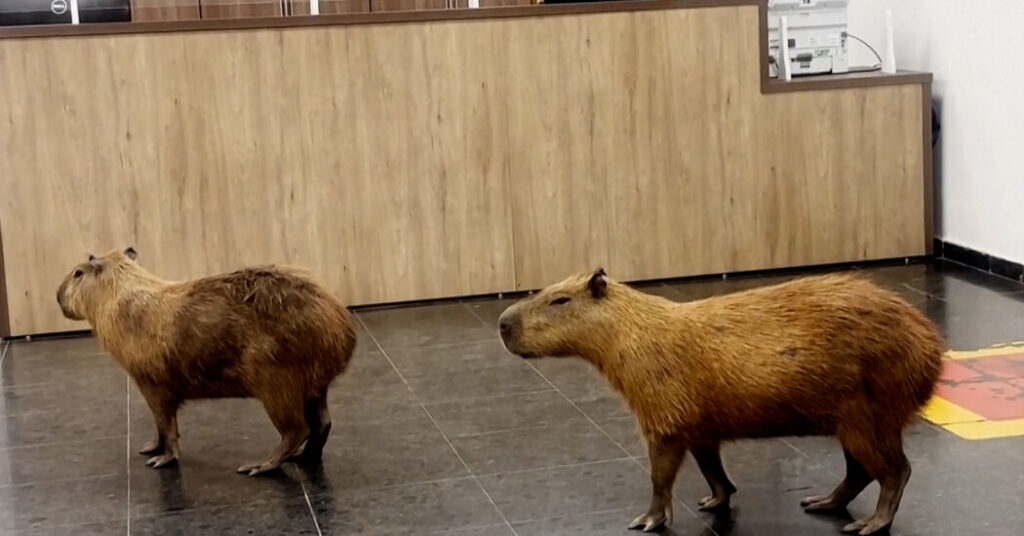
A Brazilian state legislature got some uninvited guests last week, and they were not petitioners or protesters, but very large rodents with vestigial tails and brown fur.
We suspect you want to know a bit more.
So the animal you’ve got for me today is …?
Not a giraffe, a duck or a stoat. Today, it’s a capybara (pronounced cap-ee-BAR-uh or cap-ih-BARE-uh).
Native to South America, capybaras are rodents: They eat grass and other vegetables and plants (including corn, beans and carrots) and, being semiaquatic, live by fresh water.
Weighing up to 150 pounds, they are also the world’s largest rodents. If that makes you think of a menacing giant rat, be easy. Capybaras won’t necessarily make you scream and jump on a chair.
In fact, many people find them … cute.
Tell me what happened in Brazil.
Two capybaras wandered last week into the reception area of the legislature of Mato Grosso, a state in Central-West Brazil. Nayara Bueno, a parliamentary aide, immortalized the moment in a brief video that she posted on social media.
“Since there’s a lake right in front of the assembly, there are usually a lot of them,” she said in an interview. “At dusk they always cross the street and head over to the assembly building because in front, there’s a fountain that’s always running. So, they’re always hanging around there, eating the grass and wading into the fountain.”
This time, on July 30, the capybaras decided to go indoors and entered the reception area.
Then they tried to pass through the turnstiles and head deeper into the building.
Luckily, shooing them away from the temple of democracy was not that difficult. “I go after them and say, ‘Go over there,” Ms. Bueno said. “Then they kind of seem to understand and come back.”
Haven’t I read something else about these critters?
It’s not unlikely. The adorable creatures seem to be a favorite in many forms of media. Maybe you read the 6,000-word paean to capybaras by the writer Gary Shteyngart in The New Yorker last year, “How the Capybara Won My Heart — and Almost Everyone Else’s.” Or followed the excitement in Britain over a naming competition for a young capybara (“Waffle” was chosen).
But surely not in the august pages of The New York Times?
Oh yes. In 2026 alone, The Times reported that hippos are threatening capybaras in Colombia; Anthropic code-named a new A.I. model “Capybara”; and a stuffed capybara was thrown on the ice at the Winter Olympics. Eight articles in all.
Whoops. Make it nine.
And that’s not even including 2025: Capybaras multiplied by the thousands in a gated community in Argentina! 2024: Tupi, a baby capybara went viral! 2022: Some ancient rodents were even bigger than capybaras! You get the picture.
The worldwide passion for capybaras must have played a role in the video from Brazil being viewed and sent around so often. After all, not much really happens in it. The capybaras lope in. The mosey around. They walk out. But still, they are capybaras!
So, so cute.
So how much danger were these Brazilian solons in?
Well capybaras do have razor-sharp teeth. But “they are not dangerous and typically don’t bite or get aggressive unless you try to catch or restrain them,” said Elizabeth R. Congdon, an associate professor at Bethune-Cookman University in Daytona Beach, Fla., and a capybara expert. So as long as no legislators annoyed, pestered or filibustered them, things were going to be OK.
I watched the video! They do seem mellow.
“They were really easygoing,” Ms. Bueno said. “It seemed like they actually understood what I said. They were so sweet.”
Zoologists say capybaras are calm and friendly. And a legislative visit might be appropriate. They are the successful politicians of the animal world, getting along with a wide range of other animals.
Tell me more about these enchanting creatures.
“For some reason, they follow the crosswalk,” said Gabriel Lucas Scardini Barros, a consultant at the legislature. “It’s crazy — in fact, the state assembly’s podcast is even called ‘Capybaras in the Crosswalk.’”
“They are supersocial,” Dr. Congdon said. “with a dominant male and several subordinate males in a group with the females and young. They will alarm call to warn each other of predators and defend the territory from other groups of capybaras.”
And now the story must turn dark. The adorable capybara can sometimes be food.
“They do taste good,” Dr. Congdon acknowledged. “In other countries — not Brazil — they are eaten during Lent because the Pope declared them ‘fish’ because of the amount of time they spend in water.”
Sounds like Mato Grosso can only gain from this capybara incursion.
Maybe. But there is a danger it may reinforce some stereotypes of less urban areas of Brazil.
“I can imagine the impact this would have on an international tourist,” said Daniel Hoffmann Wagener, a legislative analyst in the state. “It must only reinforce the idea that in Mato Grosso, jaguars and other wild animals live alongside the population right in the middle of the street.”