

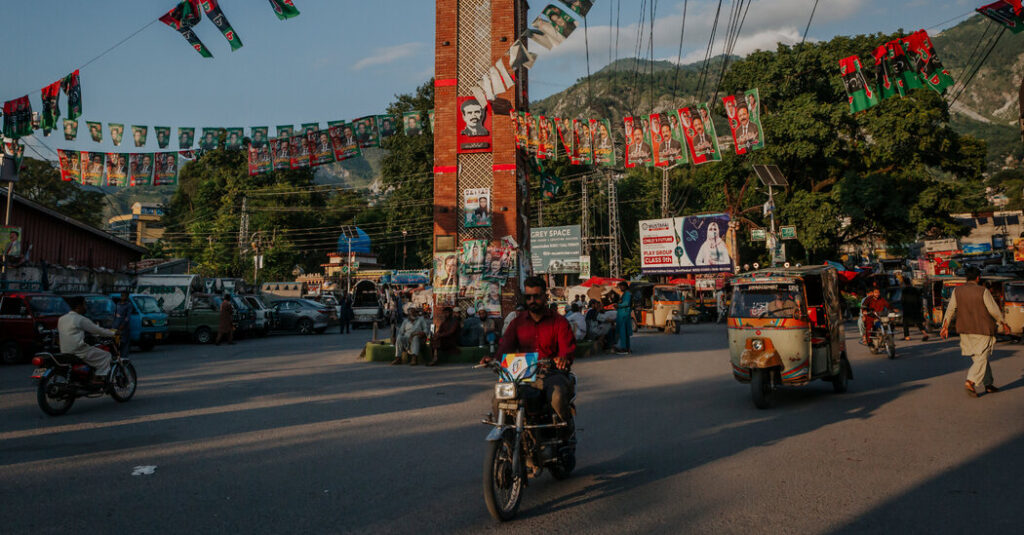
India and Pakistan have fought multiple wars over Kashmir, a Himalayan territory that both countries claim. For Pakistan, this external rivalry has long overshadowed political problems within Kashmir.
But the discontent there now seems too serious for Pakistan to ignore.
What began as demonstrations over the soaring cost of living in the part of Kashmir that Pakistan controls has evolved into a political movement, the Joint Awami Action Committee, a coalition of traders, civil society activists and local politicians. The coalition has organized protests in recent weeks that are posing the most significant challenge in years to Pakistan’s authority over the region.
The coalition announced a long march in early June toward the regional capital, Muzaffarabad, to pressure the government into accepting its demands for more autonomy. The group planned to start the march on June 9 in its stronghold, Rawalakot, just 20 miles from the heavily militarized de facto border that divides Kashmir into two parts, one administered by Pakistan, the other by India.
The Pakistani authorities responded by banning the group under counterterrorism laws on June 5 and later arresting several key leaders. Nevertheless, supporters staged weeks of sit-ins in Rawalkot while negotiations continued. At least 30 people, including protesters, law enforcement personnel and bystanders, have died in clashes from early June to July 27, according to local officials and independent estimates.
When I visited the area last week, I found that the Pakistani government had all but cut off parts of Pakistan-administered Kashmir from the outside world. Internet service across the region had been suspended for weeks, interrupting access to banks and A.T.M.s, and there were police checkpoints on the roads to Muzaffarabad. The cool, lush valleys surrounding the Neelum and Jhelum rivers, which are usually full of tourists escaping peak-summer heat, were largely deserted.
Clashes between protesters and the police erupted in Muzaffarabad on Friday and continued through Sunday, and the authorities shut down the internet again after it had been restored for just one day.
Pakistani officials insist they will not back down because of what the defense minister, Khawaja Asif, called “violence and armed groups.”
Formed in 2023, the Joint Awami Action Committee led protests in 2024 and 2025 that won major economic concessions, forcing Pakistan’s government to slash local electricity rates and subsidize the price of flour, making it much cheaper than in other parts of Pakistan.
This year, however, the alliance broadened its agenda, turning its attention to constitutional reform. The central demand is an end to a measure in the Constitution that sets aside 12 of 45 seats in the territory’s legislature to Kashmiri refugees who live elsewhere in Pakistan. The coalition says the change would give Kashmiris more local control; Pakistan says any change to the special status of Pakistan-administered Kashmir would weaken Pakistan’s diplomatic stance in its dispute with India.
Residents say they are anxious after the violent clashes and lengthy internet shutdowns, especially during the summer tourist season.
“Local businesses are suffering due to the unrest,” said Muhammad Akbar, who manages a riverside waterfall attraction, adding that they are still recovering from last year’s military tensions between India and Pakistan.
The unrest is one of several crises facing Pakistan. The military is battling twin insurgencies in the southern and western provinces of Balochistan and Khyber-Pakhtunkhwa, which have killed thousands of security personnel in recent years.
But Pakistan-administered Kashmir has long been regarded in Pakistan as relatively peaceful and politically stable. The protests have challenged that image and opened a new front of public dissent against the Pakistani government.
After several rounds of failed negotiations, the Pakistani government appears determined to press ahead with its crackdown.
Tallal Chaudhry, state minister for the interior, said the government had accepted all of the group’s demands, with the exception of the constitutional reforms. “This is no longer a protest movement,” he said. “These are rioters now, not protesters.”
Danish Khan, an associate professor at Franklin & Marshall College in Pennsylvania, who studies the region, warned that continued harsh measures against the protesters risks validating the movement’s central argument: that Pakistan-administered Kashmir is “treated primarily as a security problem rather than as a population with legitimate political grievances.”
Many analysts trace the movement’s roots to 2019, when India revoked the constitutional autonomy of the part of Kashmir that it administers and placed it under direct federal rule.
The move triggered demonstrations across Pakistan-administered Kashmir in solidarity with residents across the Line of Control, which divides Kashmir between India and Pakistan.
“The anger began with Pakistan’s silence after India’s move,” said Zahid Amin, a veteran political activist in Muzaffarabad.
Pakistan-administered Kashmir operates under a semiautonomous constitutional framework with its own president, prime minister, legislature and Supreme Court and state flag. Yet candidates seeking elected office must pledge allegiance to Pakistan.
Movement supporters insist that they are neither separatists nor looking to join India, but pushing for better governance.
Pakistan’s military spokesman, Lt. Gen. Ahmed Sharif Chaudhry, said the state had acted with restraint toward the protests and has repeatedly urged the group to participate in local elections, which began on July 27, and pursue their demands through legal channels.
“But they want to achieve it through force, whereas only the state has the monopoly on the use of force,” he said at a news conference on Friday.
Qamar Cheema, an Islamabad-based political analyst, said the government’s concessions to protesters had “reinforced the perception that street pressure works, allowing the group to exploit public grievances and shift political debates that belong in Parliament onto the streets.”
The protest coalition says it is not participating in the elections. But candidates aligned with the movement say election officials have rejected their nomination papers without explanation, an accusation the authorities deny. The coalition has called for an unofficial boycott.
The third phase of the elections will take place on Aug. 10, but major political parties are already challenging its legitimacy. The alliance on Monday demanded a new election under a caretaker government.
Jalaluddin Mughal contributed reporting.