

By Omoyeni Ojeifo
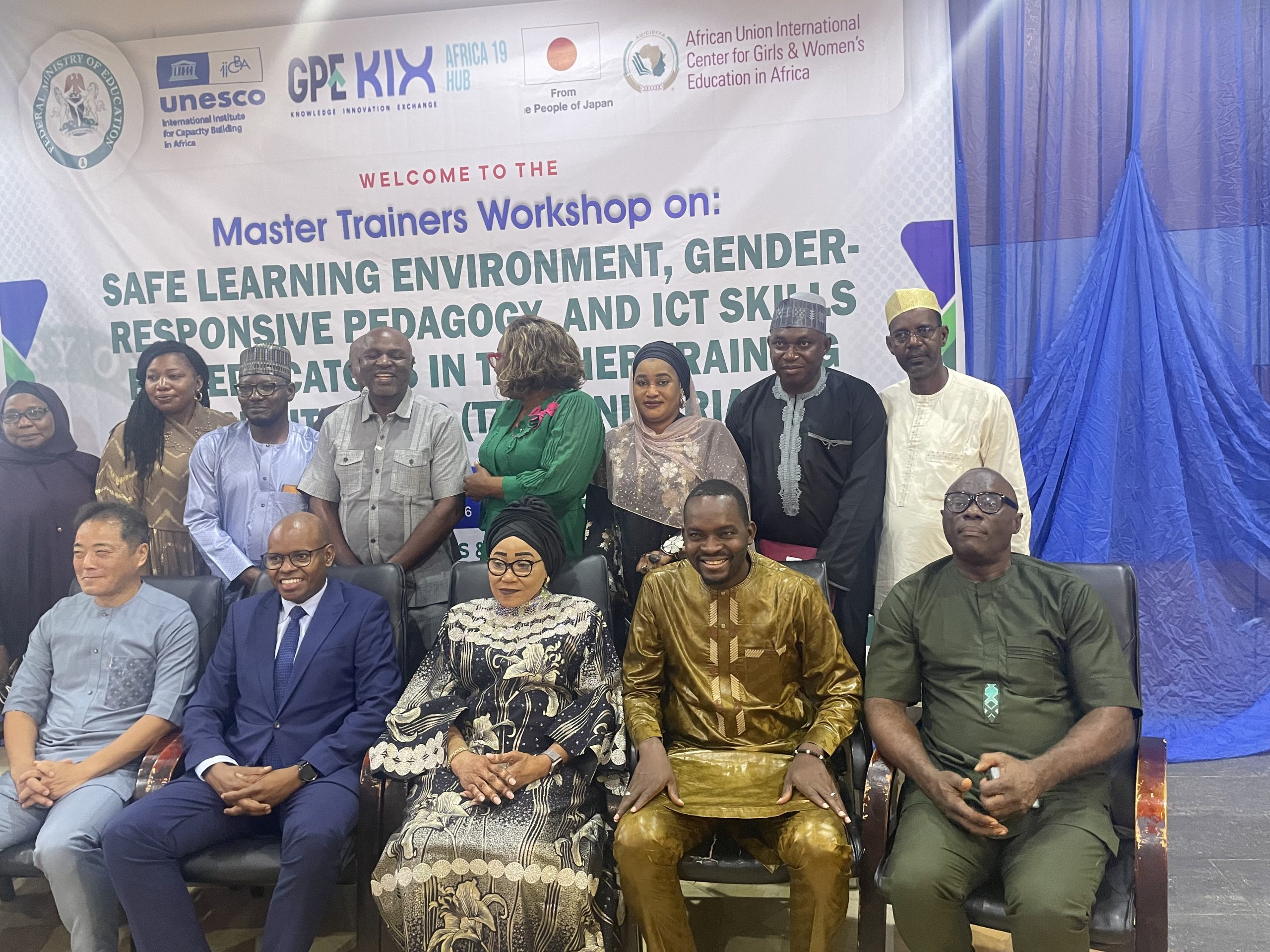
To strengthen teachers preparation in safe learning, gender responsive pedagogy and ICT skills, the Federal Government, in partnership with UNESCO, Japan and the African Union, has commenced training for 45 master trainers.
The three-day training, involving participants from 15 teacher-training institutions, is expected to equip the master trainers to cascade the knowledge and skills acquired to approximately 500 teachers and educators across their institutions.
The Minister of State for Education, Prof. Suwaiba Said Ahmed, stated this in her keynote address at the Master Trainers Workshop on Safe Learning Environment, Gender Responsive Pedagogy and ICT Skills for Educators in Teacher Training Institutions, TTI, in Nigeria, in Abuja on Monday.
Represented by Dr. Uchenna Uba, Director, Colleges of Education, the minister explained that the initiative was designed to strengthen teachers’ ability to recognise when learners are unsafe, excluded or struggling and respond appropriately.
“We are here to ask what matters after a child crosses the school gate. Is she safe? Is she included? Is she learning? Have we prepared her teacher to notice when the answer is no,” PerSecondNews quotes her as saying.
Ahmed emphasized that the training must equip future teachers to promote equal participation, challenge harmful behaviour and respond appropriately when learners report abuse.
“Our graduates must also know how to share questions fairly, challenge a harmful remark without humiliating a child, and respond properly when a learner reports abuse.”
She maintained that the Federal Government’s anti-bullying policy must become visible through the everyday actions of teachers and other adults responsible for learners.
“A child should not have to read a policy document to know that the adults in our school will protect her.”
Ahmed explained that the 45 master trainers from 15 teacher-training colleges would deepen their capacity in gender-responsive safe learning environments, preventing and responding to school-related gender-based violence and digital teaching.
“The masters trainers would subsequently take the knowledge back to their institutions, where it would reach approximately 500 teachers and educators,”she added.
She challenged the participants to demonstrate the approaches in real lessons, allow colleagues to practise them and observe whether the training produces meaningful changes.
“When you return to your college, show your colleagues what this world looks like in a real lesson. Let them practise it. Observe what changes,” the minister stressed.
Also speaking at the event, the Director, Colleges of Education, Dr. Uchenna Uba, represented by the Deputy Director, Colleges of Education, Godwin C. Egbunefu, described the programme as more than a capacity-building exercise.
“The workshop is more than a capacity-building exercise. It is about creating learning environments where every child feels safe, participates, leads and fulfils their God-given potential,”he said.
Uba urged the master trainers to ensure that the knowledge gained reaches teacher educators, teachers and ultimately the children they serve.
“You are multipliers and change agents. The knowledge and skills you acquire here must be taken back to your institutions and cascaded to teacher educators and teachers, so the benefits reach the classroom and, most importantly, the child.”
The UNESCO Representative to Nigeria, Dr. Isaias De Rosa, linked the programme’s focus on gender, safety and ICT to the central role of teachers in translating education policies and investments into classroom outcomes.
“Technology can provide tools and policy can provide the framework, but teachers bring learning to life. People, especially teachers, transform education, and without strong teachers, our educational system will not improve,” he noted.
According to De Rosa,the project identified three interconnected areas requiring attention: teachers’ capacity to apply gender-responsive pedagogy, practical skills for creating safe and supportive learning environments, and digital competence and ICT integration.
Commenting on on the programme, Mr Boubakar Yougbare,the representative of the African Union International Centre for Education of Girls and Women in Africa, AU/CIEFFA, described the workshop as part of a wider ambition to strengthen the institutions responsible for preparing Africa’s teachers.
He highlighted persistent education challenges across sub-Saharan Africa, including poor learning outcomes, school dropout, shortages of qualified teachers, unsafe learning environments and disparities between boys and girls.
He linked those challenges to insecurity, climate-related risks and school-related gender-based violence, stressing the importance of investing in teachers and the institutions that prepare them.
“Quality education for girls must include protection, retention and prevention of violence, alongside learning spaces where girls are safe and able to progres, he stressed.
“A school that is not safe, cannot provide meaningful access to education, regardless of what enrolment figures may show,” he said.
In his remarks, the Deputy Director and Head of Mission of the Embassy of Japan in Nigeria, Mr. Kozaki Hitoshi, described Japan’s support as a concrete expression of international solidarity for girls’ education.
“This commitment is a concrete expression of international solidarity in favour of girls’ education and represents Japan’s support for stronger, safer and more inclusive education systems.”