

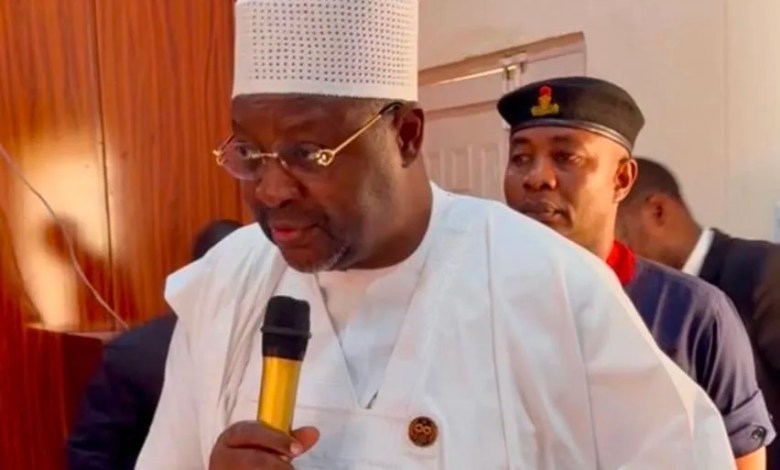
…Receives Award of Excellence in Humanitarian Leadership, National Service
KANO — Special Adviser to the President on Media and Public Communications, Chief Sunday Dare, CON, has declared that Nigeria is not a lost cause, challenging young Nigerians to reject despair and take greater responsibility for rebuilding the country.
Dare said Nigeria’s future would ultimately depend on a new generation of citizens willing to embrace patriotism, integrity, competence and responsible leadership while rejecting ethnic divisions, religious intolerance and destructive cynicism.
He spoke in Kano while delivering a distinguished lecture titled “Peace, Leadership & Nation Building” at the Faculty of Law, Northwest University, in collaboration with the International Humanitarian Law Society of Nigeria.
The event attracted academics, students and other stakeholders, including the Emir of Kano, His Royal Highness Muhammadu Sanusi II, CON.
“Nigeria is not a lost cause. Africa is not a condemned enterprise. Sustainable peace is not a utopian fantasy,” Dare declared.
Drawing on the African proverb that “any river that forgets its source eventually dries up,” the presidential aide said patriotism must remain at the heart of Nigeria’s national identity and its quest for lasting peace and development.
He warned that ethnic parochialism, religious intolerance, regional divisions and hate could further weaken the country unless Nigerians recognise their shared destiny.
According to Dare, Nigeria should be seen as an “unfinished house” requiring the collective effort of its citizens to repair and strengthen, rather than a country to be abandoned because of its imperfections.
“When you love your country, you do not abandon her when she stumbles; you stand up, stretch forth your hands, and lift her up,” he said.
Dare placed particular emphasis on Gen Z and other young Nigerians, describing them as educated, globally connected and technologically sophisticated, but insisting that digital influence alone would not transform the country.
He challenged young people to channel their energy into governance, politics, law, technology, entrepreneurship, public service and other areas of nation-building, while developing the competence, discipline and character required for leadership.
He equally urged the older generation to provide credible mentorship and open up meaningful opportunities for younger Nigerians to participate in leadership and decision-making.
On governance, Dare advocated a new model of humanitarian leadership in which public office is regarded as a responsibility to serve and protect citizens rather than an avenue for personal entitlement.
He identified selflessness, empathy, accountability, courage and respect for human life as essential qualities of leadership, stressing that decisions made by those in authority have direct consequences for farmers, vulnerable families, displaced persons and millions of young Nigerians seeking opportunities.
The presidential adviser also argued that sustainable peace and development cannot thrive without justice, equality before the law and strong institutions.
He called for the protection of civilians and vulnerable groups during security and humanitarian crises, saying respect for human dignity must remain central to governance and security operations.
Turning to the media, Dare warned journalists against allowing sensationalism, hate speech, artificial intelligence, deepfakes and digital disinformation to undermine social cohesion.
Drawing from his journalism and public communications background, he described a free, independent and responsible press as indispensable to democracy, urging media professionals to prioritise truth, accuracy and ethical journalism.
Dare proposed a five-point pathway for Nigeria’s national renewal: radical institutional reform for justice; innovation-driven and inclusive economic empowerment; stronger civic education and a culture of peace; an uncompromising anti-corruption ethos; and a new humanitarian social contract between government and citizens.
He said access to clean water, quality education, healthcare and physical security must be treated as fundamental responsibilities of government, alongside the creation of greater economic opportunities for young Nigerians.
A major highlight of the event was the presentation of an Award of Excellence in Humanitarian Leadership and National Service to Dare in recognition of his contribution to humanitarian leadership, national service and the promotion of peace.
Ending his lecture with a message of optimism, Dare said Nigeria’s challenges must not be allowed to extinguish faith in the country’s future.
“The river of our national destiny will not dry up. It will flow wider, deeper, and stronger—carried on the undiluted, patriotic, and humanitarian wings of this brilliant new generation,” he declared.