

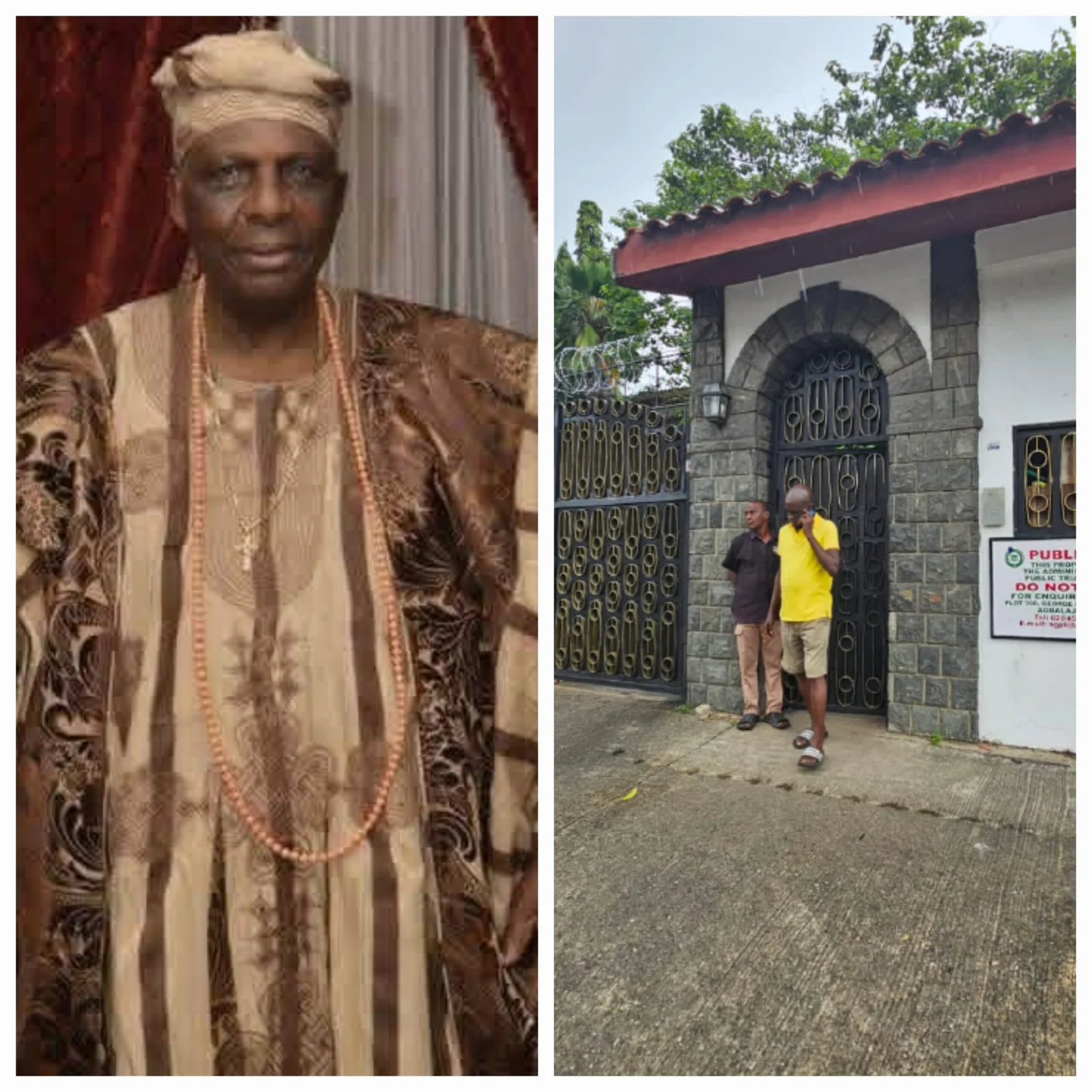
The Lagos State High Court has ordered the Lagos State Administrator-General to assume interim control of the estate of late billionaire industrialist and Parakoyi of Ibadan, Chief Labode Oladimeji Akindele, as a bitter legal battle over the validity of his Will enters a critical phase.
Justice Tanimola Ajorin-Ajose, sitting at the Lagos State High Court, made the order following an application by the deceased’s first son, Oladipo Alade Akindele, who is challenging the entire Will and seeking to prevent its use as the basis for administering his father’s estate.
The court directed the Administrator-General to administer the estate pending the hearing and final determination of the substantive suit and ordered the office to operate under the immediate control and direction of the court.
Justice Ajorin-Ajose also directed the interim administrator to file quarterly reports detailing the administration of the estate and ordered all parties to cooperate in preserving the assets.
The intervention followed concerns raised by the claimant that the estate, which includes properties generating rental income, could be exposed to waste or dissipation while the dispute over the Will remains unresolved.
The claimant alleged that income from some properties had not been properly accounted for and that rents remained outstanding because there was no effective executor or administrator in place to manage the estate.
The defendants opposed the application, questioning the claimant’s case and the jurisdiction of the court, particularly in relation to properties allegedly located outside Lagos State and Nigeria.
They also argued that the properties said to constitute the estate had not been sufficiently identified and that some of the claimant’s allegations were vague and speculative.
The court, however, held that its immediate concern at the interim stage was the preservation of the estate and prevention of waste pending determination of the substantive dispute, rather than resolving the precise extent or composition of the estate.
The judge noted that the Will was under challenge and that there was no executor or administrator effectively in place to manage the estate.
The court consequently found the application for the appointment of an interim administrator meritorious.
The order adds a significant new dimension to a probate dispute that has continued for more than six years after the death of the renowned businessman on June 29, 2020.
Akindele, who was born in Ibadan, Oyo State, died at his Lagos residence at the age of 88.
Widely regarded as one of Nigeria’s prominent industrialists, he built a substantial business empire with interests spanning maritime services, fishing, finance, real estate and international investments.
His business interests included companies such as Fairgate Group Limited, Fairgate Estates Limited, Fairgate Investments Limited and Madandola Group, among others.
The dispute over his estate is now before Justice Ajorin-Ajose in Suit No. LD/10/2020, with the first son seeking declarations that the purported Will is invalid and incapable of forming the basis for administering the estate.
Oladipo, who describes himself as the seventh biological child and first son of the deceased, is challenging the Will on several grounds, including alleged non-compliance with the applicable Wills Law, questions surrounding its execution and the absence of a Family Protocol allegedly referenced in the document.
He is also seeking an account of the estate’s assets, income, expenditure and transactions undertaken since his father’s death.
The suit has brought into the open a series of disputes concerning the circumstances surrounding the administration of Akindele’s affairs after his death, including the conduct of his funeral, the reading of the Will and the documentation said to govern the management of the family’s wealth.
According to the claimant’s court processes, he was in Cape Town, South Africa, on business when he received news of his father’s death.
He alleges that conflicting accounts subsequently emerged regarding the circumstances of the death and that his request for a post-mortem examination was not honoured.
He further alleges that his name was omitted from the obituary announcing the funeral ceremonies and that he was excluded from aspects of the arrangements.
The defendants have denied the allegations, maintaining that the deceased had during his lifetime taken steps that resulted in the claimant’s exclusion from certain family affairs.
According to their Statement of Defence, Akindele had disowned the claimant, although the defendants acknowledge that he was the deceased’s biological child and first son.
They contend that the omission of his name from the obituary reflected the late industrialist’s wishes and was not part of any posthumous effort to deny his paternity.
Another major point of contention is the reading of the disputed Will at the Probate Registry of the Lagos State High Court on August 17, 2020.
The claimant alleges that although he was named as a beneficiary, he was neither notified nor invited to the reading.
He said he subsequently instructed his lawyers to obtain a Certified True Copy of the Will and conducted a search of the probate file.
He further alleges that several beneficiaries and proposed trustees attended the reading and that about 20 certified copies of the Will were obtained, but none was made available to him.
The defendants dispute the significance of his non-attendance, arguing that the Probate Registry had limited the number of persons who could attend and that beneficiaries living abroad were not invited because of the short notice.
They also contend that there was no legal requirement compelling the claimant to attend the reading.
Family Protocol at centre of dispute
Perhaps the most contentious issue concerns a document described in the claimant’s pleadings as the “Bode Akindele’s Family Protocol”.
The claimant contends that the Will repeatedly refers to a Deed of Declaration and Family Protocol, identified as Schedule Two, which was intended to regulate the governance of the family, its wealth and the trustees responsible for administering the estate.
He alleges that when he obtained a Certified True Copy of the Will and later inspected the original lodged at the Probate Registry, the document was not attached.
According to him, the alleged protocol is fundamental to the operation of several provisions of the Will and its absence renders the testament incomplete and legally defective.
He is asking the court to declare that any family protocol produced after execution of the Will cannot lawfully become part of the testamentary document.
The defendants, however, acknowledge the existence of the document but describe it as the “Sir (Chief) Olabode Oladimeji Akindele Family Constitution”.
They contend that the document, dated October 14, 2018, was duly executed by the deceased, several of his children and one of the defendants between October and November 2018.
They maintain that the claimant was not among its signatories and argue that the document had been sufficiently identified and incorporated into the Will.
The defendants further contend that the fact that the document was not physically attached to the Will does not invalidate the testament.
The claimant has also raised questions about the execution of the Will, alleging that the date appearing on the document was altered from August 5, 2015, to May 5, 2017, without proper authentication.
He further alleges that signatures accompanying the alterations differ from those of the attesting witnesses.
The claimant has indicated that expert evidence would be presented at trial in support of the allegations.
He also challenges what he describes as inconsistencies and drafting errors in the document and argues that the Will does not adequately identify the deceased’s extensive assets.
Among the properties referred to in the claimant’s pleadings are commercial properties allegedly owned by the late industrialist in parts of the United Kingdom, including London, Wembley, Leicester, Southampton, Camberley and Aylesbury, as well as a family residence in Spain known as “Nigerian House”.
The claimant argues that the alleged omissions raise questions about the completeness of the document in relation to an estate with substantial international interests.
The defendants have denied the allegations and maintained that the claimant is required to prove the assertions contained in his pleadings.
The claimant is asking the court to declare the Will invalid on grounds including alleged non-compliance with the Wills Law, lack of due execution, alleged absence of testamentary capacity and failure to include the Family Protocol said to be referenced in the document.
He is also seeking an order restraining the defendants from administering the estate under the disputed Will and requesting a comprehensive account of the estate’s assets, income, expenditure and transactions since the death of the industrialist.
The defendants have denied wrongdoing and challenged the allegations. For now, none of the central allegations concerning the validity of the Will, the alleged alteration of its execution date, the Family Constitution or the management of the estate has been finally determined by the court.
The appointment of the Administrator-General is similarly an interim measure designed to preserve the estate pending determination of the substantive dispute; it does not amount to a final ruling on the validity or invalidity of the Will.
With the estate’s assets, the competing claims of family members and the validity of the testamentary document all in dispute, the case could have implications beyond the Akindele family and provide important judicial guidance on the administration of contested estates and the interpretation of Nigerian probate law.
Justice Ajorin-Ajose has adjourned the matter until September 28, October 7 and October 8, 2026, for continuation of hearing