

The Nigerian military’s pursuit of some of the country’s most wanted commanders of the Islamic State West Africa Province (ISWAP) has entered a new phase, with cash rewards totalling about ₦60 million now being offered for information leading to key terrorist leaders.
The strategy represents a renewed attempt to harness public cooperation in a fight where years of sustained military pressure have yet to eliminate the insurgency. Whether financial incentives can deliver the intelligence needed to locate and apprehend high-value targets remains the critical question.
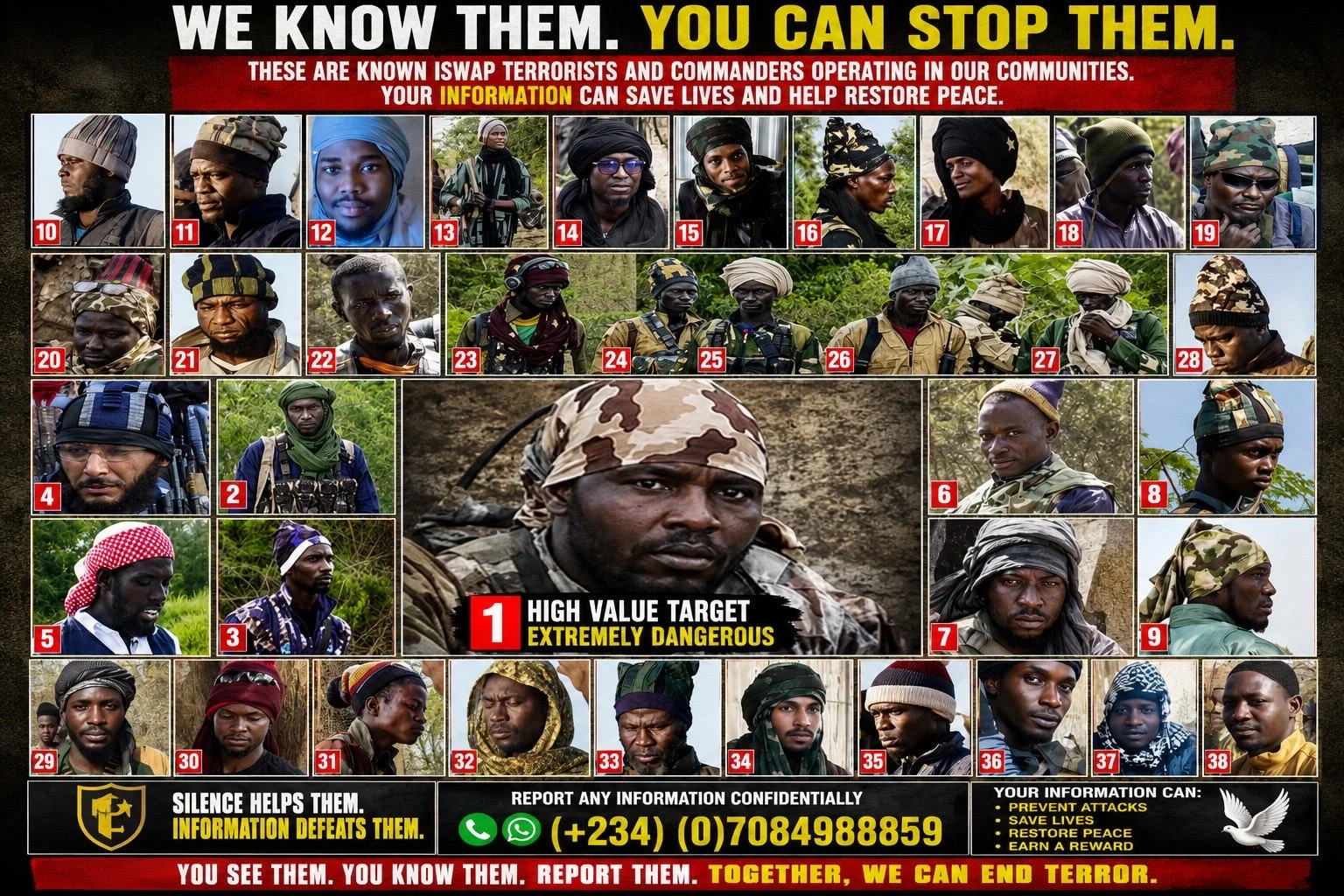
Following intelligence gathering that led to the identification of 38 key terrorist commanders, the Nigerian Army is appealing directly to the public for actionable information on their whereabouts.
The development raises an important question: Can financial incentives help bring some of Nigeria’s most wanted terrorists to justice?
The military’s latest intelligence breakthrough reportedly began on the battlefield rather than through public tip-offs. Troops recovered electronic devices, including a camcorder allegedly used by ISWAP members to record propaganda videos.
Analysis of the devices reportedly enabled security agencies to identify several senior commanders operating around the Lake Chad Basin. Among them is Abu Musa Al-Mangawi Baa Shuwa, described as the Wali, or governor, of ISWAP, for whom a ₦50 million reward has been announced. A further ₦10 million reward has been placed on another wanted commander.
The development is significant because it underscores the changing nature of modern warfare. Counterterrorism operations are increasingly driven by intelligence, technology and forensic analysis as much as by conventional military firepower.
Mobile phones, computers and digital storage devices can provide valuable intelligence, potentially revealing command structures, movement patterns, communication networks and other operational details.
In that respect, the Army’s ability to identify senior ISWAP commanders may prove as important as the bounty programme itself.
But identifying terrorist leaders is only half the battle. Locating and apprehending them is often considerably more difficult.
The Lake Chad Basin remains one of West Africa’s most challenging security environments. Its difficult terrain, scattered islands and remote settlements have historically provided insurgents with opportunities to evade security forces.
Even with credible intelligence, military operations require careful planning, accurate targeting and sustained pressure to locate and apprehend high-value suspects. This is where the bounty programme could potentially make a difference.
By offering rewards of ₦10 million and ₦50 million, the Army hopes to encourage people with credible inside knowledge to provide information that security forces may otherwise struggle to obtain.
Terrorist organisations rely heavily on secrecy, fear and local networks. Reward schemes seek to weaken those advantages by giving insiders and community members an incentive to cooperate with security authorities.
Yet the size of the reward is only one part of the equation. For many people living in communities affected by insurgency, the overriding concern is not financial gain but survival. Anyone suspected of assisting security agencies could face retaliation from terrorist groups. Even a ₦50 million reward may not persuade potential informants if they believe their identities could be exposed or their families placed at risk.
That makes public confidence crucial. The military has assured Nigerians that information provided will be treated confidentially and that informants will be protected. Those assurances, however, must be backed by credible security measures.
If residents are confident that they can provide information without exposing themselves or their families to danger, the reward programme stands a better chance of producing meaningful intelligence.
The initiative also highlights the growing importance of community participation in national security. Security agencies cannot be everywhere at once, particularly across the remote areas of Borno State and the wider Lake Chad region. Residents may notice unusual movements, unfamiliar faces or suspicious activities long before security forces do.
Encouraging responsible information-sharing can therefore strengthen intelligence gathering without requiring civilians to confront terrorists directly.
However, authorities must also proceed with caution. Reward programmes can generate false, exaggerated or deliberately misleading information from individuals seeking financial gain or attempting to settle personal disputes. Every tip must therefore be independently assessed and verified before operational decisions are taken.
Acting on inaccurate intelligence could waste scarce resources, compromise operations and potentially endanger innocent lives. More importantly, the bounty should not be treated as a silver bullet.
The arrest of one or even several ISWAP commanders will not automatically bring the insurgency to an end. Like many terrorist organisations, ISWAP has demonstrated an ability to replace fallen leaders, reorganise its networks and adapt to military pressure.
Long-term success will therefore require more than financial incentives. It will depend on sustained military operations, stronger intelligence capabilities, effective regional cooperation and continued efforts to disrupt the group’s financing, recruitment and propaganda networks.
Perhaps the most significant lesson from the latest development is that Nigeria’s counterterrorism campaign is becoming increasingly intelligence-driven.
The reported recovery of a single camcorder and other electronic devices, followed by forensic analysis that helped identify senior ISWAP figures, illustrates the growing importance of technology in modern security operations.
The battlefield is no longer defined solely by weapons and troop deployments. Digital devices, communications data and other forms of electronic evidence can provide critical clues about the organisation, movements and activities of armed groups.
Against this backdrop, the Army’s bounty programme deserves cautious optimism. Offering ₦10 million and ₦50 million rewards could encourage individuals with credible information to come forward, particularly if they are convinced that their identities will remain confidential and that adequate protection will be provided.
But money alone cannot defeat an insurgency that has persisted for years. The real measure of the initiative will not be the size of the rewards announced, but the results they produce.
If the programme contributes to the arrest or disruption of high-profile ISWAP commanders, weakens the group’s command structure and helps reduce attacks across the North-East, it could become a useful addition to Nigeria’s counterterrorism strategy.
If it fails to produce actionable intelligence, it will reinforce a more familiar lesson: defeating terrorism requires more than financial incentives. It requires public trust, reliable intelligence, technological capability, effective protection of informants, and sustained military pressure.
Awoniyi Ademide is a digital journalist with experience covering metro, politics, governance, security, and social issues. He specialises in news reporting, investigative research, interviews, multimedia storytelling and SEO-driven content, delivering accurate, engaging and original journalism for digital audiences.