

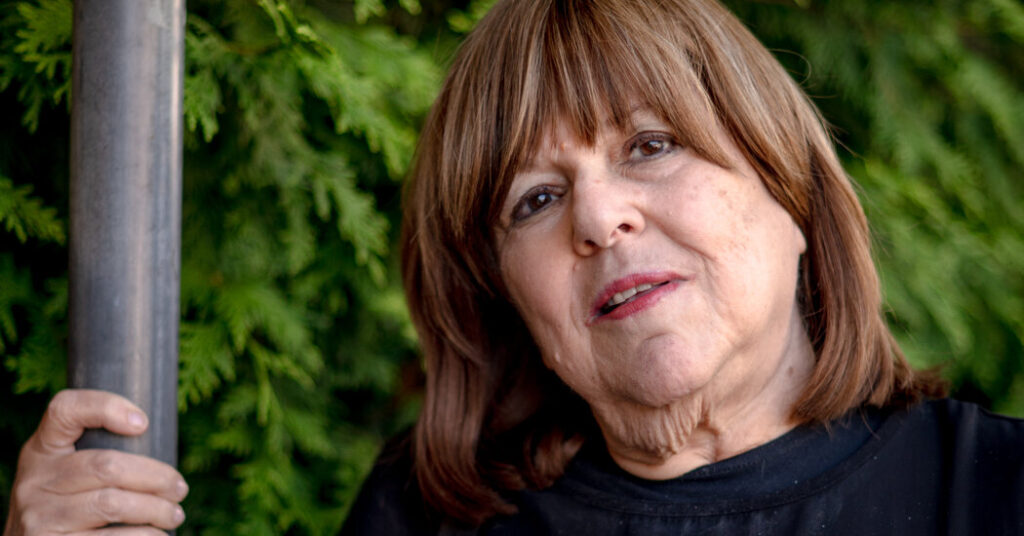
Rizy Horowitz often wakes up screaming in the middle of the night.
As the program manager at Nachas Health and Family Network, a nonprofit serving a dwindling number of Holocaust survivors in the ultra-Orthodox neighborhood of Borough Park, Brooklyn, she has heard her share of horror stories.
“I know thousands of ways people can be tortured,” she said.
Lillian Feintuch, 92, a Hungarian survivor who said her train was stopped just before arriving at Auschwitz, survived four near-death experiences as a child, including a Nazi placing a gun to her forehead.
Dolly Rabinowitz, who turned 101 in late July, survived Auschwitz and a death march to Ravensbrück with her two sisters, but watched her mother be dragged off to a gas chamber, she said.
And David Einhorn, also an Auschwitz survivor, was nearly starved to death.
Ms. Horowitz has listened to these stories since 1990, when Nachas — which means “joy” in Yiddish — was formed to help survivors file for reparations. Back then, she served around 5,000 survivors. She’s now down to about 280.
Each afternoon, Monday through Thursday, the survivors, some with canes and motorized scooters, arrive at Ms. Horowitz’s brightly lit space on 48th Street in Brooklyn. They chat, in Yiddish and English, and brag about their grand- and great-grandchildren. She serves them kosher pizza, falafel, calzone and knishes, and hands out prepackaged dinners. She offers an ear and a sense of community to a group that is slowly shrinking.
To help the survivors and herself occasionally forget their stories, she has taken them on trips to the Catskills and the Oval Office, and she throws them parties.
“Rizy treats them like they’re 18 years old,” said Freida Rothman, a Brooklyn jewelry designer who helps organize and fund trips for Nachas. “She gives them life and a reason to wake up in the morning. She believes in them.”
The most recent party was for Mr. Einhorn, who turned 100. He was late to his own party.
A crowd of about 200 waited patiently for him on a Monday evening in July at the Seville Manor banquet hall, hung with glowing chandeliers and gold and silver helium balloons. A half-hour went by, and Mr. Einhorn was still nowhere to be seen.
He had good reason for being late. Mr. Einhorn had not been well the past few weeks, receiving blood transfusions to stay alive to see his birthday and other upcoming family events: the marriage of one of his 11 grandchildren and the birth of his 21st great-grandchild.
He wanted to witness it all.
Mr. Einhorn is one of only 187,000 Holocaust survivors worldwide, down from 245,000 recorded 18 months earlier, according to the Claims Conference, an organization that fights for reparations for survivors around the world and funds 300 social service groups, including Nachas. New York has the highest population of survivors in the United States, the group said, with over 70 percent in Brooklyn. But the number of Brooklyn survivors is down to 7,400 from around 10,000 in 2024.
“In one way we don’t want to recognize that we’re going to live in a world without Holocaust survivors,” said Gideon Taylor, the director of the Claims Conference. “But that’s the reality we face.”
To preserve firsthand accounts of the Holocaust, the Claims Conference has developed an immersive virtual reality program that mixes archival footage, artificial intelligence and audio. They also run a “speakers bureau,” which connects more than 300 survivors with schools and other organizations, all to ensure that history never repeats itself.
“We have this moral obligation of making sure their stories are told and retold, and the lessons are learned from what happened during the Shoah,” said Mr. Taylor, using a Hebrew term for the Holocaust.
According to the Claims Conference’s Vanishing Witnesses report from 2025, half of the Holocaust survivors still alive will be gone within the next five years. In 10 years, 70 percent are expected to die, and in 15 years, 90 percent. Even though their numbers are falling, their needs are growing. Many require 10 to 15 hours of care a day, Mr. Taylor said.
“When we first started, we couldn’t even catch our breath,” Ms. Horowitz said. Before she arrived each morning, there would be a line of survivors outside looking for help with their reparations paperwork. Once the claims were filed, Ms. Horowitz turned her attention to their day-to-day struggles.
“We had to make sure these survivors had normal lives,” she said.
Ms. Horowitz began helping with food stamps and insurance and eventually offered them free meals. They show her their scars, tattoos and bullet holes. “For some of them it was the first time they ever spoke of their experience,” she said. But she understands. Ms. Horowitz’s mother, an Auschwitz survivor now in her 90s, didn’t tell her daughter her story for decades.
Thousands of Ms. Horowitz’s clients have died since she began Nachas. “It hasn’t been easy,” she said. She doesn’t go to funerals or sit shiva. “In my mind, I tell myself they’ve gone on vacation, and they will be coming back,” she added. “Otherwise, it would be too painful.”
Ms. Horowitz knows her days at Nachas will eventually end when the last of the survivors are gone. “It’s a very strange mixed feeling,” she said. “I gave away my heart and soul to them.” But she’s looking forward to her next chapter, with plans to work for her daughter’s business, a mental health clinic in Queens.
She recently went to a rabbi for guidance on how soon she should leave Nachas. “He told me, as long as the survivors are alive, you can’t leave them,” Ms. Horowitz said. “So I will be there as long as they need me.”
Mr. Einhorn eventually arrived at his birthday party, escorted by the Hatzolah volunteer ambulance service. He was dressed in a black yarmulke and matching suit.
The crowd erupted in song — “Siman Tov u’Mazel Tov” — clapping along as Mr. Einhorn was wheeled around the room, his guests rushing over for his blessing. “God should help me to bless you while I can,” he said slowly, struggling over each word in his strong Romanian accent. “You should live together in peace, with no sickness.”
Rabbi Dovid Goldwasser told the crowd a story that many in attendance were already familiar with. But he told it again, like a prayer they needed to repeat from time to time: Mr. Einhorn, a prisoner digging coal near Auschwitz, prayed to God as Yom Kippur was approaching in 1944. He wanted to fast but was being starved to death by the Nazis. Just as Mr. Einhorn finished his prayer, a truck full of cabbages drove past, one rolling out and stopping at his feet. He ate half and saved the other half for after his fast.
“If that’s not a miracle, God, I don’t know what a miracle is,” Rabbi Goldwasser said.
When the volunteer ambulance service returned, this time to take Mr. Einhorn back home, a crowd walked him out, dancing and singing with him along the way. “He left on a high note,” said Sara Rosenblatt, one of his daughters.
Mr. Einhorn died four days later.