

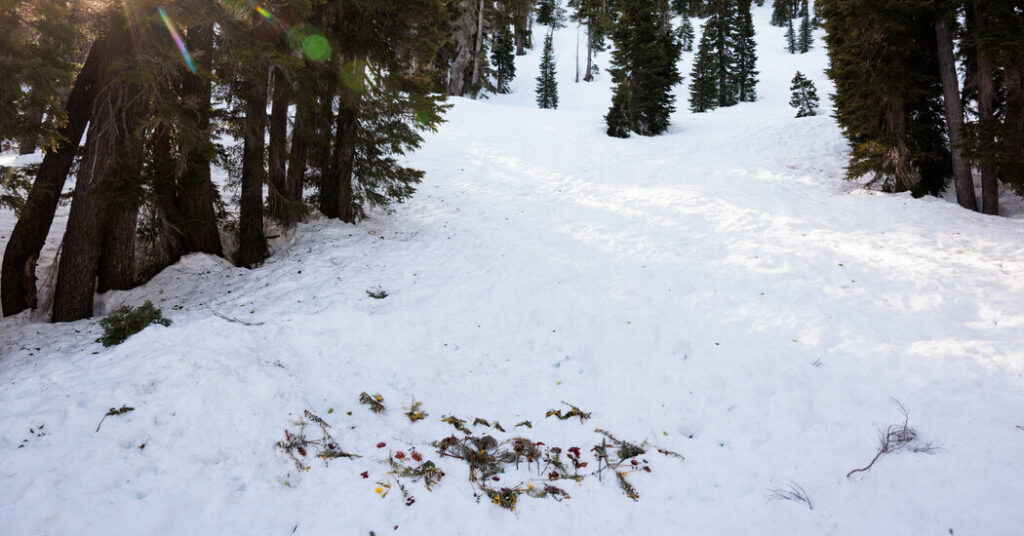
A report commissioned by the guide company that was leading a backcountry ski party near Lake Tahoe in February when an avalanche killed nine skiers attributed no direct blame to the company.
The report details the movements of the group of backcountry skiers led by Blackbird Mountain Guides after it left the Frog Lake Huts, near Donner Pass, during a major snowstorm on Feb. 17.
It leans on previously reported news media accounts, the GPS tracks of two party members and avalanche and weather data. It includes accounts of Blackbird guides, including the lone surviving guide as well as the owner, Zeb Blais, who was not on the trip but joined the search-and-rescue effort.
The report draws no conclusions and does not say if mistakes were made. And it does not ask or address a key question: Why did the 15-member group leave the huts in the snowstorm rather than staying sheltered?
The exact cause of the avalanche remains unclear.
“It is not known, nor will ever be known, whether the avalanche was naturally triggered, or triggered by the weight of the group,” the report said.
The aftermath of the avalanche has been clouded by possible legal ramifications for Blackbird and Blais. The sheriff’s department for Nevada County, where the avalanche occurred, said on Friday that the case remained open and was under review by the district attorney. Civil lawsuits from victims or families are possible, too, though none have been filed.
On Thursday, the sheriff’s department released heavily redacted coroner reports for the nine victims. All died of asphyxia “due to burial in snow during avalanche,” the coroner said.
The report contains two parts. The bulk is an “independent preliminary report” prepared by Don Sharaf, former owner of the American Avalanche Institute, a Colorado-based company that has taught safety courses for more than 50 years.
The other is a “supplemental document” prepared by Blackbird, highlighting some of the “key findings.” Among them, Blackbird said, was the route selection, which has been the subject of great speculation.
Blackbird, with dozens of guides, taught avalanche-safety courses and regularly took clients on overnight trips to Frog Lake. The chosen route on Feb. 17 was the one most frequently used by Blackbird. A meeting on the morning of the avalanche included discussion of giving a wide berth to the northern slopes of Perry’s Peak, where the avalanche occurred, the report said.
Using the GPS tracks of one of the deceased guides and one of the surviving clients, the report posits that the group tried to cross a small creek multiple times, away from a known avalanche zone and toward relatively safer terrain, “but were most likely turned back by open water and vertical creek sidewalls.”
Blackbird’s supplement highlights that possibility.
“Based on the group’s tracks from the preceding days, they would not have known about this impassable barrier before their exit on Tuesday morning,” the supplement said.
Two of the survivors, Jim Hamilton and Anton Auzans, said on Saturday that they did not recall any attempts or discussions about crossing the creek, though both men were at the tail end of the group. Neither was interviewed for the report, nor were other survivors besides the guide Ryan Tilley.
Other possible routes from the huts that morning were potentially more problematic, the company said. They were longer and also included avalanche exposure, while skirting private property, Blackbird said.
Blackbird wrote in its part of the report that it had followed “established risk-management practices “including terrain and route selection, continued assessment of weather and snowpack conditions, and careful management of exposure.”
It added: “Guiding under elevated avalanche hazard is a recognized and accepted professional practice when these methods are applied.”
Blackbird had two groups of clients scheduled to stay for two nights at the Frog Lake Huts, which are owned by the Truckee Donner Land Trust and have been open to the public since late 2021.
One group had eight women, mostly from the Bay Area, led by two guides. The other had three men, unknown to one another before the trip, led by another two guides.
On the clear morning of Sunday, Feb. 15, with a strong multiday snowstorm forecast to arrive that night, the groups left from Donner Pass near Interstate 80. They skied north for several miles to reach the heated huts, passing not far from where the avalanche happened two days later.
The groups skied independently that afternoon and in the fresh snow on Monday. On Tuesday morning, the day of departure, a planned ski run before returning home was called off because of heavy snow and wind. The groups were combined and they set off together.
Less than two hours after leaving the huts, the avalanche buried most of the skiers. Six of the women and three of the four guides were killed.
“There is nothing easy about any part of this,” the guide company said in a statement on Saturday. “Nine deeply loved people are gone, three of them our own guides. There is still much that remains unknown, but this is the most complete information available so far and we hope the release of this information can help the community begin to heal together.”
David Choo, father of Nicole Choo, one of the guides who died, said the report contained information that was already known. “Nothing in the report changes our view that this was a tragic accident,” he said.
His hope, he said, is that others will learn from it.
“Backcountry skiing will always be inherently risky,” he said. “It is only through more education of the entire industry and community, both individually and as collectives, that we can minimize the loss of lives through avalanches.”