

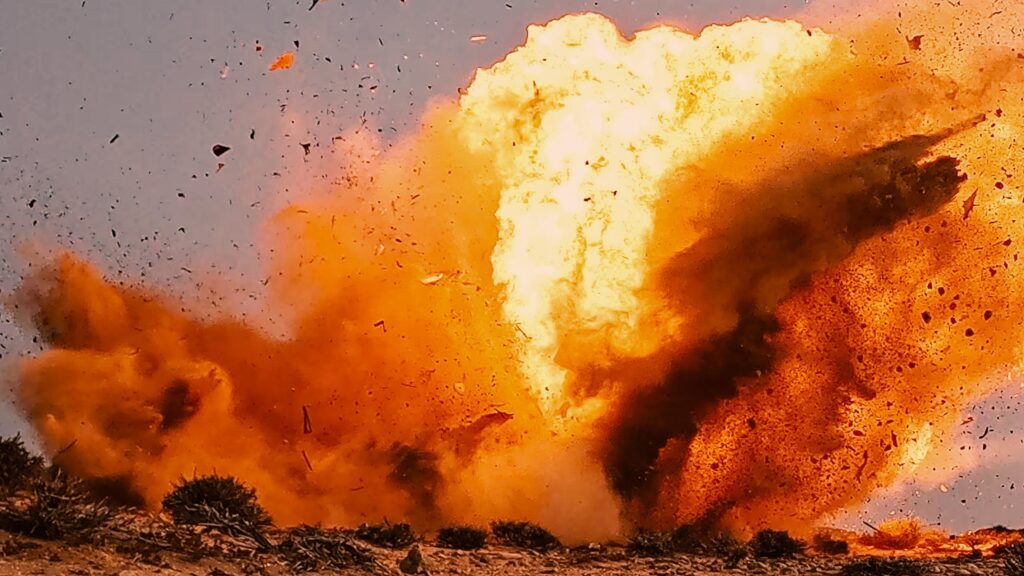
The U.S. Army said Friday that it is opening five military test ranges to private companies developing missiles, drones, and other weapons, in an effort to cut months—and potentially years—from the time it takes to test new systems and get them into the acquisition pipeline. But officials say the initiative is not a response to concerns about dwindling munitions stockpiles.
Army Secretary Dan Driscoll announced the initiative at a military testing range in Michigan, telling reporters that this effort would cut down months of red tape that military contractors must go through before launching new technology.
He explained that it takes 12 to 18 months for a company to test a product “that can make a soldier’s life better, that can increase their lethality, and that can keep them safer.”
“That is not sufficient,” he said.
Read More: The U.S. is Facing an Ammunition Shortage Due to the Iran War. Here’s What That Means
Before acquiring weapons, the military requires multiple rounds of rigorous testing to ensure that the weapons are battle-ready. That can result in potential producers facing long wait times in order to demonstrate proof of concept. To shorten that timeframe, the Army launched an online portal that allows munitions manufacturers to request access to a range. An Army “concierge” then helps them confirm availability and book a time. Driscoll said this process ensures that these companies, which do not need to have existing contracts but might one day become vendors to the government, will have access to a test range within 30 days of requesting it.
The four domestic ranges that will become immediately accessible are at Camp Grayling in Michigan, Camp Shelby in Mississippi, and the Dugway Proving Ground in Utah, in addition to a range that had previously gone unused at the Yuma Proving Ground in Arizona.
There is also an overseas site: Covenant Industries was the first to use the new scheduling system and tested its Anthem missile at the Multidomain Training Area in Morocco on Thursday. Executive Abby Denburg told reporters that the company would begin delivering “production-ready assets for our manufacturing line” at the start of 2027.
Driscoll said that more sites could be added in the future.
“By bringing in more facilities, you don’t have to schedule something and wait six months until you get an opening,” Mark Cancian, a senior adviser with the Center for Strategic and International Studies (CSIS), tells TIME. He says that this effort is a “natural step” toward addressing the production pipeline bottleneck.
Is the initiative a response to the munitions shortage?
The Army’s new scheduling system was announced just days after the Washington Post reported that President Donald Trump and Defense Secretary Pete Hegseth had clashed over a munitions shortage caused by the ongoing war with Iran. Sources who witnessed the spat at Camp David indicated that the President felt misled about the extent of the war’s impact on stockpiles, according to the Post.
Trump has repeatedly denied that there are munitions shortages, and he threatened jail time for officials who share information about the military’s reserves.
“The U.S. has massive amounts of ‘munitions,’ especially of certain types,” Trump said Thursday on Truth Social, without clarifying the kind of weapon he was referring to. He also claimed that “large amounts” were being manufactured and shipped.
But CNN reported Wednesday that the U.S. had used up close to 80% of its interceptors for the THAAD anti-ballistic missile defense system, which cost over $15 million each, and approximately 50% of its Patriot interceptors, which cost around $4 million each.
The reports echoed warnings from Sen. Mark Kelly in May that munitions stores had been heavily depleted by the war, citing a briefing from the Department of Defense (DoD). After these comments, which were made on CBS’s Face the Nation, experts told TIME that it could take three to four years for production to replenish the nation’s stockpiles.
When questioned about it on Friday, Driscoll said simply: “We have a larger arsenal than any nation in the history of the world, and we will have an even larger arsenal with new and different and layered defenses.”
Yet the military’s own acquisition efforts acknowledge limits to existing inventories. In describing its Ground-Based Affordable Mass (G-BAM) Challenge, which launched in July, the Defense Innovation Unit said future conflicts would require the military to generate affordable long-range firepower at “a scale, cost, and pace that current inventories alone cannot support.”
Stacie Pettyjohn, a senior fellow and director of the Defense Program at the Center for a New American Security (CNAS), tells TIME that the DoD is more concerned with testing new technology than replenishing existing items.
“The U.S. has very good existing weapons—like the ones being used against Iran—but it takes years to produce these sophisticated missiles,” she says. “It is quite apparent that it needs simpler—‘good enough’—missiles that it can afford to buy in larger quantities and, equally importantly, that can be produced more quickly.”
Speeding up weapons testing is only part of the solution
Cancian says the new test range scheduling system is likely an attempt to address two issues. “One is the desire to expand munitions production—particularly to bring on new kinds of munitions—and the second is Hegseth’s push to accelerate the acquisition process,” Cancian says. “This is one way you can do it: by making more test facilities available, and therefore speed up the testing.”
Driscoll acknowledged that he was inspired, in part, by Ukraine’s rapid response to diminished support from its allies, leading to a rapid expansion of missile and drone manufacturing startups.
“If you look at what Ukraine has done so incredibly well, it’s this innovation through necessity, and it’s innovation at the speed that is near or close to matching the commercial sector,” Driscoll said. “So what we, the Army, are trying to do is break down every single barrier that we have put up over the last 20 or 30 years.”
Read More: Chalk One Up for Ukraine
Major aerospace players such as Lockheed Martin and Boeing, as well as arms-makers like General Dynamics, have long been the country’s go-to for defense contracts. But Hegseth’s DoD has more recently strived to increase production by incentivizing smaller companies and startups to build cheap-yet-effective weapons.
For its G-BAM Challenge, the Pentagon said it is seeking long-range precision-strike systems that can be demonstrated within 60 to 90 days and scaled into production within 12 to 18 months. Its website stated that weapons must have a target cost of less than $250,000 apiece at scale.
Such efforts have already had an impact on the market, with venture-backed defense technology startups increasingly winning large contracts with the military. Many of the newcomers are software-centric and fast-moving, which helps distinguish them from traditional defense contractors.
With access to test ranges, startups will have even more opportunities to compete with major producers, which in turn gives the United States a wider array of options in terms of cost and timeline.
But Pettyjohn says that the new initiative will only go so far when it comes to improving the nation’s munitions pipeline. Other areas of the pipeline remain bottlenecked, she explains. For example, she says that the military also needs to “cut down the timelines for new suppliers to get certified.” The process can take up to two years, involving registration, facility certification, cybersecurity compliance, and other critical steps to qualify for defense contracts.
As additional steps are taken to address bottlenecks throughout the acquisition pipeline, Pettyjohn indicates that the most important thing will be a continued emphasis on quality.
The DoD’s current standards “emphasize safety and performance above all else,” she says, explaining that it’s critical amid periods of growth to ensure standards are not being lowered just “so that weapons can be produced more quickly.”