


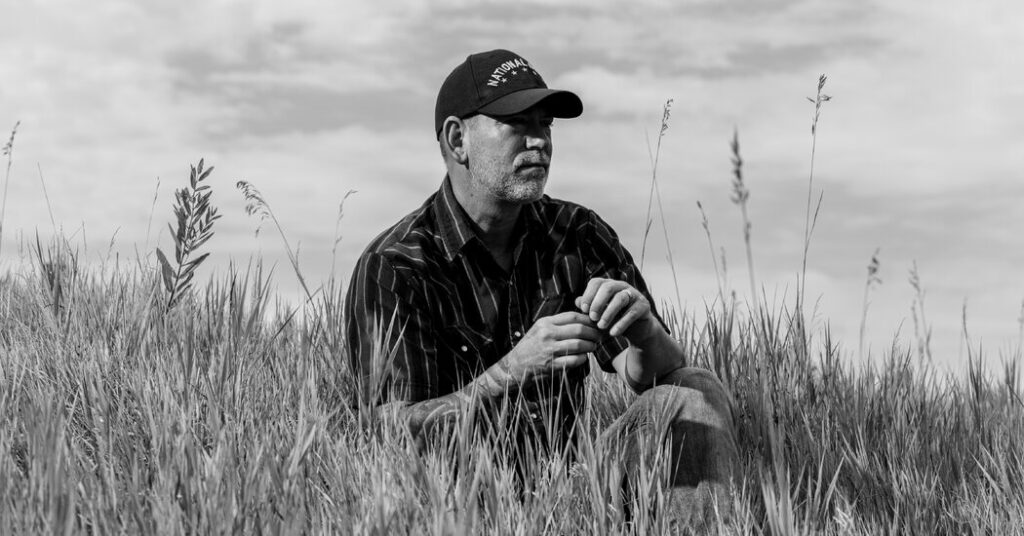
The Senate candidate Dan Osborn wants to be crystal clear that he is not a Democrat. No way. No thank you. Yes, he is running to unseat the Republican Pete Ricketts in Nebraska. And, yes, he has much to say about how President Trump’s policies are hurting Nebraskans. Not to mention how shamefully the Republican-led Congress is failing to stand up to the executive branch. But Mr. Osborn is a “Lifelong Independent” — as his campaign signs clearly proclaim — and when folks ask why, he has a simple explanation.
“I don’t like either party,” he told me over pizza and beer recently, after a morning of campaigning. “I think they both kind of suck.” His goal, as Mr. Osborn tells it, is to infiltrate the Senate and start breaking the unhealthy two-party death grip on the system.
Given this pox-on-both-their-houses posture, it might seem strange that the Nebraska Democratic Party is backing Mr. Osborn’s candidacy, that national Democrats have given him their tacit blessing and that his campaign events tend to be packed with more die-hard Democrats than fence-sitting unaffiliateds. Strange, maybe. But also smart.
Nebraska is a ruby red enclave where registered Republicans outnumber Democrats nearly two to one. Regardless of how the political winds are blowing nationwide, a Democrat winning a Senate seat in the state anytime soon feels about as likely as Tucker Carlson becoming the next mayor of Tel Aviv. But a salty, populist independent with blue-collar street cred, a progressive economic platform and moderate takes on cultural issues? That is a solid maybe.
So it is that Mr. Osborn, a Navy veteran turned industrial mechanic and union organizer, now finds himself at the center of a high-stakes electoral experiment being conducted by the Democratic Party he has openly rejected. It is an intriguing enough prospect that Democrats in other deep red pockets of the country, including Idaho and Montana, have been charting similar courses.
The strategy is not without risk. By boosting an independent like Mr. Osborn, Democrats could indeed be facilitating the demise of the two-party system over which they have long enjoyed co-dominance. Trickier still, by not running its own candidate, the party might give some voters the impression that it has given up on rural America. But those feel like long-term, second-tier concerns compared with the fierce urgency of rural America’s antipathy toward Democrats — an antipathy unlikely to be improved by the ongoing crusade of the party’s left flank to drive out moderates.
The potential reward, by contrast, is immense: reducing the number of Republicans in the closely divided Senate, with an authoritarian president in need of reining in. Sure, Mr. Osborn would presumably oppose pieces of the Democratic agenda. Maybe even big pieces. But in Nebraska — unlike, say, New York — Democrats don’t have the luxury of purity tests and ideological fragility. They need to figure out how to grow their tent. Now. And if the Osborn model works, they’ll need to carry it through across other hostile terrain.
Part of what has Democrats so fired up about Mr. Osborn in particular is that he has already proved himself a compelling pitchman for the anti-establishment, working-class message the party is interested in reclaiming. Two years ago, he ran against Nebraska’s senior senator, the Republican Deb Fischer. Back then, the state’s Democrats were annoyed by his upstart run. The state party chair, Jane Kleeb, accused him of being “inauthentic” and a threat to the Democrats’ agenda. His independent candidacy, always a long shot, was dismissed by many political watchers as beyond quixotic.
Mr. Osborn lost, but not by much, coming within seven points of beating Ms. Fischer. It was a startling overperformance that got Democrats asking themselves: What if we went all in on this guy next time?
Since his last run, Mr. Osborn has worked to up his game. He has traveled the state, talking with health care workers and bartenders, farmers and ranchers. (Nebraska is a huge ag state.) His supporters say he has gotten better on the stump. He is not a smooth or charismatic speaker, but he comes across as solid and earnest. He won’t be “beholden” to corporate interests or “controlled by party bosses,” he promised the barroom full of people at a town hall in Columbus last month. “I would be the most popular politician overnight in this country,” he predicted, with people far-and-wide marveling, “Guys, did you see what Nebraska did?! A shop-floor mechanic beat the son of a billionaire? The times, they are a-changin’!”
Mr. Osborn speaks directly to voters’ widespread disaffection with the political establishment, accusing both parties of putting their own interests, and those of their funders, above the public good. He is a fierce critic of the Supreme Court’s Citizens United campaign finance ruling, he does not take corporate PAC donations, and he is adamant that politicians who do — be it Ms. Fischer or Nancy Pelosi — cannot be trusted.
Off the stump, Mr. Osborn passes the political test of a guy you’d like to have a beer with. He is loose, chatty, goofy and prone to saying stuff that would give the average campaign consultant a heart attack. Our lunch conversation, joined by several of his campaign staff, began with an explanation of his tattoos — two are of his daughters’ names, none are Nazi-adjacent — before touching on such colorful topics as the “I love Intercourse” T-shirt he bought for his wife while visiting Intercourse, Pa. (she won’t wear it); the parade of worker grievances he learned to deal with as a union leader; and how fun it would be to play in the annual Congressional Baseball Game. A pitcher in high school, Mr. Osborn joked that he would probably aim to hit the occasional batter — “I’d throw right into ’em” — to keep the opposition off balance. Notably, he did not say which team he envisioned pitching for.
Mr. Osborn’s supporters also consider the Republican opponent this cycle, Mr. Ricketts, a better foil than Ms. Fischer was in 2024. Ms. Fischer “is a ranch woman who knew how to pull a calf,” noted John Hansen, the president of the Nebraska Farmers Union. (For decades, Ms. Fischer worked on her family’s ranch.) Mr. Ricketts is the son of Joe Ricketts, the billionaire founder of the brokerage firm TD Ameritrade. “Pete Ricketts, there’s a lot of people that look at him and they kind of see a spoiled rich kid,” said Mike Gage, the president of the state’s A.F.L.-C.I.O., which is backing Mr. Osborn. “Replace a billionaire with a mechanic” has become a tag line for the Osborn campaign.
Also important: Mr. Trump will occupy a very different role in this race than in the last one. Among other economic challenges facing Nebraskans, this administration has poorly served the state’s farmers and ranchers, said Mr. Hansen. “We’re in crisis.” In 2024, the Nebraska Farmers Union supported Ms. Fischer over Mr. Osborn. This year, it is backing Mr. Osborn over Mr. Ricketts.
Maybe the most intriguing, and potentially significant, change from 2024 is Mr. Osborn’s improved relations with Nebraska Democrats. “It’s a totally different election cycle and relationship that we have with Dan,” said Ms. Kleeb, the state party chair. “In ’24, we felt like we were just on totally different pages. We didn’t feel like it was a coalition effort.” Back then, she recalled, Mr. Osborn was seen as criticizing Democrats too aggressively and identifying with Mr. Trump’s policy positions on border security too enthusiastically.
The state party has done some soul-searching as well, added Ms. Kleeb. Nebraska Democrats had to “put our egos aside” and acknowledge that backing Mr. Osborn gave Democrats a better shot at seeing their issues and values taken seriously. “We know we will disagree with Dan on various issues,” said Ms. Kleeb. The left wing of the party will most likely take exception to his views on gun control, she offered. Some of his positions on immigration, his concerns about government spending and his personal opposition to abortion (even as he supports codifying the Roe v. Wade position) may also rub progressives the wrong way. “And that’s OK,” said Ms. Kleeb. “We are comfortable being uncomfortable.”
National Democrats are being extremely quiet about Nebraska. But they are on board with the plan, Ms. Kleeb told me. Nebraska Democrats are backing several independents up and down the ballot this year, leaning into the independent boomlet that Mr. Osborn has been credited with inspiring. “We absolutely embrace them,” said Ms. Kleeb.
In fact, she hopes to see “more candidates within our own Democratic Party, as well as more independents, start creating more coalitions. Because I really do think that is the path back to creating more durable policies that look and sound more like America and that can last beyond one election cycle,” she said. “I think that is part of our party’s future, especially in red states, and we shouldn’t be embarrassed about it.”
Democrats elsewhere seem to agree. In Montana, several prominent Democrats, including the former Montana senators Jon Tester and Max Baucus, are promoting the independent Senate candidate Seth Bodnar. Unlike in Nebraska, the state party in Montana has not been on board, and its candidate, Alani Bankhead, dug in rather than bowed out. Ahead of Monday’s deadline to withdraw from the ballot, both candidates faced pressure to get out to avoid splitting the non-Republican vote, but neither budged.
In Idaho, the Democratic Senate candidate, David Roth, dropped out of that race last month, leaving it to the independent, Todd Achilles, to take on the longtime Republican incumbent, Jim Risch. A county Democratic group had warned Mr. Roth that if his campaign didn’t show prompt improvement, they would consider endorsing Mr. Achilles against him. Last Tuesday, the Democratic Senate candidate in South Dakota, Julian Beaudion, did the same for the independent Brian Bengs.
Joe Manchin, the former Democratic senator from West Virginia, wants to scale up this trend. Last month, he announced a new organization aimed at getting more independents elected to Congress. With the House and Senate so closely divided, he told CNN, it wouldn’t take many free agents to bring their more partisan colleagues “to their knees.”
Especially with democratic socialists making waves in the primaries, the Democratic Party seems unlikely to make much progress broadening its brand appeal this year. If Mr. Osborn succeeds, or even comes closer than last time, the blue team should ramp up its coalition building with red-state independents who are, if not in their camp, at least adjacent. It could make for a more dynamic, maybe even less polarized, Congress.
The Times is committed to publishing a diversity of letters to the editor. We’d like to hear what you think about this or any of our articles. Here are some tips. And here’s our email: [email protected].
Follow the New York Times Opinion section on Facebook, Instagram, TikTok, Bluesky, WhatsApp and Threads.