

Featured
By Goddy Ikeh
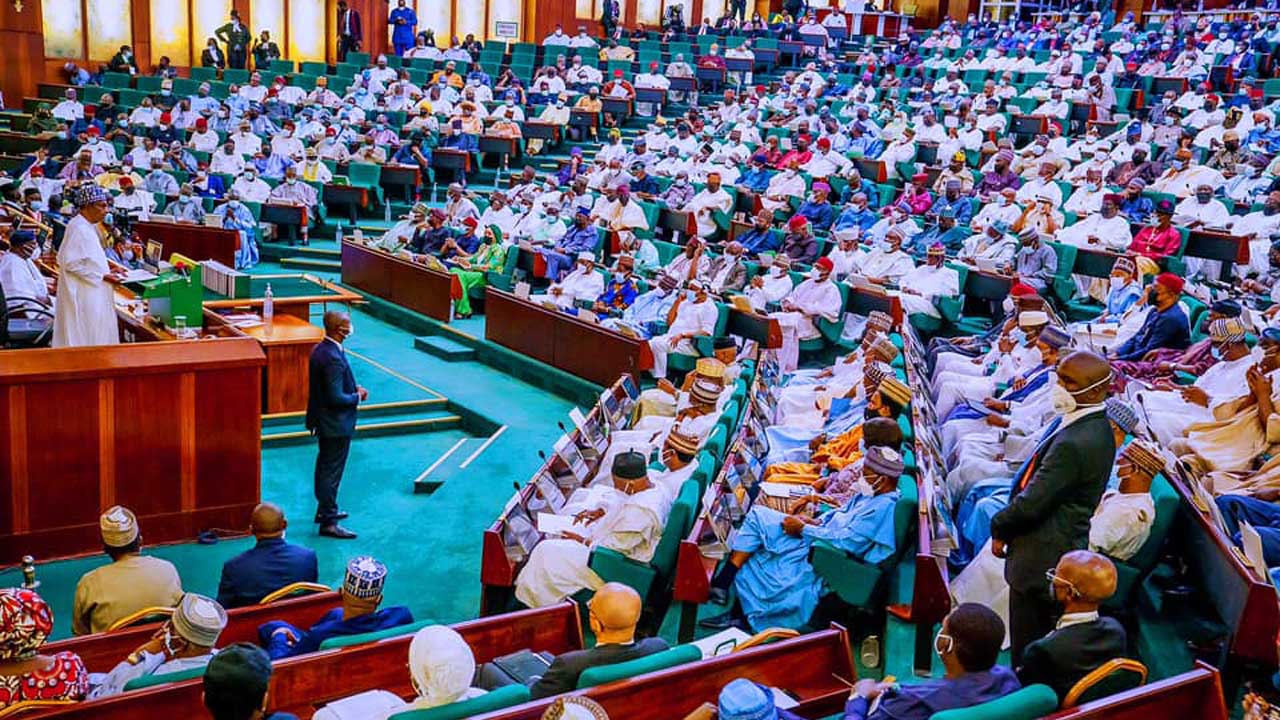
IRKED by recent controversies involving fake agencies of government, budget padding and the outcome of the Catholic Bishops visit to President Bola Tinubu that are threatening public confidence in government accountability, some lawmakers have stated categorically that while they are not opposed to State Police, economic reforms or necessary public expenditure, they are, however, opposed to unconstitutional procedures, legislative shortcuts, unimplemented budgets, opaque expenditure and the continuing failure to protect the Nigerian people.
The concerned lawmakers stated in a recent statement that they are demanding an Emergency National Assembly Session over alleged ₦8.83tn off-budget spending, budget failures and worsening insecurity.
that the emergency session must address the issue of under-implementation of the 2024, 2025 and 2026 Appropriation Acts; the constitutional controversy surrounding the State Police Constitutional Alteration Bill; allegations of off-budget expenditure.
This group of bi-partisan lawmakers in the House of Representatives under the aegis of Save Nigeria Group is demanding that the National Assembly should address as a matter of urgency the non-release of capital funds to security agencies, the deteriorating security situation, and measures required to restore public confidence in the rule of law and democratic governance.
The lawmakers lamented that Nigeria’s democracy is nose-diving and that silence in the face of repeated constitutional violations and institutional failures could no longer be justified.
They pointed out that the country is confronting an alarming disregard for the rule of law, chronic budget under-implementation, allegations of off-budget expenditure, worsening economic hardship and an unacceptable security situation.
The concerned lawmakers emphasised that democracy cannot survive where constitutional procedures are treated as inconveniences and legal safeguards are replaced by political improvisation.
They expressed concern over the emerging pattern in which constitutionally prescribed procedures are treated as optional.
Beyond the intervention of the lawmakers, Nigeria has for decades been battling with corruption which has remained one of Nigeria’s greatest development challenges, surviving successive administrations, institutional reforms and anti-graft campaigns.
Despite the establishment of agencies such as the Economic and Financial Crimes Commission, EFCC, and the Independent Corrupt Practices and Other Related Offences Commission, ICPC, many analysts argue that corruption has merely evolved into more sophisticated forms.
Today, alongside rising insecurity, unemployment, poverty and inflation, Nigerians are increasingly expressing concern over what many describe as a growing crisis of budget credibility and political corruption.
The concern has intensified following recent revelations that billions of naira were appropriated in the 2026 Federal Budget for questionable or non-existent entities, alongside controversial allocations for projects such as royal palace construction.
The controversy has reignited debate about transparency, accountability and fiscal discipline in Nigeria’s public finance management.
Although constituency projects inserted annually into federal and state budgets have long generated public skepticism, the latest revelations have amplified concerns over how public funds are appropriated and monitored.
Public attention was drawn to reports that budgetary allocations running into billions of naira were made for entities such as the Peace Corps/PFIPC, despite questions surrounding their legal status and operational existence.
The development prompted investigations by the National Assembly, while the Federal Government also initiated legal processes to determine how the controversial allocations found their way into the Appropriation Act.
Beyond the immediate controversy, analysts identify deeper structural weaknesses in Nigeria’s budgeting process.
One recurring concern is poor budget implementation. Although the Federal Government proposed a record ₦58.47 trillion budget for 2026, observers argue that releases for critical infrastructure, healthcare, education and other social services have consistently fallen below approved appropriations.
Some analysts also question why aspects of the 2024 and 2025 budgets are reportedly still being implemented in 2026, arguing that prolonged implementation weakens fiscal discipline, distorts planning cycles and undermines legislative oversight.
Another issue frequently raised is the persistence of budget padding, duplicated projects and opaque line items.
According to governance experts, weak institutional controls and inadequate scrutiny during budget preparation create opportunities for inflated allocations, duplicated projects and expenditures that may not deliver value to citizens.
Civil society organisations have also joined the debate. Accountability groups such as BudgIT and Tracka criticised what they described as the prioritisation of questionable or elite-driven projects over essential public services, including education, healthcare and basic infrastructure.
Some opposition politicians similarly argued that recurring budget controversies have continued to erode public confidence in government finances.
The Budget Office of the Federation, however, maintains that no public funds were released to the controversial PEAC/PFIPC allocation.
In a statement signed by its Assistant Director and Head of Information and Public Relations, Afolabi Falulu Olajuwon, the office explained that appropriation by the National Assembly does not automatically authorise expenditure.
According to the Budget Office, every expenditure must satisfy statutory requirements, including financial clearance, lawful recruitment where necessary, payroll enrolment, treasury warranting, cash backing and procurement approvals.
The office insisted that none of these conditions was fulfilled in respect of the PEAC/PFIPC allocation.
“There was therefore no Financial Clearance. There was no lawful recruitment. There was no payroll enrolment. There was no salary payment,” the office stated.
It added that regulatory requirements, including confirmation by the National Salaries, Incomes and Wages Commission regarding staffing and remuneration structures, were not completed.
While investigations into the controversial allocation continue, fresh questions have emerged over provisions reportedly earmarked for palace construction in some states.
Critics argue that such projects raise important questions about expenditure priorities at a time millions of Nigerians face economic hardship and infrastructure deficits.
The consequences, analysts say, are significant.
Beyond the budget controversy, governance experts warn that Nigeria may be witnessing a more sophisticated pattern of political corruption.
According to some analysts, corruption is increasingly embedded within political structures, making accountability more difficult to achieve.
They argue that political defections have, in some cases, created perceptions that individuals facing investigations or prosecution receive political protection after joining the ruling party, although each case depends on legal and judicial processes.
Others contend that corruption has increasingly shifted from conventional embezzlement towards more complex financial practices involving foreign exchange manipulation, abuse of tax incentives, payroll fraud and other systemic financial leakages.
Resources that could finance roads, hospitals, schools, electricity and other public services are lost, while citizens’ confidence in public institutions continues to decline.
Nigeria also continues to perform poorly in several international governance and corruption assessments. The country consistently ranks among nations facing significant corruption challenges in global governance indices, including Transparency International’s Corruption Perceptions Index, the World Bank’s governance indicators and the Ibrahim Index of African Governance.
These assessments generally indicate weaknesses in transparency, public sector accountability and the control of corruption when compared with many peer countries.
For many governance experts, the persistence of corruption despite more than two decades of democratic rule underscores the need for stronger institutions rather than stronger personalities.
They argue that effective budget scrutiny, transparent procurement systems, digital monitoring of public expenditure, independent oversight institutions and swift prosecution of offenders remain essential to restoring public confidence.
Many also believe that political accountability must extend beyond electoral cycles if Nigeria is to reverse the entrenched culture of impunity.
As investigations into the latest budget controversies continue, many Nigerians are watching closely to see whether the outcome will strengthen public confidence in government accountability or reinforce longstanding concerns that corruption remains deeply entrenched in the nation’s political and fiscal systems.
For many observers, the real test is no longer whether scandals will emerge, but whether institutions can respond decisively enough to deter future abuses and restore integrity to public governance.
M.P
Tags: Bipartisan Lawmakers Budgets Corruption