

By Valentine Obienyem
Four days ago, the manager of St. John Vianney Science College, Ukwulu, Mr. Gerald Ogbulikpe, called to ask me to chair the graduation ceremony of the outgoing class today, August 8, 2026. I accepted only yesterday, after confirming that nothing had come up on my schedule. So, rather unexpectedly, I found myself today among students, parents, teachers and formators.
I thought I would simply chair the ceremony and offer the customary opening remarks. Instead, I ended up delivering the keynote address.
As I looked at the graduating students, I recalled my own secondary-school graduation in 1989. I reflected on how easily young people can lose their way when youthful confidence is not tempered by experience and rational guidance. I therefore urged them to listen to those who have walked the road before them.
I also reflected on the meaning of graduation. In our time, formal graduation ceremonies were largely associated with universities and other tertiary institutions. One listened to a graduation or commencement address after completing university.
“Commencement,” I noted, would certainly be appropriate today, because these young people are commencing a new phase of life. But I eventually settled on another description: a transition address.
They are transitioning from secondary to tertiary education, from adolescence towards adulthood, and from a closely supervised environment into a world where they will increasingly have to make decisions for themselves.
And so, my message to them centred on four duties: the duty to themselves, to society, to their formators and to God.
The Duty to Oneself
The first is the duty to oneself – to become the person one has been formed to become.
I expressed my confidence that they had received good formation at St. John Vianney Science College. But formation has not truly succeeded if it remains merely an external set of rules obeyed because someone is watching. Its real test comes when the person is free to choose.
To make the point, I referred to something I had noticed that morning. One of the graduating students was wearing earrings. My concern was not the earrings themselves, but the timing. If a student spends years in an institution with certain standards of appearance and discipline and then abandons them immediately after examinations, one may reasonably ask whether the values were ever internalised.
I told the student, in effect: if what you were taught was merely a rule you obeyed because your formators were watching, the rule disappears when the formators disappear. But if the value has taken root within you, you carry it with you even when nobody is watching. The manager, sitting nearby, looked around in disbelief.
The student must therefore ask himself: Who am I becoming? What kind of man do I want to be? What values will guide me when I am no longer supervised?
Freedom, I told them, is not the licence to do everything one discovers one can do. It is the strength to choose what is good even when one is free to choose otherwise.I recalled here the words of one of my former teachers, Fr. Collins Uche Okeke:“Freedom is self-control and the ability to free the soul from the pangs of irrational desires.”That, I told them, is the kind of freedom worth carrying into adulthood.
The Duty to Society
The second is the duty to society.
Education is never merely a private investment. Behind every educated person are parents who sacrificed, teachers who taught, institutions that provided opportunities and a society that made education possible.
As these young people proceed to the university, I urged them to remain focused. The excitement of a new environment must not draw them into secret societies, destructive associations or distractions capable of destroying their future.
Nigeria does not merely need more undergraduates. It needs responsible citizens – young people who will refuse to cheat because others cheat, who will resist stealing public resources because others have done so, and who will not mistake corruption for cleverness or integrity for foolishness.
The education they have received should therefore make them not only successful individuals but useful citizens.
The Duty to Their Formators
The third is the duty to those who formed them. I am always particular about this because good teachers are treasured by society.
Behind every secondary-school graduate are parents, teachers, formators, friends and institutions. Some of the rules and corrections they received may have seemed difficult or even unnecessary at the time. But maturity often teaches us to appreciate the discipline we once resisted.
I told them that the best way to honour their formators is not merely to remember their names or thank them in speeches. It is to become the kind of men and women their formators hoped they would become.
The best tribute to a good teacher is a life that proves the teacher’s work was not wasted.
But that is not all. In future, I told them, they should form the habit of visiting their teachers and thanking them for jobs well done. There are teachers whose influence remains long after the classroom has been left behind. They should never become too successful to remember those who helped them begin.
The Duty to God
Above all is the duty to God.
Whatever professions they eventually choose and whatever heights they attain, they must not lose their moral and spiritual bearings. Knowledge gives power, but character determines how that power is used. Education may teach a person what is possible; conscience must help him discern what is right.
We call God the “summum bonum” – the highest good, the ultimate end towards which all other goods should ultimately be ordered. Let Him always be allowed into our lives. No achievement, however great, should become a substitute for Him.
I told the students that they were about to enter an environment very different from the one they had known. I have known some pious Christians who entered the university with a strong faith, only to have that faith shattered almost overnight, as though by a sudden catalytic shock.
The university can expose a young person to ideas, lifestyles and influences that challenge everything previously taken for granted. That is not necessarily a bad thing; faith that is examined can become deeper and more mature. But a student who enters that environment without roots can easily mistake every challenge to his beliefs for a reason to abandon them.
They must therefore continually recognise their roots.They should remember where they came from, what they were taught, the people who formed them and, above all, the God in whom they were taught to believe. Going to university should enlarge their minds, not empty their souls.
Kant gives the moral question a formulation worth remembering:“Act only according to that maxim whereby you can at the same time will that it should become a universal law.” In the university and beyond, they will encounter situations in which they may be tempted to ask, “Can I get away with this?” Kant invites us to ask a higher question: “Would I want everyone to act this way?” That is the difference between mere cleverness and moral responsibility. The important question in life is therefore not only, “What can I do?” but also, “What ought I to do?”
They must never allow the pursuit of knowledge, success or freedom to sever them from conscience and from God. For education should not merely teach us how to navigate the world; it should help us understand how we ought to live in it.
May they go into the world with open minds, but also with rooted hearts. May they encounter new ideas without losing their moral compass, and may every new horizon deepen rather than diminish their search for truth.
Above all, may they never forget the “summum bonum.”
To Conquer the World
While the manager was reading his address, he summarised the vision of St. John Vianney Science College in a phrase that caught my attention: “to build an institution that will produce great men and women who will conquer the world.”
I alluded to this vision in my address and reminded the students of the infinite possibilities that education opens before them.
They should not go to university merely to acquire certificates. They should go to discover, to question, to read, to think and to enlarge their understanding of the world. It was in this context that I recalled Democritus, who said: “I would rather discover a single demonstration in geometry than win the throne of Persia.”
I asked them to reflect on that extraordinary statement. The throne of Persia represented power, wealth, prestige and influence. Yet Democritus considered the discovery of truth more valuable.That is the power of knowledge. A throne can be lost. Wealth can disappear. Political power changes hands. But a genuine discovery can become part of humanity’s permanent intellectual inheritance.
If St. John Vianney Science College wants to produce young men and women who will “conquer the world”, then that conquest should not be understood merely as the acquisition of wealth, fame or power. The first world they must conquer is the world within – the world of ignorance, fear, indiscipline, intellectual laziness and moral weakness.
Here, Kant’s distinction between the world of nature outside us and the moral law within us is instructive. He famously wrote of: “the starry heavens above me and the moral law within me.”The grandeur of the world outside us may inspire awe, but it is the moral law within that gives direction to our freedom.
The young person who cannot govern himself cannot truly conquer the world. To conquer the world within is to bring one’s desires, intellect and will under the discipline of truth and moral law. It is to acquire the freedom not merely to do what one wants, but to do what one ought.
The real conquest, therefore, begins within. Only a person who has learnt to govern himself can hope to exercise a worthy influence over the world outside him.
The Students and Their Talents
The students themselves added colour to the occasion.
The presentations were impressive: a science presentation, drama, ballet, spoken-word poetry, musical renditions and cultural dances. Each revealed a different dimension of their formation.
Watching them, I was reminded that education is larger than the classroom. A good school must cultivate the intellect, certainly, but also character, creativity, discipline and a sense of cultural identity.
Their performances showed that they had acquired more than what could be measured in examination scripts.
Awards That Speak of Character
The presentation of awards was another important part of the ceremony.
Among the awards were Parents of the Year, alongside awards recognising outstanding students in academics and character. I found this particularly significant.
The combination makes a statement about the philosophy of the school: St. John Vianney Science College is interested not only in producing academically brilliant students, but in forming morally sound human beings.
Academic excellence without character can become dangerous; character without intellectual development can limit one’s capacity to contribute. The real goal should be the formation of the whole person.
I reminded the students that the greatest award they will ever receive may not be a trophy presented on a stage. It is the reputation they build when nobody is watching.
Saints as Models
Finally, I encouraged them to look beyond contemporary celebrities and public figures for models of what a life of purpose can become. I urged them to read the lives of the saints.
I mentioned St. John Vianney, whose name the school bears, as a model of dedication and holiness. I also mentioned St. Aloysius Gonzaga, whose youthful life demonstrates that age need not be an obstacle to holiness and disciplined living.
I referred as well to St. Thomas Aquinas, whose intellectual achievement reminds us that faith and reason need not be enemies and that the pursuit of knowledge can itself become a service to God and humanity.
I urged the students to read these lives, not merely to admire the saints from a distance, but to discover in them examples of discipline, courage, intellectual pursuit, sacrifice and fidelity.
The Graduation Cake as a Metaphor
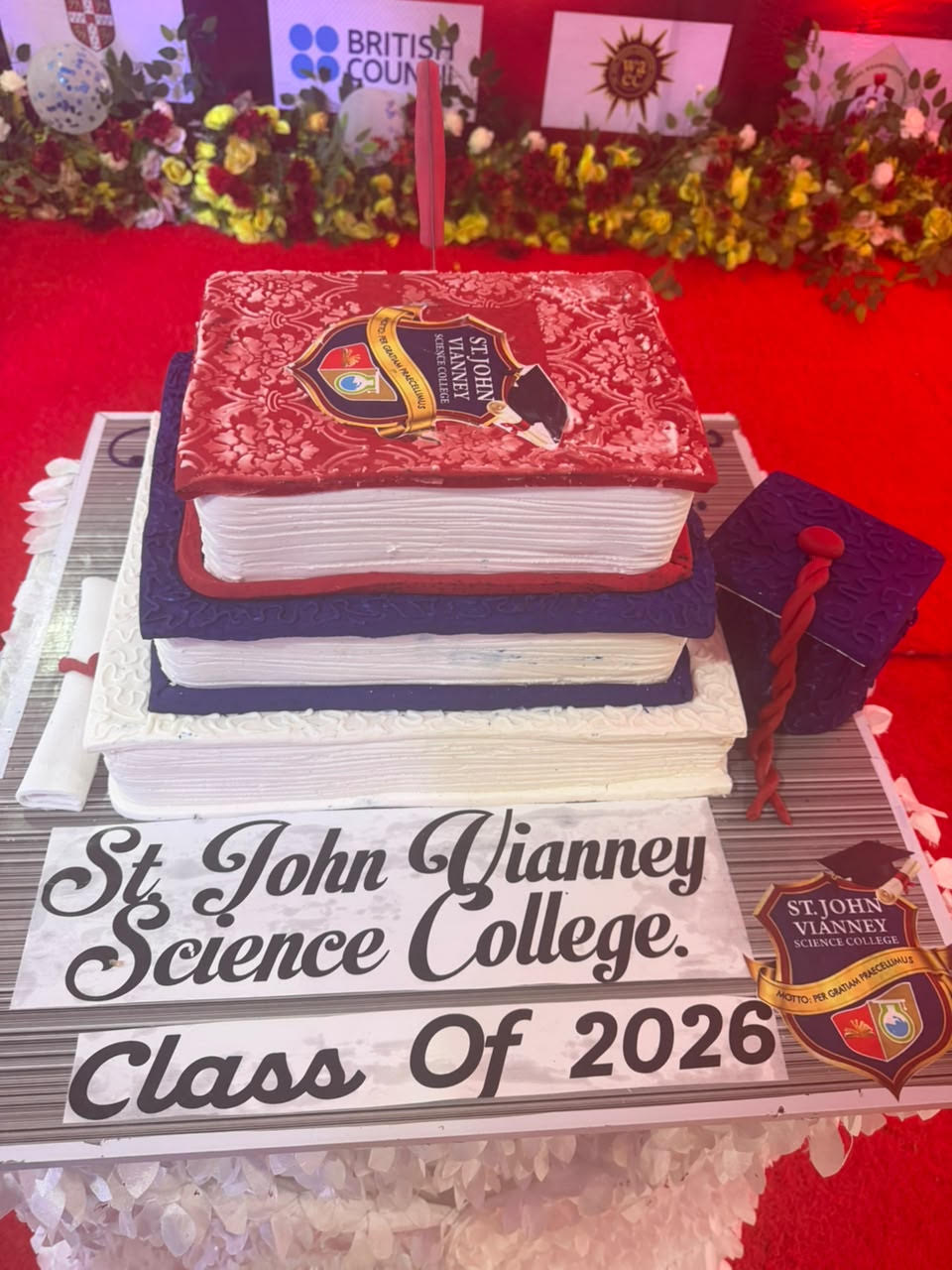
The graduating cake (attached) itself was laden with symbolism. Viewed as a metaphor for their academic journey, the three stacked textbooks represent the foundation of knowledge, discipline, sacrifice and the many late nights upon which their education was built, layer by layer.
The diploma scroll and mortarboard symbolise the culmination of that long journey – the reward for their hard work and the formal transition into a new chapter of life.
At the centre, the school crest, bearing the motto “PER GRATIAM PRAECELLIMUS” – “By grace we excel” – and the inscription “Class of 2026” provide a reminder that their achievement is not merely a product of individual effort. It also testify to grace, shared values, resilience, friendship and the sense of community that bound them together throughout their years in the school.
In that sense, the cake was more than something prepared for the celebration. It was, in its own delightful way, a visual summary of their journey: knowledge acquired, challenges overcome, dreams pursued and a new chapter about to begin.
Fr. Ebube Muonso and the Vision of the School
Before the event came to an end, Fr. Ebube Muonso himself arrived. His presence was significant. It was a reminder of how deeply the school means to him and how invested he remains in its growth and future.
He exhorted the parents never to relent in giving their children the best, reminding them that children are the greatest investment any parent can make. He spoke of life as a journey and, with his characteristic wit and engaging anecdotes, illustrated some of the mysteries, twists and lessons that life often presents.
He spoke passionately about excellence and shared his vision of making the school even better than it is today. That he came to the event after a hectic day said something about how dear the school remains to him.
He also had a word for the graduating students. He explained to them that teachers, despite their human imperfections and occasional mistakes, always mean well for their students. They should therefore learn to appreciate the sacrifices and guidance of those who have contributed to their formation.
Then came one of his most memorable images. He described the graduating students as eagles whose wings have now grown. Having grown their wings, they should not be kept in the nest or have their flight hindered. They must leave, soar, explore the world and discover what they are capable of becoming.
He also expressed his readiness to assist them in securing admission into higher institutions, with only one request: they must pass very well.
He commended the Chemistry and Physics teachers with ₦1 million each for ensuring that the entire graduating class made A1 in Physics and Chrmistry. He also commended the best graduating student, Mrs Jennifer Chibuze, with ₦1 million, describing the student as exceptional.
He thanked Mr. Ejike Anyaduba for what he does for the school and for the Church, and again requested everyone to remain close to God.
Listening to him, I was reminded that institutions are sustained not merely by buildings and classrooms but by the vision of those who create them and the commitment to keep that vision alive.
Fr. Ebube Muonso’s appearance and words brought the event to a fitting conclusion: the children had completed one stage of their journey, but their wings had only just begun to unfold.
A Transition, Not an Ending
As I spoke, I could not help remembering my own graduation in 1989.
I was young then, as they are young now. Looking back, I realise how much of life I had yet to encounter – opportunities I could not imagine, mistakes I could not foresee, friendships I could not anticipate and lessons no classroom could teach.
That is why I told them to be deliberate about their choices.
Not every opportunity is worth taking.
Not every friendship deserves keeping.
Not every pleasure is worth pursuing.
Not every popular opinion is true.
And not every failure is the end of the world.
Today, therefore, is not simply an ending. It is a beginning. It is a transition.
My hope is that these young people will leave St. John Vianney Science College carrying more than certificates. May they carry the values they have been taught, the gratitude they owe their formators, the responsibility they owe society, the hunger for knowledge that will take them beyond the classroom, and the faith that will give direction to their lives.
And may they indeed conquer the world – not by dominating it, but by learning, serving, creating and leaving it better than they found it.
In Closing
In closing my keynote address, I thanked the founder of the school, Rev. Fr. Obinwa, popularly known as Fr. Ebube Muonso, for the vision and commitment that gave birth to the institution. He was represented at the ceremony by Rev. Fr. Henry Nnajiofor before he eventually arrived. Fr. happened to be my senior in the seminary.
Meeting Fr. Henry brought back memories of our seminary days. As former schoolmates naturally do, we talked about old times, recalled people and events, and laughed over memories that only those who shared them could fully appreciate.
That moment also reminded me of something I wanted the graduating students to understand: the bonds formed in secondary school can become some of the most enduring relationships in life.
They are leaving the school today, but they are not leaving one another. The friendships, experiences and shared struggles of these formative years can become a source of strength long after they have forgotten many of the lessons they learnt in the classroom.
I therefore urged them to preserve their bonds. They should look out for one another, celebrate one another’s successes and stand by one another in difficult moments. In later years, they may discover that the friendships formed in these years are among the greatest gifts their school has given them.
A school does more than prepare young people for examinations. It creates communities, friendships and memories that can endure for decades.
As they leave St. John Vianney Science College and begin their different journeys, I reminded them that they may travel to different universities, pursue different professions and eventually live in different parts of the world. Yet the bond they share as members of this graduating class should remain. They have been classmates; they can become lifelong companions.
And perhaps, in the years ahead, they will discover that one of the most enduring forms of education is not what they learnt from their books, but what they learnt from one another.
I have decided to attach the picture of the best graduating student with Fr. Ebube Muonso as a small tribute to hard work, discipline and excellence. Behind every outstanding result is a story of effort, sacrifice, perseverance and, often, the quiet support of parents, teachers and formators.
The photograph therefore represents more than one student’s achievement. It is a reminder to the entire graduating class that excellence is possible when talent is matched by discipline and opportunity is met with hard work.
The journey ahead is long. Like an eagle whose wings have grown., let them fly.