

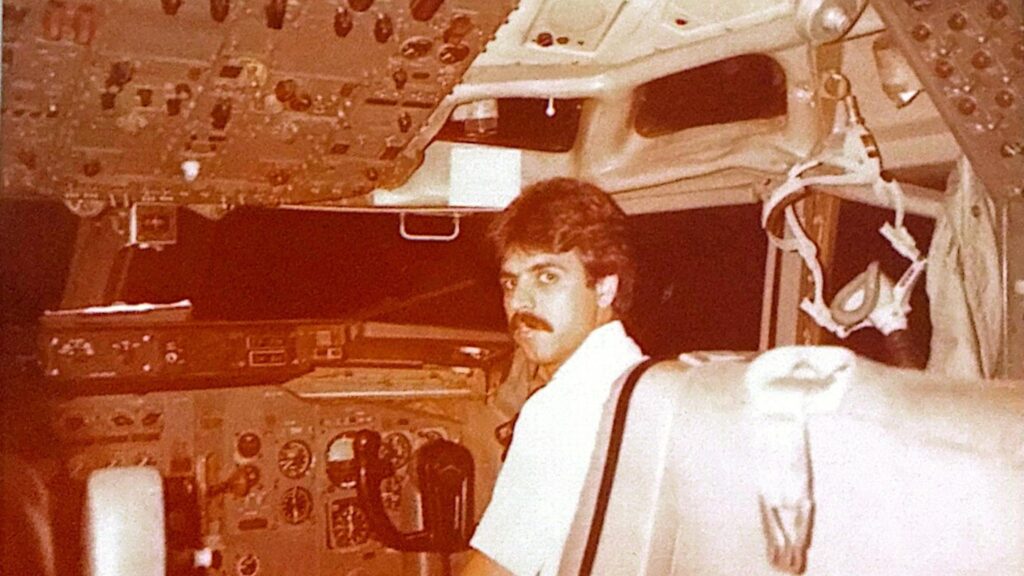
On a June evening, I was at the Heathrow Airport in London boarding a flight for Bogotá. I was travelling to be at a wedding I had come close to not attending. At the boarding gate next to mine, passengers lined up for an EVA Air flight to Taipei. I watched strangers queue for a plane like the ones my father, Captain Hamid Reza Alimardani, used to captain. He had flown that route for years. I had flown it once when he was captaining it, and I still remembered the small jolt of pride in seeing him walk up to the gate in uniform. My father, the captain.
We lost him six years ago. When the EVA Air crew came through to board, I caught myself scanning their faces, searching for him. I was flying into his absence. The airport, the office of his entire working life, reminded me that there was no leaving this grief behind, only different directions within the same departure.
I had spent the morning crying. Not over the Taipei gate. Not yet. I broke down at a boarding gate in Oslo after reading of the death of Marjane Satrapi, the graphic novelist and filmmaker, who wrote, drew, and filmed Persepolis, her extraordinary memoir of a girlhood in Iran before and after the 1979 revolution. She was 56. Her husband had died a little over a year earlier. Her family described the cause of her death as: “she died of sadness.”
I read the words “died of sadness” and something in me came undone. I cried the way you cannot stop. I cried the way you frighten the people around you. I cried until I thought I would not be able to board the first of my three flights to the wedding in Colombia. I cried because I knew the wedding would remind me of my grief, my loss, and everything else Satrapi had taught me to name as a girl, when I first discovered her graphic novel.
I did not know Marjane Satrapi. But I had come of age inside her work, the way many of us did, the Iranian girls and boys whose childhoods, lives, and families were defined by a revolution and the politics of a country we would spend most of our lives away from. She took the private grief of one Iranian life and transformed it into something the whole world could hold. In a frame in Persepolis, the protagonist Marji describes goodbyes as “a little like dying.” I must have read it as a teenager and thought it was a clever, sad line. I did not know then how literal this metaphor would become.
The pilot who flew through fire
My father didn’t come from money. He was the first in his family in Tehran to get a college education. He dreamed of medical school in his early 20s. When Iran Air offered him a fully funded path to train as a pilot in the United States, he accepted. Iran Air was among the finest airlines in the world in the 1970s, when my father trained with it. Then came the revolution in the winter of 1979, and Ayatollah Ruhollah Khomeini transformed Iran into a theocratic Islamic Republic. Nine months after the revolution, the war between Iran and Iraq erupted in September 1980, lasting eight years and costing more than a million lives.
My father stayed in the cockpit, flying passenger and cargo routes through a country at war because he was needed and because there was nothing else to do for a man who could only fly. The airports he flew in and out of were targets. Iraqi bombers had hit Tehran’s Mehrabad Airport on the first day of the war; the skies over Iran were no safer, and civilian planes risked being mistaken for military targets and fired upon. My father barely spoke of those dangers and difficulties, the way men of his generation often did. He hid it well.
He did tell me stories that made me understand life in Iran after the revolution and during the war. In 1983, my mother was heavily pregnant with my older sister. My parents had stepped out for an errand. A group of pasdars—the Persian word for members of the Islamic Revolutionary Guards Corps—stopped them in the street. The pasdars often stopped and questioned young couples on the suspicion of their being together outside of marriage. My parents had been stopped and questioned before. My mother was visibly pregnant, and still a pasdar pressed the barrel of his gun to her belly. My father, who had been flying under fire without complaint, lost it. “How dare you? She is my wife,” he shouted. “She is carrying my child.”
My mother spoke of the fear she felt more than he ever did. She would tell me how she sheltered with my older sister when the air raid sirens went off, and how she listened for the jets overhead. In those moments, what frightened her most was not her own safety but the knowledge that her husband was up there somewhere, flying in the same sky swarming with fighter planes dropping their bombs on Tehran.
My father did make sure I grew up knowing these things: the stops in the street, the nights sheltering from bombs, and the family and friends swept up in the massacres of political prisoners in the late 1980s. He hated flying for an Iran Air that now belonged to the people who had terrorized and murdered so many Iranians he had loved. Yet he kept flying, because he had no other trade, and because for years he was doing the slow work of getting us out, to either Canada or the United States.
On July 3, 1988, Captain Mohsen Rezaian, a colleague of my father’s, was at the controls of Iran Air Flight 655, traveling from Bandar Abbas, Iran, to Dubai, when the American warship, the USS Vincennes, reportedly mistaking the aircraft for a threat, fired a missile that struck the plane. Two hundred and ninety people fell into the Gulf, including him. Captain Rezaian had trained in Florida before the revolution, as my father had, and shared his sense of disillusionment that Iran could no longer offer a safe or prosperous future for their families. He was already emigrating to America; my father was waiting to move his family to Canada. My father continued flying Iran Air for close to a year after Flight 655. There was no alternative for a man whose life was defined by flight.
When a path to Canadian citizenship opened up for us in 1989, my father moved our family to Toronto, right before I was born. And then, because he could not find work as a pilot in Canada, he went to find it wherever it would have him. Belgium. Taiwan. The far gates. He spent the back half of his life leaving, again and again, to support our new lives outside of Iran, sending money from cities we could not picture, a father assembled mostly out of absences and homecomings. Six years ago, only a year into his retirement, cancer took him during what he thought was his break from leaving.
Ways of our fathers
I had been leaving and arriving in airports ever since without quite noticing, changing three flights on a recent Thursday between a work trip and the wedding in Colombia, when I came to realize—as I watched strangers boarding a flight to Taipei that my father used to pilot—that I had inherited his ways.
I was waiting for the flight to Bogotá, the flight I had almost not wanted to take. I had been reluctant to attend the wedding. The groom was a boy I had known since we were children. His father was my father’s close friend, and their friendship had remained a source of solace for us across the geographies that their work had scattered us across. The wedding was in Colombia, half a world from anywhere I knew or came from.
An Iranian friend of mine, who had been to Colombia, insisted that I had to see a museum of memory, built to hold the memory of the dead claimed by violence and conflicts. She had come out of it hoping that Iran could have something like it one day. Her wish sat with me, and so the first thing I did on landing in the country was visit that museum of memory. Colombia could build a house for its dead because its violence and conflict had reached the point where the country could bear to openly mourn them. Iran cannot, because the people who made so many thousands of our dead are still the people in charge, still adding to the count.
Our grief has nowhere to be housed. It has had to live elsewhere: in books like Satrapi’s, in the videos people film at the risk of their lives, in the work some of us have made our profession. Satrapi did it with a pen, taking one Iranian childhood and making it something the rest of us could grieve inside.
My work is about technology and human rights, shaping the tools for the people most at risk, including the ones documenting abuses so the record survives. It had never struck me that this was a kind of memory-keeping, that I had been doing it for years without a name.
Within two days of my friend telling me about the museum in Colombia, I found an answer to that wish at the very wedding I had wanted to avoid. The groom’s father, a pilot like my father, stood to speak, and amid all that joy, he spoke the names of the dead aloud. Captain Hamid Reza Alimardani. My father. Captain Davoud Zeinali. Another one of their friends, also gone, recruited a lifetime ago by Iran Air into a brotherhood that lasted the rest of their lives.
The groom’s father would not let the celebration paper over the absence, and he did so in the one place where you are meant to be only happy. I was sitting with the daughters of Captain Zeinali, that other lost friend. Our mothers were close by. When he spoke the names of our beloved departed, we teared up, all of us at once, the daughters and the mothers together. Then he crossed the floor and cried with the women whose husbands he had outlived.
I understood then what I had been looking for in the museum. The men flew together and some of them did not come home. The women remained and kept the memory. And here it was in one room: the brotherhood holding on past death, the grief being handed down to the daughters who would carry it next. The museum that Iran cannot build was being built around me—assembled from people, carried in exile—because it cannot exist at home. It is real, it is portable, and the reason it must be portable is the same reason there is so much to remember.
I had dreaded the wedding for the grief I knew it would stir. Yet I told myself that if I flew all that way, stood in the room with his friends and let it break, something would resolve. Then the wedding ended. Everyone scattered to their own flights. I was left with the thing nobody warns you about: the emptiness afterwards, the flatness, the discovery that no event could bring him back. It had only gathered his absence in one place for a weekend and then released it again. I flew home carrying the same absence, but only heavier, somewhere out over the Atlantic without him, and understood that no occasion ever closes the gap. It only moves you to the next gate.
We are a people who are always leaving. My father left for a living. My family left in search of a better life. Satrapi left as a girl and left the world on Jun. 4. Iran Air Flight 655 took off in July 1988 and never landed. Death is only the last departure. There is one defense against a life made of departures, and it is to say out loud what you are losing, so that it cannot leave you completely.
Satrapi said it in ink. The groom’s father said it in a speech. I am saying it here. Naming is the only departure that runs the other way: it brings them back instead of carrying them off. I was sixteen when I read in Satrapi’s Persepolis that a goodbye was a little like dying, and thought that was the whole of it. It is only half. The other half is that saying a name aloud is a kind of arrival.
I do not have a country to keep my father in. I have my words. A gate, a ghost route, a speech, a row of weeping daughters. Grief spoken into the open is the closest thing to a homeland that exile leaves you. So I am speaking it. My father was a pilot. He left Iran carrying the hope of one day being buried there. He flew the Taipei route and never made it back. He is gone, and this is the closest I can bring him home.