

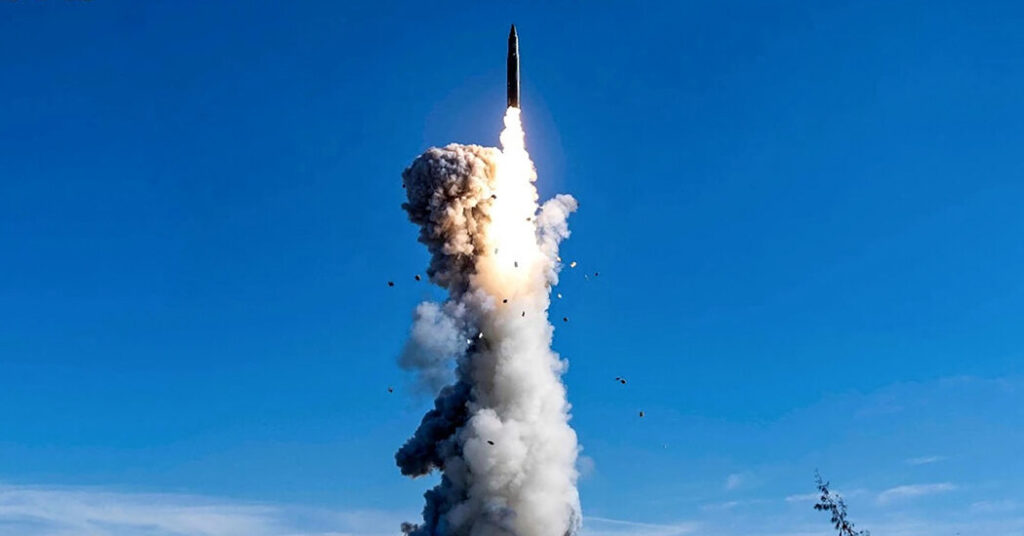
China test-fired a long-range ballistic missile with a dummy warhead in the Pacific Ocean on Monday, the first such launch in almost two years, prompting alarmed countries to criticize the move as destabilizing.
Governments in the region were warned of the launch shortly beforehand. The overt display of China’s fast-expanding military capabilities threatens to further fan a defense buildup around the Pacific in the midst of anxieties about the strength of the U.S. commitment to the region.
The missile was launched from a Chinese nuclear-powered submarine and sent a “mock warhead” into the Pacific Ocean, according to a report from Xinhua, China’s official news agency.
“The missile landed accurately in the designated area,” the report said. The test launch at 12:01 p.m. Beijing time, Xinhua said, was “not directed against any specific country or target.”
It was not immediately clear where the missile was fired from or landed. The launch came as the leaders of Australia and Fiji announced a mutual defense treaty and a regional security alliance, the latest in a string of agreements Canberra has been striking with Pacific Island nations that are widely viewed as efforts to push back against China’s encroachment.
In September 2024, China fired a nuclear-capable intercontinental ballistic missile carrying a dummy warhead across the Pacific Ocean into waters near French Polynesia, drawing condemnation from countries in the region. It marked China’s first-known ICBM test in the Pacific region in four decades.
Winston Peters, New Zealand’s foreign minister, said in a statement the country was “deeply concerned” and that the test seemed to be part of “a recurring pattern by China.”
“New Zealand considers this an unwelcome and concerning development. We, like our neighbors in other Pacific countries, have no interest in China using the South Pacific as a testing site for missile capability,” he said.
Australia’s foreign minister, Penny Wong, called the test “destabilizing to the region” and said that it was “in the context of a rapid military buildup by China.”
The Japanese government said in a statement on Monday that it had “conveyed its serious concern regarding the intensification of China’s military activities.” Japan had urged China to reconsider the launch after receiving the warning, the statement said.
Last year, a Chinese naval task force also carried out live fire drills in the Tasman Sea between Australia and New Zealand, prompting dozens of civilian flights to change course to avoid the area.
John Blaxland, professor of international security at the Australian National University and a former Australian military intelligence officer, said that Beijing was testing not only its own capabilities, but the reactions from countries in the region as well as the United States.
“What China is doing, like they’re doing with Taiwan, is probing and testing and incrementally acclimatizing intrusive, assertive, authoritarian behavior,” he said.
In its announcement on Monday, the Chinese government did not specify the type of missile it tested.
Jeffrey Lewis, a scholar at Middlebury College in Vermont who studies China’s nuclear weapons modernization, said that he thought the Chinese military was most likely testing the JL-3, a new generation ICBM that is designed to be launched from submarines.
China displayed the JL-3 missile at a military parade in Beijing last year. A Pentagon report in 2023 said that the missile was being deployed on China’s latest generation of submarines, making them capable of striking the continental United States from the Chinese coast.
The region should expect more tests, Mr. Lewis said.
“It suggests a new era of testing where every system will get its moment in the sun,” he said, referring to China’s growing array of nuclear-capable missiles. He said that more such tests would give China greater confidence in its nuclear deterrent.
“The Chinese have historically tested their ICBMs less than other countries,” Mr. Lewis said. “I think that was political and now those politics have changed and I think they’re adopting an approach of testing more. They’re willing to pay the political costs of that in a way that they weren’t in the past.”
China’s submarine-based missiles have long been a weak spot in the country’s nuclear deterrent. Its nuclear-powered submarines have been noisier than those of other powers, especially the United States, making them easier to detect and potentially destroy. But the People’s Liberation Army has been trying to narrow the gap by developing stealthier submarines and new missiles.
The 2024 test most likely involved a DF-31 road-mobile missile that was launched from Hainan, an island province in southern China, according to an analysis published by the Federation of American Scientists.
Laura Chung and Javier C. Hernández contributed reporting.