

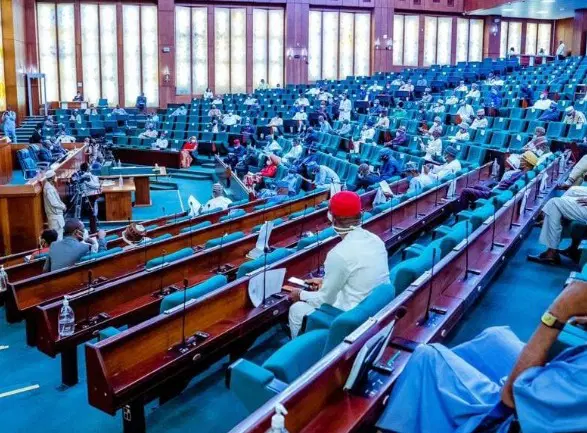
The House of Representatives on Thursday approved the Constitution Alteration Bill seeking to establish state police across Nigeria, despite a protest and walkout by members of the minority caucus, who argued that the legal framework required further refinement and that the constitutional amendment process was not properly followed.
The bill, titled “A Bill for an Act to alter the Constitution of the Federal Republic of Nigeria, 1999, to provide for the establishment of state police services and for related matters,” secured the constitutionally required two-thirds majority after consideration by the House.
The legislation was transmitted to the National Assembly by President Bola Tinubu as part of the administration’s efforts to decentralize policing and strengthen the country’s security architecture amid persistent insecurity across several parts of Nigeria.
If it is harmonized with the Senate version, approved by at least two-thirds of the 36 state Houses of Assembly, and assented to by the President in line with constitutional requirements for constitutional amendments, the legislation will create the constitutional basis for the establishment of State Police Services.
Presenting the report of the House Committee on Constitution Review, Deputy Speaker and Committee Chairman, Benjamin Kalu, described the proposal as one of the most significant constitutional reforms in Nigeria’s security sector.
He commended President Tinubu for transmitting the executive bill, saying it reflected constructive cooperation between the executive and legislative arms of government.
According to him, the amendment is designed to bring policing closer to the people, improve intelligence gathering, strengthen community policing, and enable state governments to respond more effectively to evolving security threats.
Sponsored
“This bill is not merely about creating another policing institution. It is about bringing policing closer to the people, strengthening intelligence gathering, enhancing community policing, improving coordination among security agencies, and empowering governments to respond more effectively to the complex and evolving security challenges confronting our nation,” Kalu said.
He acknowledged that the proposal might not satisfy every stakeholder but argued that constitutional reform is an incremental process.
According to him, the amendment only establishes the constitutional foundation for state police, while critical implementation issues—including recruitment, training, operational standards, funding, accountability, and intergovernmental coordination—would be addressed through subsequent legislation.
“We must not allow the pursuit of perfection to become the enemy of meaningful progress,” he added, urging lawmakers to support what he described as a historic reform.
Proceedings, however, took a dramatic turn during the Committee of the Whole.
Rather than conducting a clause-by-clause consideration and vote, as is customary for constitutional amendment bills, the Speaker, Tajudeen Abbas, read the long title of the bill before putting it to a voice vote.
SPONSORED