
Lawal Daura: In the Fight Against Insecurity, Physical Security Must Be Complemented by Quality Intelligence

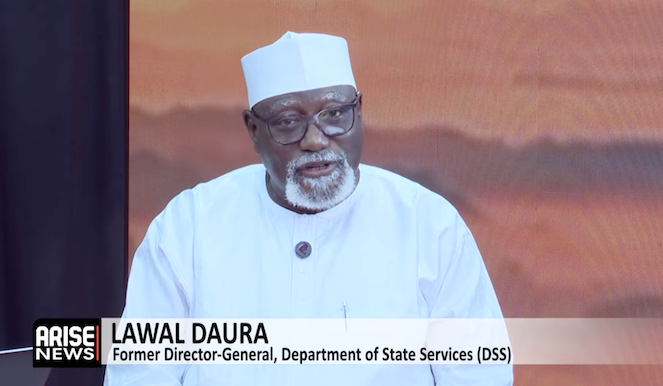
The former Director-general of the Department of State Services, (DSS), Lawal Daura, has stressed that physical security alone is insufficient to address Nigeria’s security challenges, insisting that it must be complemented by quality intelligence and improved coordination among security agencies to effectively prevent kidnappings and other violent crimes.
Speaking with ARISE NEWS on Monday, Daura bemoaned the persistent state of insecurity in Nigeria, citing the abductions of the Chibok and Dapchi schoolgirls, as well as the recent kidnapping of pupils in Oyo State, as evidence of a recurring security challenge. He said the country must draw lessons from every incident to prevent future abductions through improved intelligence gathering, coordination, and operational planning.
“The issue of insecurity and the problem that has been bedeviling the nation within the past one or two decades has been a concern to all Nigerians, whether you are in the security business or outside it. Incidentally, security is a topic or a subject that is of interest to all because the first thing that everyone considers is safety and security.
“Coming to the issue of the recently released abducted school pupils in Oyo State, I think it is more or less like a repeat of what has been done over the past decade. You can recall the issue of the Chibok girls, and later, the Dapchi girls.
“Conventionally, when incidents like this happen, the first and most important thing to focus on is a real interrogation of what transpired—both from the victims and those who were able to witness it, and of course, those who were involved in the rescue operation.
“Yes, physical security is very important, but what compliments physical security is the ability to have quality intelligence input. Now, the issue is, sometimes the intelligence may be available, but the coordination and collaboration between the various agencies may be a very, very difficult issue,” he said.
On the failure to prosecute perpetrators of mass kidnappings, Daura said the problem was not necessarily a lack of political will but the improper application of it. He argued that while political leaders have the final authority, security operations should be left to professionals with the requisite expertise.
“I think the political will may be there, but unfortunately, it may not be placed or applied properly. This can take place across a range of issues. There are times when political leaders may try to assume the position of the operators. But you know very well there is a serious limitation to that. Yes, the political leaders have the final authority, but the real nitty-gritty of what is to be done in order to achieve positive results rests with the experts. Unfortunately, that is often discounted,” he argued.
On whether the rescue of the abducted pupils in Oyo State had weakened the Ansaru terrorist network, Daura said he did not believe the group’s capabilities had been significantly degraded, adding that the abductors appeared to have escaped.
“I don’t think so. I don’t think it has done that because I may not have all the details, but what I read from the media was that they abandoned the pupils. That means those that might have been in possession of the real information that would be of help must have disappeared. It goes back to the saying, ‘He who fights and runs away lives to fight another day.’ So, we may not be taking our chances too much on that,” Daura noted.
Addressing allegations that former President Muhammadu Buhari governed through a “cabal,” Daura refuted the claims, insisting that no such group existed during the administration.
“First of all, I wish to categorically state that there was nothing like a cabal. It was just in the imagination or perception of the public, or some people who really wanted to take over the administration and couldn’t find a justifiable cause to do so,” he insisted.
Responding to claims that he continued to wield significant influence within Nigeria’s security establishment after leaving office, the former DSS boss said he merely offered advice to support the government in line with his oath of service.
“I wouldn’t say influence, but certainly, I was making some input. By virtue of my oath, which is still binding on me until death, I am supposed to make positive input to any government of the day in order to assist it to succeed. So that is not really anything strange or new,” he clarified.
Reacting to claims that insecurity is worse under southern presidents than northern presidents, Daura rejected the narrative, describing it as historically inaccurate and unsupported by evidence.
“I think it is a reflection of the defect or lack of full knowledge of our history. It is unfortunate, as educationists have been complaining about the review of our curriculum, which removed history for quite a long time. Today, many Nigerians, especially under the age of 50, know little or nothing about their history. It is not easy for one to understand the present without knowing the past. At least, even if you are not there, you should be able to trace what happened or what brought you to where you are today. It is only at that point, or with that kind of knowledge, that you may be able to figure out where you are headed.
“But for one to think that because a Northerner is leading Nigeria, insecurity becomes less, or vice versa, I don’t think it is correct. What is empirical, and what we have witnessed within the last ten years, makes it evidently clear that it does not really matter who is in office or who is the president.
What is so clear, though, may probably be either having people that may not really fit to be where they are, or people that lack the capability to do what they are expected to do. But then, because they have some very favorable disposition from the political leadership, they get covered, they get shielded, and they are not exposed for whoever they are,” he said.
Favour Odima
Follow us on: