

Brazil is in the midst of a cinematic golden age. In the past two years, the country has produced two Oscar-caliber films, “I’m Still Here” and “The Secret Agent,” both of which grapple with the country’s grim era under military dictatorship.
But now a different kind of cinematic thriller has seized the nation’s attention, “Dark Horse,’’ a heroic portrayal of former President Jair Bolsonaro’s rise to power — that doesn’t mention his conviction for having plotted a coup until the ending credits.
Though the film does not have a public release date, it has already drawn the spotlight, becoming part of investigations that have upended the presidential aspirations of a son of Mr. Bolsonaro.
The biopic is unusual in several ways, made by an executive producer who has never made a film, shot in English in a country where relatively few speak the language, with no precise date for when it will hit movie theaters, and carrying a reported cost that would make it the most expensive movie ever produced in Brazil.
The film’s financing has become a national obsession after a Brazilian news media website began publishing leaked audio recordings and text messages in May that included Mr. Bolsonaro’s son, Flávio Bolsonaro, seeking funding from a disgraced banker at the center of a multibillion-dollar banking scandal.
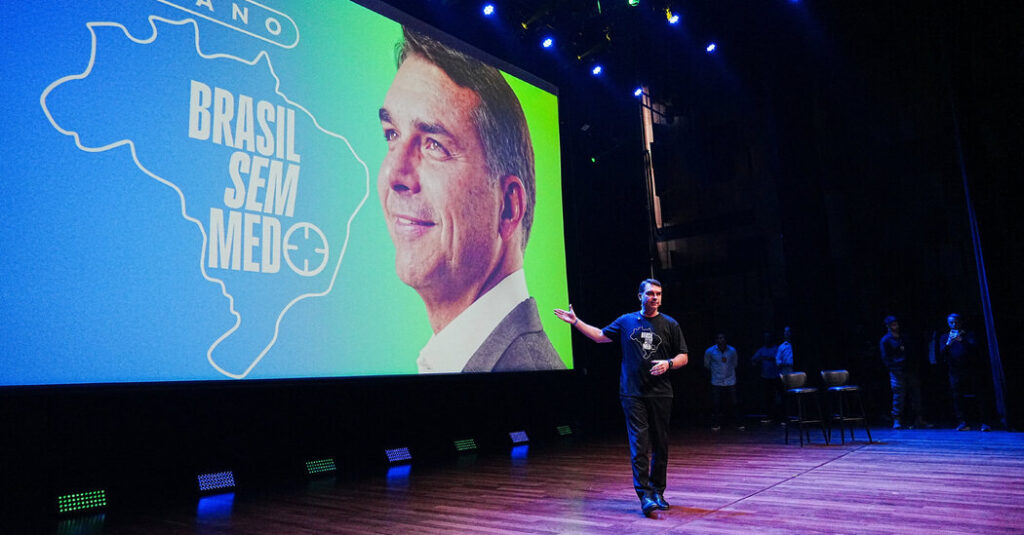
Flávio Bolsonaro, a senator, is planning to challenge Brazil’s leftist president, Luiz Inácio Lula da Silva, in October’s election and try to shift Latin America’s largest nation to the right.
His father was sentenced to 27 years in prison for planning to overturn his election loss four years ago. (For health reasons, he is serving his sentence under house detention.)
The disgraced banker, Daniel Vorcaro, was the head of a major Brazilian bank called Banco Master and is imprisoned as part of a sweeping financial fraud investigation that has implicated a wide swath of the country’s political elite.
The bank ultimately collapsed, wiping out billions of dollars in public pension investments and in a fund that insures financial deposits, Brazil’s equivalent of the U.S. Federal Deposit Insurance Corporation, the authorities said. Mr. Vorcaro has denied any wrongdoing.
Hours before the news media website The Intercept Brasil released the leaked audio recordings and text messages, the outlet asked Flávio Bolsonaro about his involvement with Mr. Vorcaro. Mr. Bolsonaro denied having any relationship with the banker.
But in a video posted on X not long after The Intercept’s report was published, Mr. Bolsonaro, who has not disputed the authenticity of the recordings and text messages, defended his interactions with Mr. Vorcaro.
“What happened was a son seeking private sponsorship for a private film about his own father’s story,” he said in the video.
A spokesman for Flávio Bolsonaro declined to comment and directed questions to the film team.
The publication of a series of leaks by The Intercept related to Mr. Vorcaro and Banco Master has forced Mr. Bolsonaro and other politicians featured in the material to defend themselves, sometimes making seemingly contradictory statements, intensifying public attention.
Fernando Meirelles, an acclaimed Brazilian filmmaker who directed another Oscar-nominated movie, “City of God,’’ has watched the scandal unfold and said he was most struck by the contradictory assertions.
“When I was young, being caught lying in public was a very serious thing,” he said. “Lying has become strangely tolerated, almost rebranded as strategy or performance.”
The Federal Police announced this month that investigations were underway focusing on the funding for the “Dark Horse’’ film and whether financial crimes had been committed.
Since the scandal around the movie erupted, Mr. Bolsonaro has fallen well behind Mr. Lula in presidential polls after the two had been largely neck-and-neck.
Mr. Bolsonaro’s credibility has been damaged among voters who had viewed him as more moderate and trustworthy than his father, said Felipe Nunes, director of Quaest, a leading Brazilian polling firm.
“They felt betrayed by him after he publicly said he had no relationship with the film,” Mr. Nunes said. ‘That created distrust.’
In lobbying the banker, Flávio Bolsonaro, according to the WhatsApp texts published by The Intercept, seemed to want to ensure that Jim Caviezel, the actor portraying his father, and Cyrus Nowratesh, the director, were properly compensated.
“Don’t even think of us not paying Jim Caviezel, Cyrus,” he wrote to Mr. Vorcaro in one text. “People of a high name in American and world cinema.”
According to audio recordings, text messages and documents published by The Intercept, Mr. Bolsonaro allegedly negotiated a commitment of roughly $24 million from Mr. Vorcaro toward the film’s production. That would easily eclipse the $5 million it cost to make “The Secret Agent,’’ which, up to now, is the most expensive film produced in Brazil.
The film’s executive producer, Karina Ferreira da Gama, told Brazilian media that the film had not received any money from Mr. Vorcaro, but days later, after more leaks from The Intercept Brasil, explained that Mr. Vorcaro had provided $11 million for the movie.
The Intercept also published banking statements showing millions of dollars sent by allies of Mr. Vorcaro to a Texas fund controlled by a lawyer for Eduardo Bolsonaro, Flávio Bolsonaro’s brother, to help finance the “Dark Horse’’ film.
Mr. Bolsonaro previously said he had no management role in the film. But after a contract published by The Intercept listed Eduardo Bolsonaro as an executive producer with authority over the film’s financial management, he said that he had served as an executive producer to secure initial funding, but had stepped down from that role.
Eduardo Bolsonaro, who has been living in Texas since last year, lobbied the Trump administration unsuccessfully to pressure Mr. Lula’s government, through tariffs and sanctions, to drop its case against Jair Bolsonaro. A Brazilian court convicted and sentenced him to jail last year for soliciting U.S. interference in his father’s trial.
Eduardo Bolsonaro said the allegations around the film’s financing were “an attempt at character assassination,’’ adding that investing in a movie “is not a crime.”
The oddities surrounding the film go beyond money.
Ms. Ferreira da Gama has no film credits listed on IMDB or with Brazil’s national film agency. The agency is investigating the production, saying the movie never registered with the agency, as its rules require, before shooting began in Brazil. The production company has not responded to the agency’s inquiries, agency officials said.
Ms. Ferreira da Gama did not respond to several requests for comment.
Several crew members told The Times that the “Dark Horse’’ budget did not match the film’s ambitions and some workers paid for props and transportation out of their own pockets. They spoke on the condition of anonymity because they said they had signed nondisclosure agreements to work on the film.
Some Brazilians said they were puzzled that the film was in English, despite being almost entirely shot in Brazil, where just a small percentage of people speak English. Mr. Caviezel said on Instagram that the movie would be released in September, though the film’s distributor said the plan was to release it after the October election.
Mr. Meirelles, the filmmaker, said the saga around “Dark Horse” continues to offer so many plot twists that it feels as if reality has outpaced fiction.
“Sometimes reality becomes so absurd that only cinema can make sense of it,” he said.
“And, for some reason, we can’t stop watching,” he added. “In Portuguese, we say we love to ‘watch the circus burn.’ It’s schadenfreude season in Brazil.”
Reporting was contributed by Leonardo Coelho Ju Faddul Lis Moriconi and Ana Ionova