

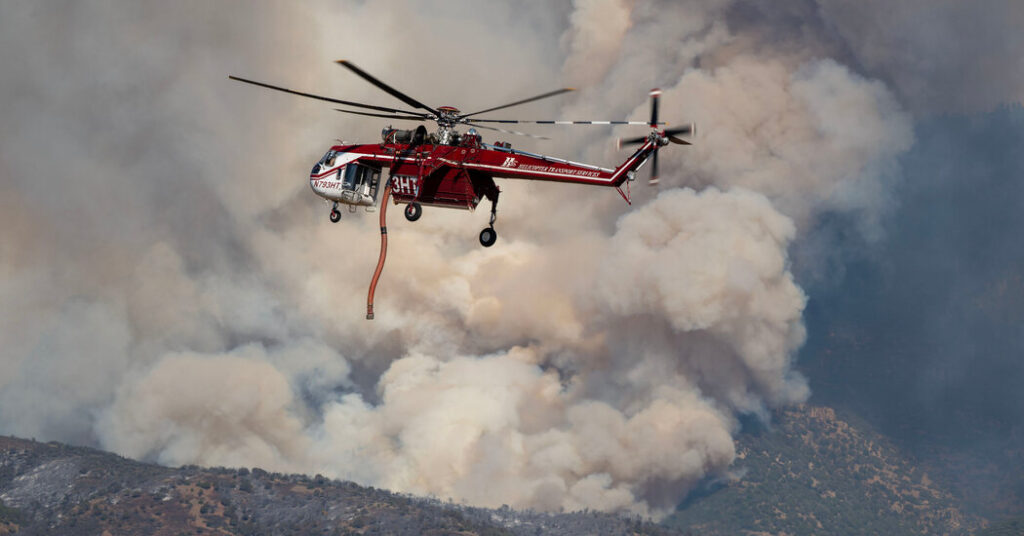
A helicopter battling one of the nation’s largest active wildfires crashed while navigating treacherous terrain in central Utah on Friday, killing the two firefighters who were on board.
The aircraft, one of several fighting the fast-spreading Widemouth 2 blaze burning through Fishlake National Forest and the surrounding communities, went down near the city of Richfield just before 11 a.m.
The wreck sparked another fire, officials said, and flames quickly overran the area, preventing emergency personnel from reaching the site for more than a day and complicating the effort to determine the fate of those on board.
“No escape routes that any firefighters could get into or out of if we had put them in there,” said Nathan Curtis, the sheriff of Sevier County, where the crash occurred.
The dangerous conditions resulted in muddled public messaging about the incident and injected an agonizing uncertainty into the search for the crew.
On Saturday morning, the National Interagency Fire Center, a coalition of federal and state agencies, reported that the two firefighters had died.
But hours later, the U.S. Forest Service issued an unsigned statement that said there was “no confirmation of the status of the victims.” Rescue teams were still unable to reach the site, which had been swallowed by the fire overnight, the statement said.
By Saturday evening, however, the authorities had confirmed their worst fears — the on board had perished.
“Fatalities such as this land heavily on the minds and hearts of our agencies and the wildland fire community as a whole,” the Forest Service said in a statement. “We honor these firefighters by supporting those who remain on scene to fight this and other fires.”
Officials have not identified the firefighters, and they were still working to determine the cause of the crash. Investigators with the National Transportation Safety Board traveled to the area but were also waiting for fire conditions to improve before they could reach the crash site, said a spokeswoman for the agency, Sarah Taylor Sulick.
But even as central questions remained unanswered, Friday’s crash deepened an already solemn mood that has taken hold at base camps and incident command centers across the West this year, as a raging wildfire season has claimed the lives of several other first responders.
In June, three wildland firefighters died while battling a blaze along the Utah-Colorado border, and on Thursday a bulldozer operator was killed in a southern Oregon fire.
“Wildland firefighting is among the most dangerous jobs in the world,” Gov. Spencer Cox of Utah said in a statement on Friday, responding to the crash in his state. “Today is a painful reminder of the extraordinary risks these brave men and women accept to protect us.”
Authorities believe the Widemouth 2 fire began with a lightning strike on July 27 and quickly scorched more than 100,000 acres, feasting on tinder-dry forests and propelled by unpredictable winds. It is the latest large blaze in what researchers say is one of the state’s worst fire seasons on record, with Utah — and the rest of the West — struggling through a brutal drought and sweltering summer.
“This is our third fire to be right at 100,000 acres this year, which is not a record that we’re proud of,” Mr. Cox told reporters during a tour of the fire line on Thursday. He said the fierce fire season had exhausted emergency workers and spread resources thin.
When the firefighting helicopter, a Sikorsky S64, took off on Friday morning, conditions were safe enough to fly, Tyler Hecht, a deputy commander with the Great Basin Incident Management Team, said at a news briefing later that day. The terrain was steep and tricky, Mr. Hecht said, but it was not unusual for this type of wildfire.
As Widemouth 2 continued to rage, with just about a quarter of the blaze contained, officials were left hoping for rain — just not too much, as communities near fire burn scars are now fearing flash floods and mudslides.
“Really,” Mr. Cox said, “we need some help from Mother Nature.”
Madaleine Rubin contributed reporting.