

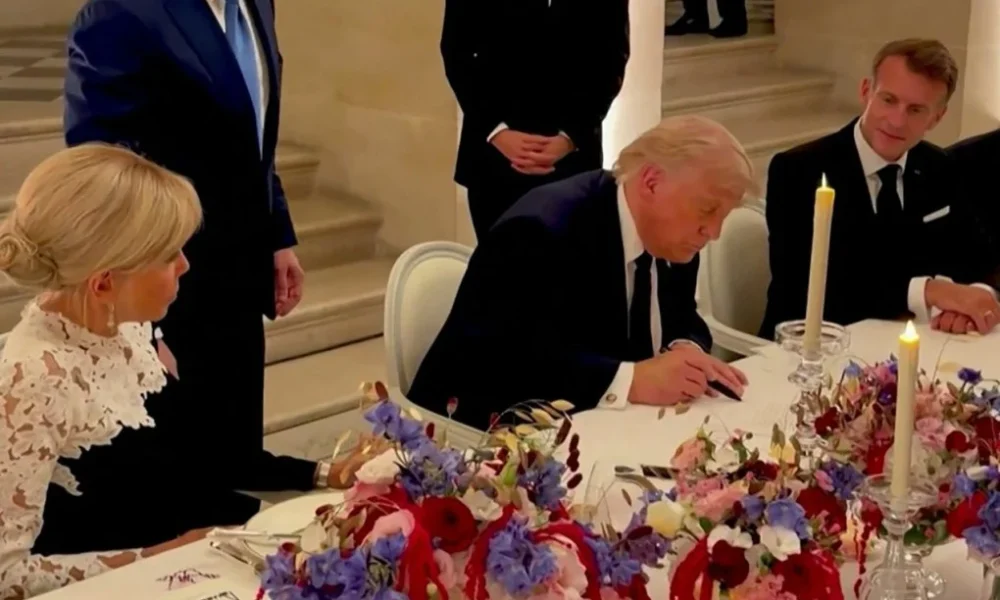
The United States and Iran have signed a preliminary agreement aimed at ending months of military hostilities in the Middle East, with a formal ceremony reportedly scheduled for Friday in Switzerland to launch a 60-day negotiation period for a comprehensive peace deal.
US President Donald Trump signed a memorandum of understanding during a candlelit dinner at the Palace of Versailles following a G7 summit.
A video shared by a presidential aide allegedly showed the signing ceremony, where French President Emmanuel Macron and other attending leaders were seen applauding.
The reported agreement is said to aim at halting hostilities triggered by US-Israeli military actions earlier in the year, which escalated into regional missile exchanges and disrupted global shipping routes, including activity around the Strait of Hormuz — a critical global energy corridor.
“Just signed it,” Trump was quoted as telling journalists upon leaving the venue, according to the circulating accounts.
Iranian state media, citing Foreign Ministry spokesperson Esmaeil Baqaei, also reportedly confirmed that a document “was finalized with the signatures of the presidents,” while stressing that it forms part of an initial framework rather than a final peace treaty.
Pakistan’s Prime Minister Shehbaz Sharif is also said to have played a mediating role in the negotiations, with reports attributing to him a statement that the agreement “shall enter into force with immediate effect,” following electronic signatures from both sides.
READ ALSO: Trump claims US-Iran peace deal imminent, says Strait of Hormuz will reopen
Key Clauses Reportedly Contained in the Framework
Details of the memorandum, as reported, outline a broad roadmap that includes a 60-day negotiation timeline for a final peace agreement, alongside immediate de-escalation measures.
Among the reported provisions are commitments to end military hostilities on all fronts, including indirect conflict zones, and pledges by both sides to refrain from further military action or threats against each other.
The framework also reportedly proposes a large-scale reconstruction and development plan for Iran, estimated at a minimum of $300 billion, to be coordinated with regional and international partners.
On nuclear issues, Iran is said to reaffirm its commitment not to develop nuclear weapons, while arrangements for its enriched uranium stockpile would be managed through a mutually agreed mechanism under International Atomic Energy Agency (IAEA) supervision.
Pending a final agreement, the reports indicate that Iran would maintain its current nuclear posture, while the United States would refrain from imposing new sanctions or deploying additional forces in the region.
Sanctions, Military Presence and Maritime Access
The reported memorandum further includes provisions for the gradual lifting of US sanctions on Iran, including the unfreezing of restricted assets upon implementation of the agreement.
Washington is also said to have committed to issuing temporary waivers allowing Iranian crude oil exports, banking transactions, insurance, and shipping services during the transition period.
In addition, the United States is reportedly expected to begin removing its blockade on Iranian ports within 30 days, while also planning a phased withdrawal of forces from areas near Iran following a final agreement.
On maritime security, Iran is said to have pledged to facilitate the safe passage of commercial vessels through key waterways, including the Persian Gulf and the Strait of Hormuz, with a temporary arrangement to restore traffic and ensure stability in global energy shipping routes.
Diplomatic and International Oversight
The reported agreement also includes a clause for final endorsement by a United Nations Security Council resolution, giving the framework potential international legal backing if fully implemented.
A formal ceremony is expected to take place in Switzerland on Friday, where technical-level negotiations are also scheduled to begin.
Caution Over Verification
However, the reported developments have not yet been independently verified by major international news agencies, and official confirmation from Washington or Tehran remains limited at the time of filing this report.
Diplomatic analysts caution that early-stage memoranda of understanding between rival states often undergo extensive revisions before any binding peace agreement is reached, particularly in high-tension conflicts involving multiple regional actors.