

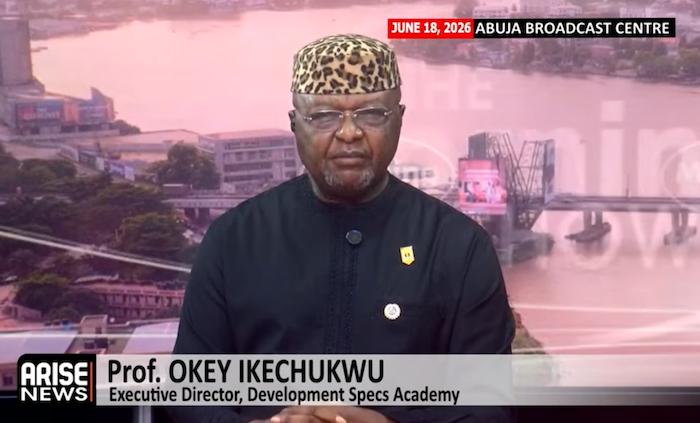
The Executive Director of Development Specs Academy, Prof. Okey Ikechukwu, has said Nigeria’s worsening security situation—driven by rising insurgency, banditry and kidnapping—demands urgent structural reforms rather than continued reliance on prosecution-focused strategies or rehabilitation programmes, which he said have failed to produce measurable results.
Speaking in an interview with ARISE News on Thursday, Prof. Ikechukwu said the core challenge confronting Nigeria is not simply about how offenders are prosecuted, but the country’s inability to prevent the emergence and persistence of criminality in the first place.
He warned that insecurity has reached a point where ordinary citizens can no longer carry out basic activities such as farming or movement in safety.
“The security situation in Nigeria in recent times should concern every citizen as we have witnessed the rise in insurgency across the country,” he said.
He stressed that insurgency, banditry and kidnapping, though distinct, all fall under a broader category of organised criminality that disrupts national security. However, he questioned whether changes in legal frameworks—such as switching between criminal and penal codes—would make any meaningful difference.
“The issue on the table is, first there is insurgency, second there is banditry, third there is kidnapping. The three are distinctly related in that they all fall within criminality and then within variables that disrupt national security,” he said.
He argued that focusing on prosecution methods distracts from the fundamental question of how to stop insecurity altogether.
“The primary question remains: whether it’s criminal or penal, what is it that will prevent insurgency, banditry and kidnapping? That’s the primary question on the table that I’d like us to take on,” he said.
Ikechukwu also questioned the effectiveness of mass incarceration as a response to insecurity, warning that it creates additional strain on already overstretched correctional facilities.
“What’s the size of the prison? As you jail more and more people, you’re going to make more provisions for their feeding,” he said.
He further argued that even proposals suggesting private-sector-led prison construction do not address the core issue of national security.
“Having done that, what is it you’re doing to guarantee national security?” he asked.
According to him, Nigeria risks focusing on “illusionary achievements” such as isolated arrests or killings of high-profile targets while failing to address everyday insecurity affecting citizens.
“We have to move and stop celebrating illusionary, or illusory, attainments, and know that the issue is national security and insecurity at the domestic level,” he said.
Turning to the issue of amnesty and deradicalisation programmes for insurgents, Prof. Ikechukwu questioned their effectiveness, citing repeated cycles of surrender and relapse into criminality.
“There’s nothing preventing anybody from rehabilitation and reintegration. But I ask a few questions,” he said.
He noted that large numbers of surrendered insurgents have passed through government programmes, yet insecurity persists.
“From the time Zulu became governor till now, there were so many waves of insurgents who were surrendering… sometimes 5,000… we got more than 20,000, 30,000 of such insurgents,” he said.
He questioned the criteria used to determine who is genuinely reformed.
“I don’t know by what screening method we came to the conclusion that these are repentant,” he said.
He warned that some individuals who underwent deradicalisation have reportedly returned to criminal activity.
“There are incidents where those deradicalized, reengaged as terrorists,” he said.
He also questioned the economic incentives behind reintegration programmes.
“You finish, quote-unquote, deradicalizing me and release me. And what I’m getting from you is probably 200,000 in a month… I was used to blowing all kinds of money, spending a lot of money on drugs, drinks, women,” he said, suggesting that such incentives may not be sufficient to change behaviour.
Prof. Ikechukwu argued that Nigeria has underutilised technological tools that could significantly improve security operations, including telecommunications tracking, financial monitoring, and digital surveillance systems.
“Every phone call you make in this country is loaded up through a tower. Therefore, you can triangulate, isolate, and know where your calls are coming from,” he said.
He added that financial transactions—whether through banking systems or cash equivalents—can also be traced with existing technologies.
“Apart from the monies that are delivered by cash, it is possible to trace all such monies that are paid through the banking system,” he said.
He further suggested that security agencies should actively collaborate with financial institutions to track suspicious transactions.
“The bank is not involved. The owner of this account, what can you tell us? These are doable things, they are not happening,” he said.
Ikechukwu said Nigeria’s insecurity problem is ultimately rooted in governance failures and weak institutional capacity rather than lack of military operations or international interventions.
“National security is not about prosecution. It’s about the fact that people all over the country can now go to their farms and feel safe,” he said.
He criticised what he described as the over-celebration of isolated military successes that do not translate into improved domestic security.
“For me, that is good news at the level of image… The death of that man or woman has had no impact whatsoever on the criminality, insecurity and insurgency in the country,” he said.
He illustrated his point with examples of everyday insecurity across Nigerian communities.
“People are in Abeokuta and they are being robbed. When they cook their food, somebody carries the pot… Insecurity is the issue,” he said.
The professor also raised concerns about inadequate funding, poor welfare, and declining morale within the armed forces, arguing that these factors weaken Nigeria’s security response.
“The fact that the military itself is being overrun because it’s not well equipped, because the budgets are not being released,” he said.
He criticised national budget priorities, contrasting security and elite spending with underfunding in education and defence welfare.
“36 billion was put down for the rehabilitation of the parking lot of the National Assembly. 36 billion to park your cars. You can’t find 4 billion for university teachers,” he said.
He also questioned the adequacy of soldiers’ daily rations in relation to inflation and cost of living.
“It does not occur to you that the ration of those soldiers… was fixed at a certain date,” he said, adding that current economic realities have rendered such provisions insufficient.
Prof. Ikechukwu concluded that Nigeria’s core security challenge is the disconnect between governance structures and the lived reality of citizens, warning that elite insulation from insecurity has worsened the crisis.
“What we have in place is elite self-protection in place of national security,” he said.
He argued that until Nigeria prioritises citizen safety over symbolic victories and elite comfort, insecurity will continue to escalate across the country.
Boluwatife Enome
Follow us on: