

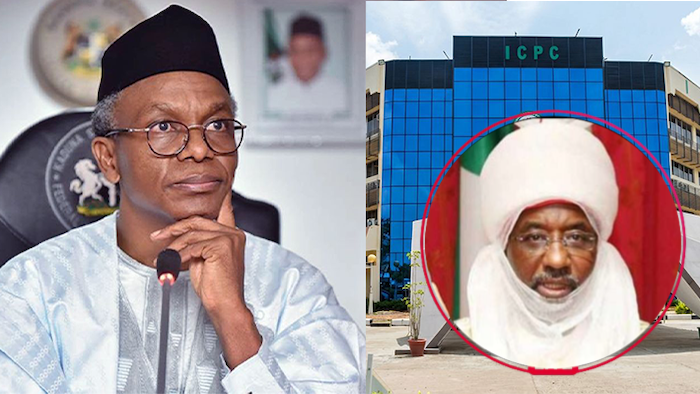
The Emir of Kano, Sanusi Lamido Sanusi, has said former Kaduna State governor, Nasir el-Rufai, is facing what he described as “extremely difficult” bail conditions in his ongoing trial over alleged fraud, claiming that authorities have imposed stringent requirements for his release from custody.
El-Rufai has been in the custody of the Independent Corrupt Practices and Other Related Offences Commission (Independent Corrupt Practices and Other Related Offences Commission (ICPC)) since February 19 over alleged financial impropriety during his tenure as governor of Kaduna State between 2015 and 2023.
On April 13, the ICPC arraigned the former governor at the Kaduna High Court on an amended nine-count charge bordering on alleged fraud and abuse of office.
Meanwhile, the el-Rufai Support Group Association (ERSGA) said it has engaged a United States-based advocacy firm to mount an international campaign over the ongoing trial of the former governor.
Mohammed Salihu, director of strategic partnerships of ERSGA, said the association had retained Vanguard Africa, a Washington DC-based organisation, to engage policymakers, democracy advocates and international stakeholders on developments surrounding el-Rufai’s prosecution.
Speaking to journalists after an event, Sanusi alleged that authorities demanded that an emir and a senior government official stand surety for el-Rufai before he could be released.
“For example, look at what is happening with my brother, Mallam Nasir el-Rufai. He is currently in custody, and the requirements for his release are incredibly difficult,” Sanusi said, speaking in Hausa.
“They stated that an emir and a senior government worker must sign his bail.”
The former governor of the Central Bank of Nigeria (CBN) also used the moment to comment on what he described as the declining social and cultural standing of northern Nigeria.
Sanusi said poverty has long been a challenge in the region, but insisted that northerners have traditionally maintained dignity and faith despite hardship.
“Regarding the north, we all know that poverty has been a long-standing issue here. Yet, despite their poverty, northern people value and respect themselves, leaving everything in the hands of Almighty God,” he said.
He warned that deeper challenges were emerging beyond economic hardship.
“What is troubling the north is not just a lack of money, but the erosion of our culture, the testing of our patience, and the continuous attempt to copy other cultures across this country.”
Sanusi added that the region’s political influence had also diminished compared to the past.
“Previously, a northerner was widely accepted to lead the entire nation, but today, northerners are no longer viewed differently from anyone else,” he said.
Boluwatife Enome
Follow us on: