

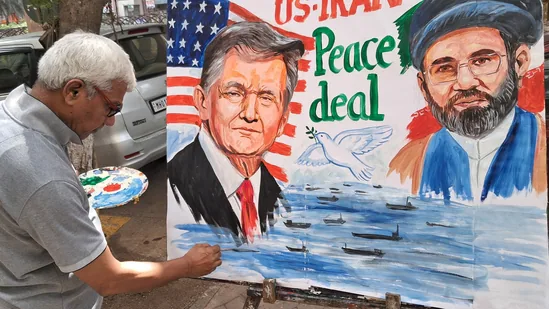
The progress over a US-Iran peace deal finally seems to be materialising after much back and forth as the two sides virtually signed a Memorandum of Understanding (MoU) on Monday.
The document was signed virtually by President Donald Trump, Vice President Vance and Iranian parliamentary speaker Mohammad Bagher Ghalibaf, according to US officials. The interim document that ends months of war will be signed physically on Friday in Geneva, Switzerland. Talks are expected to begin soon after.
Buoyed by positive progress on Iran-US truce, oil prices extended losses on Tuesday, as markets weighed prospects for resumption of supply through the key Strait of Hormuz.
Here are some key questions about the peace deal answered:
What does the MoU hold?
The details of the MoU haven’t been made public officially, but Vance on said it is “a very general document” with specifics of the deal to be worked out during further negotiations.
“The MOU…is about a page and half so it is a very general document. On a number of issues, we are going to have to figure this stuff out during the technical negotiation phase,” US vice president JD Vance told CNN.
While still a framework, the deal marked the biggest breakthrough toward resolving the conflict that has killed thousands and upended energy markets since it began with joint US-Israeli strikes on Iran on February 28
Will there be sanctions reprieve for Iran?
The MOU will provide a structure for how the US-Iran relationship will operate in the future, a US official was quoted as saying by Reuters. The official further said that any benefits to Iran such as sanctions relief and release of Tehran’s frozen funds would only come based on their willingness to work with Washington on their nuclear program and not fund “radicalism” in the region.
“We are prepared to release frozen funds and we are prepared to relieve sanctions, and we’ll do some small gestures of that in the beginning if they make some small gestures to us that show that they’re willing to meet their commitments as well,” another US official was quoted as saying.
What about US naval blockade of Hormuz?
Once the deal is signed, the strategic oil passage, Strait of Hormuz, would be opened without tolls or any other restrictions. The vessels are already moving in Hormuz, including a supertanker sanctioned for its role in moving Iranian oil is moving toward the Persian Gulf, Bloomberg reported.
Iran media also reported that at least three Iranian oil tankers and two cargo ships carrying essential goods passed through the Strait of Hormuz.
Trump, on his Truth Social, announced the removal of US naval blockade on Hormuz “I hereby fully authorize the toll free opening of the Strait of Hormuz, and, simultaneously herewith, authorize the immediate removal of the United States Naval blockade. Ships of the World, start your engines. Let the oil flow!,” he wrote.
He said Hormuz “is already partially opened,” and “it’ll be completely opened” on Friday.
When will the final deal be locked?
While the interim agreement extends the ceasefire announced in April by another 60 days, the final deal will be finalised after the negotiations resume on Friday. Iran foreign minister Abbas Araghchi said on Tuesday that talks with the US will resume on Friday in Geneva where the representatives from two sides will be physically signing the interim deal.
However, uncertainty may still loom over the final deal as Araghchi said the deal to end the war with the US would also require Israel to withdraw from Lebanon. He said that Israel’s continued occupation of southern Lebanon would violate the memorandum of understanding reached between the United States and Iran, in comments aired on Iranian state television.
Iran-US talks and doc signing
Iran’s Araghchi on Tuesday told state media that the talks with the US on final deal are likely to begin in Geneva on Friday. However, he also noted that the ending of Lebanon war is ‘most important issue’ in US deal and that the end of Iran war includes end of Israel’s occupation of Lebanon.
The interim agreement extends a tenuous ceasefire announced in April by another 60 days.
Iran and the US signed the deal electronically on Monday by President Trump, Vance and Iran’s Ghalibaf, according to AFP.
“The president wanted to sign it personally because he wanted to show his… dedication to bring this through to a successful resolution,” a US official was quoted as saying.
Will Iran give up on its nuclear programme?
Iran’s nuclear programme has been a thorny issue for the peace deal. Trump on Monday said that Iran has agreed to ‘never have nuclear weapons’
Araghchi has said that talks with the US on a final agreement covering Iran’s nuclear programme will begin after the MoU signing.
“In the final agreement, decisions will be made on the nuclear issues and the lifting of sanctions,” he added.
However, US intelligence has doubts on Iran’s intentions on peace deal with CIA Director John Ratcliffe informing President Trump and other senior officials that evidence gathered by US intelligence agencies indicating its unwillingness, Axios reported.
Is there an overall agreement between US and Iran?
The conflicting remarks from Iran and the US hint that despite the interim peace deal, tensions still dominate the relations that have been battered by four months of conflict.
“I am somewhat concerned that Iran’s view of the agreement seems different than what the American negotiating team is claiming,” Sen Lindsey Graham, a key Trump ally, told Axios. The report quoted unnamed US officials saying the discrepancies were caused by Iran overselling the deal for ‘domestic consumption.’
Is Israel on the same page?
Israel’s offensive on Lebanon has been a sticking point for Iran-US deal, with Israel leaders criticising the pact. Defense Minister Israel Katz has maintained that Israel will not withdraw from the parts of southern Lebanon it occupies or give up its ability to respond to Hezbollah attacks. If Iran strikes Israel over the war in Lebanon, Katz said, Israel will hit Iran “with full force.”
A senior US official quoted by the Axios said the deal does not require an Israeli withdrawal and would not create a “one-way ceasefire,” meaning Israel could respond if Hezbollah attacks. Trump has said he hopes to “solve” the situation in Lebanon and that “we’ll have to have a little chat with Hezbollah about this.”