

Judiciary
By Anthony Isibor
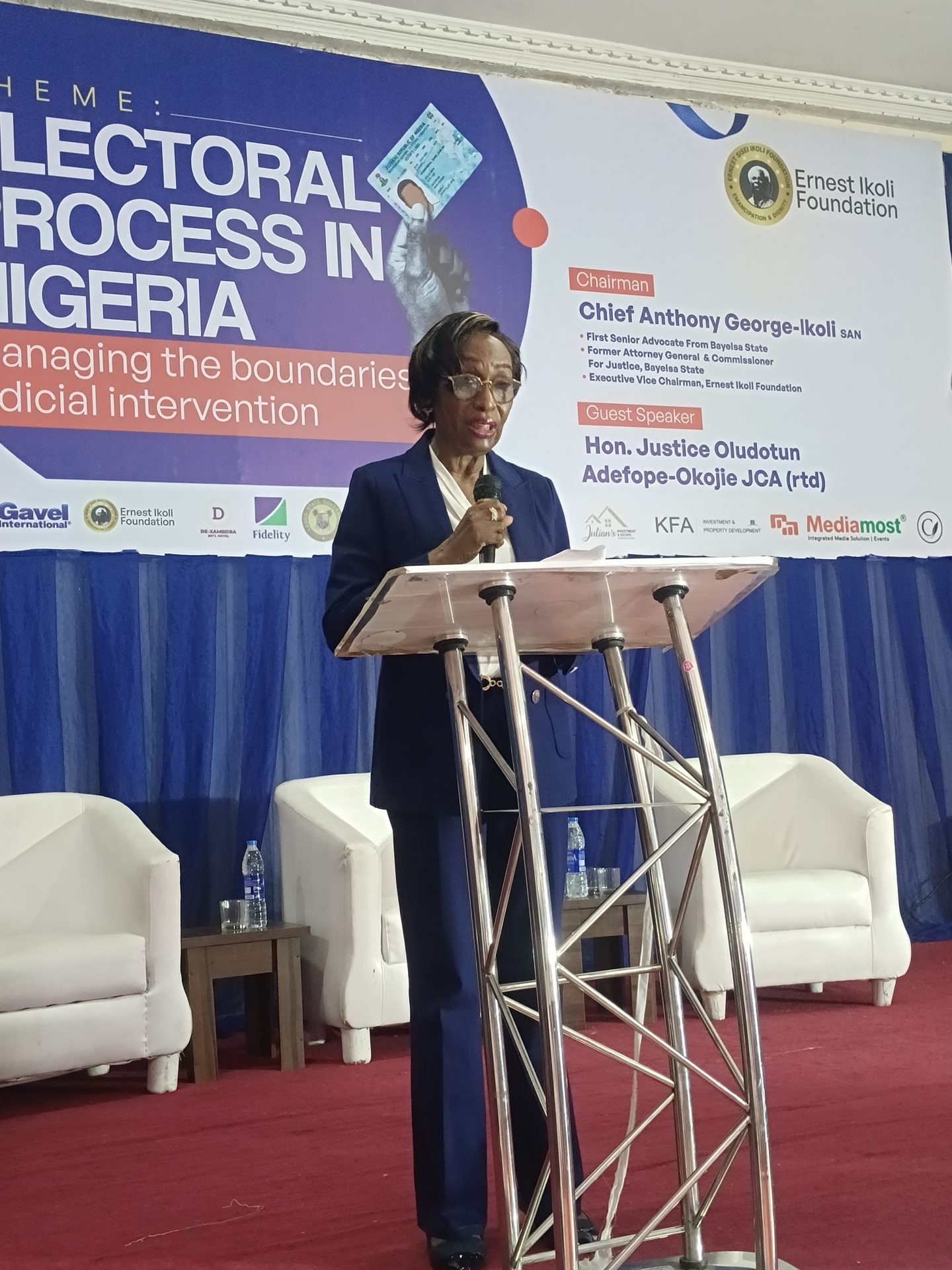
RETIRED Justice of the Court of Appeal, Oludotun Adefope-Okojie, has called on Nigerian courts to abandon their traditional reluctance to intervene in the internal affairs of political parties where the parties violate their constitutions and electoral laws.
She said that judicial intervention had become necessary to stop political parties from manipulating their internal processes through flawed congresses, unlawful substitutions and the imposition of candidates who did not emerge through legitimate procedures.
Delivering the guest lecture at the 2026 Gavel International Annual Conference and Awards in Lagos on Tuesday, Adefope-Okojie argued that political parties had contributed significantly to the increasing number of election disputes by failing to observe their own constitutions in selecting candidates for elections.
According to her, some parties deliberately take advantage of the courts’ traditional position that their internal affairs are not justiciable to perpetrate irregularities during congresses and primaries.
She said the practice had created a situation in which legitimately elected candidates were sometimes replaced with handpicked individuals, leaving aggrieved aspirants with little option but to seek redress in court.
Adefope-Okojie said the courts should no longer turn away when political parties violate their own rules and disregard the provisions of the Electoral Act.
She cited a recent Supreme Court decision delivered on April 30, 2026, in which the court, by a 3-2 majority, reaffirmed that although the internal affairs of political parties are generally not justiciable, the courts could intervene where a party violated its constitution and relevant electoral laws.
She said the majority decision represented the correct approach to addressing abuses within political parties.
“I agree with the majority decision of their Lordships. The courts must no longer refuse to intervene where political parties violate their own constitution and rubbish the Electoral Act,” she said.
According to her, the judiciary has a responsibility to sanitise the electoral system rather than allow political parties to exploit legal protections surrounding their internal affairs.
“The duty of the court is to ensure that justice is done and not to shut its eyes against its bastardisation by the political parties,” she added.
The retired justice maintained that judicial intervention remained indispensable to constitutional government, the enforcement of electoral laws and the protection of citizens’ political rights.
She, however, cautioned that such intervention must not undermine the democratic choices of voters.
She said the fundamental responsibility of the courts was to protect the electorate’s choices, not to replace them with decisions that could produce candidates who did not enjoy the people’s mandate.
Adefope-Okojie explained that Nigerians’ constitutional right to choose their representatives extended beyond the right to vote.
It also included the right to choose among lawfully nominated candidates, the equal treatment of votes, the accurate declaration of results and access to an independent judicial process where electoral outcomes were disputed.
She identified a major weakness in Nigeria’s electoral jurisprudence, noting that election disputes had historically been treated largely as conflicts between political parties and candidates, while the electorate whose votes were at stake had little direct opportunity to defend its mandate.
She cited the Supreme Court’s decision in the Zamfara State APC primaries dispute, where the party’s failure to conduct valid primaries resulted in its candidates being disqualified and votes cast for it being treated as wasted.
The decision resulted in candidates of the Peoples Democratic Party benefiting from the disqualification, despite the APC having secured the overwhelming majority of votes in the state.
She also recalled the Bayelsa governorship dispute involving the disqualification of the deputy governorship candidate of the All Progressives Congress over false information submitted to INEC.
The disqualification affected the joint ticket, resulting in the removal of the governor-elect and the emergence of the candidate who came second in the election.
She said such cases illustrated the need for courts to consider the implications of their decisions for the electorate.
Adefope-Okojie said the judiciary should strike a balance between enforcing electoral laws and preserving the sovereignty of voters.
She urged political parties to comply with their constitutions, INEC to discharge its responsibilities impartially and judges to exercise their powers with courage and fidelity to the law, particularly as Nigeria approaches the 2027 general elections.
The conference had as its theme, “Electoral Process in Nigeria: Managing the Boundaries of Judicial Intervention”.
A.I
Nov. 17, 2026
Tags: Gavel International Annual Conference and Awards 2026 INEC Justice Oludotun Adefope-Okojie