

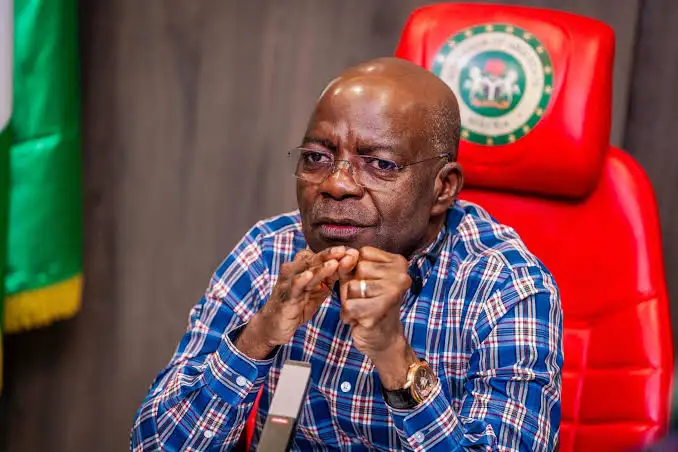
Abia State Governor, Alex Otti, has presented a N1.23tn 2027 budget proposal to the State House of Assembly, with 80 per cent earmarked for capital projects and 35 per cent allocated to education and health.
The governor said the proposed allocation reflected his administration’s commitment to infrastructure development and human capital investment, while maintaining fiscal discipline.
Otti presented the Appropriation Bill to the Assembly in Umuahia on Thursday for consideration and approval, describing it as an ambitious but realistic financial plan to sustain the state’s development agenda.
Presenting the estimates before the Speaker, Emmanuel Emeruwa, and other lawmakers, Otti said N960bn, representing about 80 per cent of the proposed expenditure, would be allocated to capital projects, while the remaining 20 per cent would cover recurrent spending.
He said the state expected to generate N647.23bn from internal and external revenue sources, including internally generated revenue, statutory allocations from the Federation Account Allocation Committee, Value Added Tax and other federal revenue sources, as well as capital receipts.
The remaining N552.67bn, according to the governor, would be sourced through concessional loans and committed strictly to infrastructure projects with regenerative value.
Otti projected the state’s internally generated revenue at N199.8bn for 2027, expressing confidence that, if achieved, the target would cover 180 per cent of recurrent expenditure.
He also disclosed that the proposed budget represented an 80 per cent increase over the current year’s budget, while projected IGR had risen by 648 per cent compared with the 2023 figure.
On human capital development, the governor said 35 per cent of the proposed budget had been earmarked for education and health, with education receiving 20 per cent and health allocated 15 per cent.
He further disclosed that the economic sector would receive 55 per cent of the proposed expenditure, covering agriculture, works, transportation, power, public utilities, petroleum and solid mineral development, among other areas.
Other areas under the economic sector include the Greater Aba Development Authority, land administration, arts and culture, the creative economy, digital capacity development, infrastructure and support for small and medium-scale enterprises.
The social sector, which covers education, health, environmental protection, sports development, local government and chieftaincy affairs, poverty alleviation, social protection and women’s affairs, would receive 7.2 per cent.
The administrative sector, including law and justice, was allocated 5.1 per cent of the proposed expenditure, amounting to N17.3bn.
Describing the proposal as both ambitious and achievable, Otti said his administration had demonstrated the capacity and resilience required to sustain its development plans.
He added that the budget was prepared with contributions from stakeholders, including business leaders, development partners, civil society organisations, community leaders and traditional rulers.
The governor urged lawmakers to scrutinise the estimates to ensure they reflected the aspirations of residents. He expressed optimism that the Assembly would pass the bill before the end of 2026.
He said timely passage would provide certainty for investors and development institutions interested in opportunities in the state.
Responding, the Speaker, Emmanuel Emeruwa, said the increase in the proposed budget reflected progress in the state.
Emeruwa assured the governor that lawmakers would carefully examine the estimates and work towards passing the bill before the end of the year.