

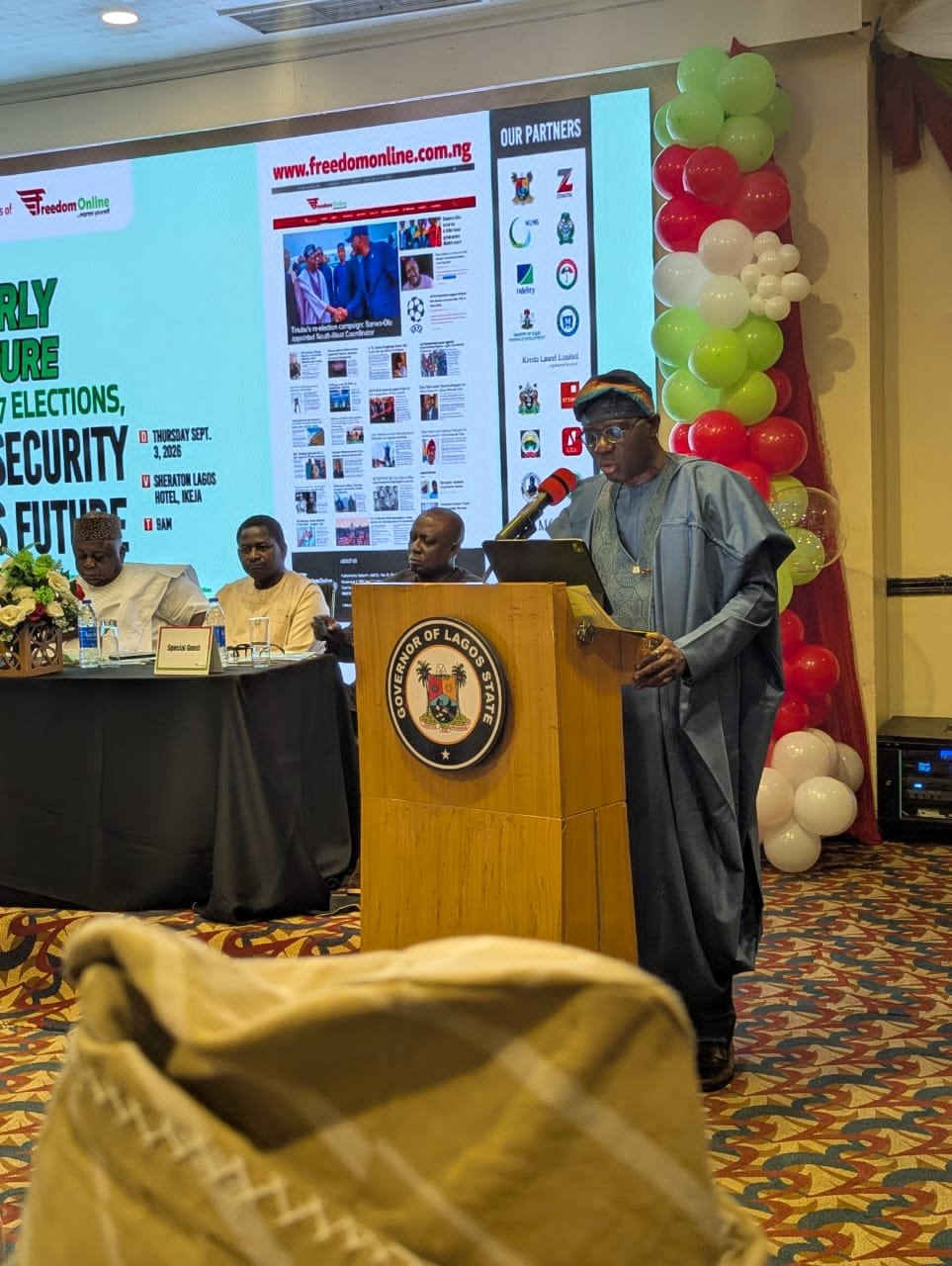
The Lagos State Governor, Babajide Sanwo-Olu, has waded into the face-off between the President Bola Tinubu-led Federal Government and Presidential candidate of the African Democratic Congress (ADC) over fuel subsidy return after the 2027 election, disclosing that the measure adopted by the incumbent president was basically to prevent the country from being plunged into economic crisis.
Sanwo-Olu, who stated that Atiku and other opposition members claim were mainly to deceive Nigerians towards voting for them, added that Tinubu’s economic policy, particularly subsidy removal, remain the most profitable plan that could address Nigeria’s economic challenges in 2023 after assuming office.
While rebuffing the assertions by Atiku and other political parties bigwigs, the Lagos governor stressed that the resources spent by previous administration on fuel subsidy could be deployed to sacrosanct infrastructural developments which would cut across roads, schools and hospitals, as well as assist the country in the fight against terrorism and providing succour to victims.
Sanwo-Olu’s defence of the Tinubu economic policy on Thursday at the 7th annual lecture of Freedom Online held in Ikeja themed: ‘2027 Elections, Economy, Security and Nigeria’s Future’, came after Atiku faulted the fuel subsidy removal and promised to reverse it if declared winner and sworn in as the country’s next President.
He opined that the existence of the fuel subsidy had become an unsustainable drain on government resources, adding that the reform is in place due to the need to further build a stronger security architecture capable of protecting lives, property and economic activity.
“That election is now 135 days away. The presidential campaign opened officially on the 19th of August. The governorship campaigns open in six days, on the 9th of September.
“The season is upon us, and the two questions that will define it are exactly the two on this morning’s program: the economy and security.
“Distinguished ladies and gentlemen, we have already seen the shape of the campaign. Barely two weeks in, opposition politicians have reached for the fuel subsidy as their instrument of choice. We will see more of this. We will see promises that no treasury on earth could honor.
“We will see coalitions form, dissolve and re-form, sometimes within the same week. This has been the pattern of every election season in this country, and 2027 will not be the exception”.
On security, the governor said that the fight against insecurity has enabled the expansion of the Nigerian Army from eight to 12 divisions and plans to recruit an additional 28,000 personnel as part of efforts to strengthen the country’s security capacity, also mentioning that the policy led to a renewed advocacy for state police, citing the Lagos State Security Trust Fund as a model for mobilising resources and supporting security agencies at the sub-national level.
He also cited recent economic indicators as evidence that the country was beginning to see the impact of reforms, including 4.43 per cent gross domestic product growth in the second quarter, improved external reserves, declining inflation, a trade surplus and upgraded credit ratings, adding that the developments should form part of the national conversation as Nigerians prepare to decide the country’s political direction in 2027.
Sanwo-Olu also highlighted Federal Government programmes targeted at youth development and human capital, including NELFUND, the 3 Million Technical Talent programme, reforms to the National Youth Service Corps, the Nigerian Youth Academy and student venture capital grants.
The state’s executive head stressed that the economic growth would have little meaning if insecurity continued to undermine businesses, discourage investment and deprive young Nigerians of opportunities.
He opined that the electoral reforms, including the Electoral Acts of 2022 and 2026, biometric voter verification and electronic transmission of results, were designed to strengthen confidence in the electoral process, mentioning the recent Osun governorship election, where the All Progressives Congress conceded defeat to Governor Ademola Adeleke, as evidence that Nigeria’s democratic institutions were capable of producing peaceful political transitions.
The Governor, who is close to the exploration of his two-term in office, urged the attendees at the event, Lagos residents and Nigerians as a whole, to jettison submissions of the APC opposition parties, stating that the Bola Tinubu’s administration as the President of the country would continually act in the interest of the populace in providing dividends of democracy.