

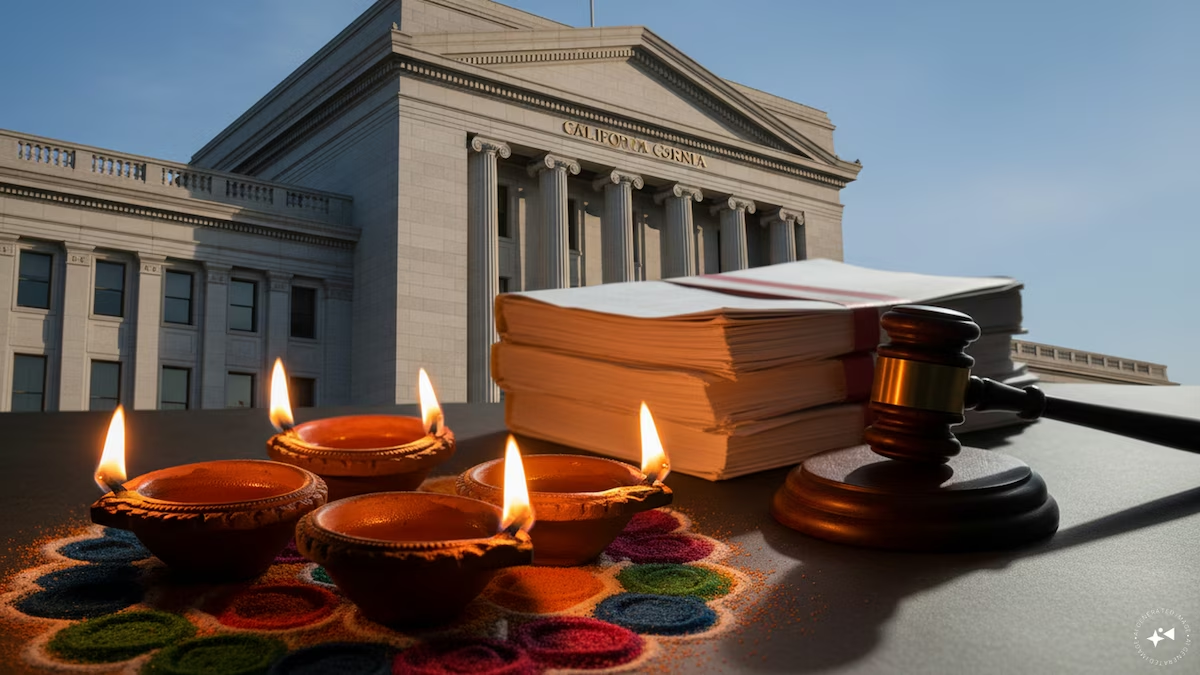
The controversy began after California Governor Gavin Newsom signed legislation last year making Diwali the state’s 12th recognised holiday, according to Los Angeles Times. However, the law is now on hold after a Sacramento County Superior Court judge ruled in favour of a petition challenging its implementation.
Why was the law challenged?
The challenge was filed by the San Francisco Taxpayers Association, which argued that recognising Diwali as an official state holiday would be costly, violate the US Constitution and effectively give Diwali a preferred status over other religious observance.
According to the petition, the law would have allowed eligible state employees who observe Diwali to receive a paid holiday. It also gave schools and community colleges the option to close on the festival and permitted classroom activities acknowledging the occasion.
The group estimated that implementing the law could cost up to $68.8 million in administrative expenses. The petition’s lawyer, Paul Scott, said the legal challenge was not directed against people who celebrate Diwali. Instead, he argued that making it an official state holiday could be seen as government endorsement of a particular religion, something prohibited under the US Constitution.
Scott also argued that the law would allow schools to celebrate Diwali in classrooms while potentially placing followers of other minority religions at a disadvantage if their festivals were not given similar recognition.
“If you’re not of that religion and you’re of some other minority religion in particular, that would suggest that Diwali is somehow getting better standing in our community and with the state government; that’s constitutionally problematic,” Scott added.
Court blocks implementation
Last month, a Sacramento judge ruled in favour of the petition, effectively preventing California from adding Diwali to its list of official state holidays for now.
However, the ruling leaves open the possibility for lawmakers to introduce a revised version of the legislation that is not centred on the festival’s religious significance.
Supporters say Diwali is more than a religious festival
Supporters of the legislation argue that the move was intended to recognise California’s diverse communities rather than endorse a particular religion.
Atul Shah, president of the Federation of Jain Associations in North America, said the legislation acknowledged an important observance celebrated by a large and diverse section of Californians while recognising “the contributions these communities have made to the social, cultural, and economic fabric of our state.”
Religious studies professor Archana Venkatesan of the University of California, Davis, also argued that Diwali, much like Christmas, has both religious and secular significance, with celebrations centred on family and community.
A growing recognition of Diwali
California is home to the largest South Asian population in the United States. Had the legislation taken effect, California would have become the third US state, after Pennsylvania and Connecticut, to officially recognise Diwali. In addition, public schools in New York City close for Diwali, while New Jersey allows students to take the day off to observe the festival. Los Angeles County has officially recognised Diwali since 2022.