

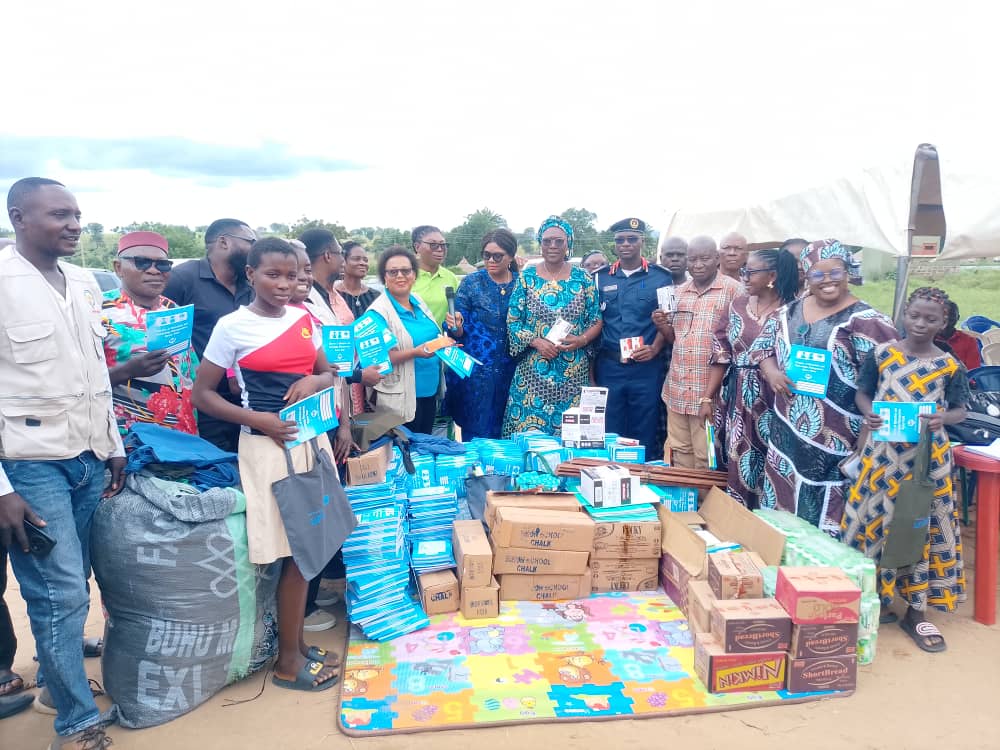
(Benue Children With Learning Materials. Photo by Sun Nigeria)
The United Nations Children’s Fund, with funding from the Swedish International Development Cooperation Agency, has renovated four classroom blocks comprising 13 classrooms and provided teaching and learning materials for 2,400 internally displaced children at Abagena IDP camp in Benue State.
The UNICEF Chief of Enugu Field Office disclosed this during the handover of renovated classrooms and educational materials to the Benue State Emergency Management Agency and the Ministry of Education at the camp in Makurdi.
The official explained that the intervention aimed to ensure children affected by displacement continued accessing safe, protective, and supportive learning environments despite disruption caused by the humanitarian crisis within the state.
According to the organisation, eight canopy tents have additionally been provided as temporary learning centres across multiple IDP camps to enable displaced children continue their education while awaiting more permanent facilities.
The organisation further supplied 250 school desks to children across several camps, describing this intervention as part of broader efforts to restore dignity and comfort for children learning within displacement settings.
The official indicated that the teaching and learning materials being distributed are expected to benefit more than 2,000 internally displaced children, focusing on improving literacy, numeracy, psychosocial wellbeing, and active learning participation.
Beyond infrastructure and learning materials, the organisation disclosed engaging 62 volunteer facilitators and mentors to teach and coordinate learners across 52 accelerated basic education and non-formal learning centres within six IDP camps throughout Benue State.
This initiative was designed to support children who missed formal schooling due to displacement in catching up with peers, regaining confidence, and continuing their education.
The UNICEF representative emphasised that education remains critical during emergencies, providing children with stability, hope, protection, and essential skills for rebuilding their lives.
She called for sustained collaboration among government institutions, humanitarian and development partners, civil society organisations, the private sector, traditional and community leaders, and donors to expand educational investments for displaced children.
She additionally urged stakeholders to provide more safe learning spaces, expand accelerated and formal education programmes, support teachers and facilitators, strengthen child protection and psychosocial support systems, and create pathways enabling displaced learners to transition into formal schooling.
Emphasising that education cannot wait, she stressed that sustained investment remains necessary to ensure every displaced child in Benue State receives fair opportunity to learn, recover, and thrive.
Receiving the items on behalf of the state government, the Commissioner for Education and Knowledge Management expressed gratitude toward UNICEF for their continued support to Benue State, particularly regarding educational access.
She described the intervention as a significant milestone for the current administration, bringing quality education access to children considered out of school due to their particular circumstances, noting the initiative extends beyond this single camp to benefit displaced children throughout multiple locations.
The commissioner noted that the state governor considers education central to human capital development, evident through substantial renovation and equipping of public schools throughout the state.
She explained that under the current administration, every individual matters regardless of age, emphasising that children possess significant potential despite their youth.
She expressed appreciation for the intervention’s role in bridging existing learning gaps and integrating these children into mainstream informal education.
She emphasised sustainability considerations, explaining that teachers were deliberately trained from within the camps rather than brought from outside, assuring that these teachers would eventually enter mainstream employment during future recruitment exercises to ensure programme continuity.
She noted regular interaction with camp residents, particularly parents, encouraging them to take ownership of these facilities and ensure proper security and protection against theft.
She urged beneficiaries to view this opportunity as valuable, encouraging diligent learning while cautioning against truancy and urging proper care for provided resources.
Speaking on behalf of the 62 facilitators, one representative thanked UNICEF for providing robust training that would enable them to positively impact student knowledge, promising to apply their learning toward developing future leaders from within the IDP camps.
Some pupils expressed gratitude toward UNICEF and the funding agency for their assistance, noting that many classmates previously sat on the floor before receiving these donations, while expressing confidence that the new provisions would facilitate learning within a more conducive environment.