

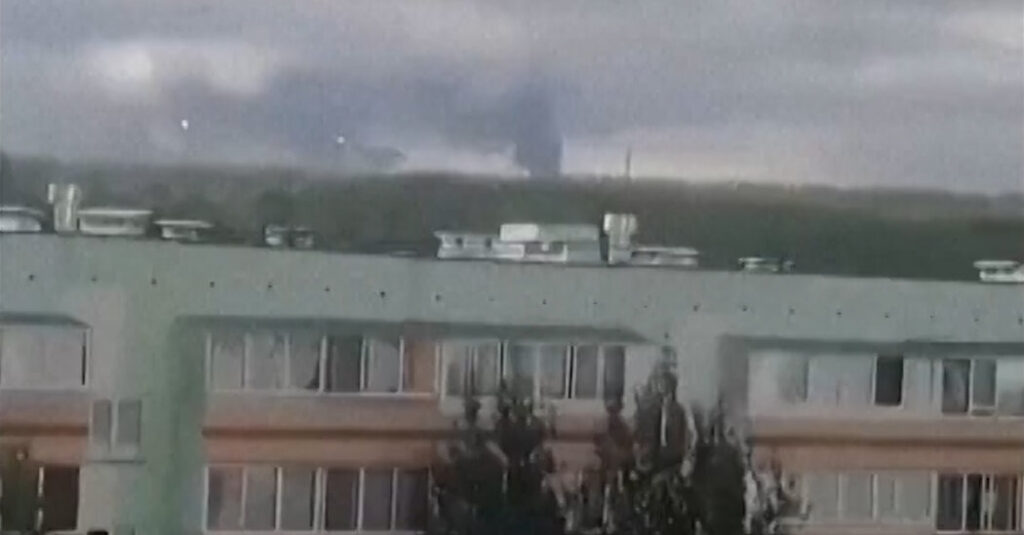
A Ukrainian drone attack Monday on an industrial city about 550 miles east of Moscow was among the deadliest on Russian territory since the full-scale war began in 2022, demonstrating Kyiv’s growing ability to strike far beyond the conflict’s front lines.
At least 13 people were killed and 39 others wounded in the strikes, according to the local mayor. Russian investigators said that civilian and industrial sites had been hit in the city, Nizhnekamsk, which is home to one of Russia’s largest and most advanced oil refineries. In a statement, the country’s Investigative Committee said a child was among those killed.
Ukraine’s General Staff said that Ukrainian forces had struck the Taneko oil refinery, and that a fire had been recorded there. In recent months, Ukraine has systematically targeted Russian oil refineries to disrupt fuel supplies to the military and to civilian consumers, causing long lines at gas stations.
The Kremlin has scrambled to resolve the shortages, and lines have since dissipated in Moscow and St. Petersburg. But supply pressures remain, and oil companies now have to spend billions of dollars on repairs.
The Uzbek consulate in Kazan, the regional capital, said seven Uzbek citizens were killed in the Ukrainian assault on Monday. Hundreds of thousands of Uzbeks work in Russia.
While deaths among civilians in Russia are growing, they still pale in comparison to civilian casualties suffered in Ukraine, where Moscow has targeted cities with heavy missiles and drones throughout the invasion.
As the war has largely reached a deadlock along the front lines in eastern Ukraine, Kyiv has sought to puncture the sense of normalcy that has defined life in most of Russia, even as thousands of Russian soldiers continue to die in the fighting. Ukraine has tried to exert enough social and economic pressure on President Vladimir V. Putin of Russia to force him to seek a cease-fire along the current front lines.
Ukrainian drone attacks have disrupted air travel across Russia and prompted widespread mobile internet shutdowns. The strikes have also triggered the worst fuel crisis in the country’s recent history and inflicted immense damage on Wildberries, Russia’s largest online retailer. Ukraine has hit more than 20 warehouses belonging to the company.
But without a large stockpile of long-range missiles that can carry heavier payloads than the explosives delivered by drones, Ukraine’s strikes inside Russia have still had a limited impact.
Life has remained largely undisturbed in Moscow and St. Petersburg, Russia’s two largest cities, as Ukraine has mounted only a few successful attacks on them. The Russian economy, while weighed down by heavy spending on the war, is not near collapse, and it has received a boost from higher oil prices driven by the conflict between the United States and Iran.
As Kyiv has expanded its strikes inside Russia, Moscow’s forces have done the same in Ukraine in recent weeks. Drones, glide bombs, and cruise and ballistic missiles have rained down on Kyiv and other major cities. Russian attacks have killed hundreds of Ukrainian civilians this summer, according to the United Nations.
Moscow is seizing on the depletion of Ukraine’s air defenses. A global shortage of the most advanced interceptors for Patriot air defense systems, the only weapons in the Ukrainian arsenal that are capable of taking down ballistic missiles, means that Ukraine is likely to remain vulnerable to aerial bombardment.
Russian attacks have also damaged Ukrainian water and electricity systems. As autumn approaches, fears are mounting that Russia will again target Ukraine’s heat and power infrastructure, leaving Ukrainians to face another brutal winter of cold and darkness.
On Sunday, following Russian strikes on Odesa, Sumy and other Ukrainian cities, President Volodymyr Zelensky warned that Ukraine would continue to hit back. “Russia’s war will be felt more and more at their own home — in Russia,” he said in his nightly address.