

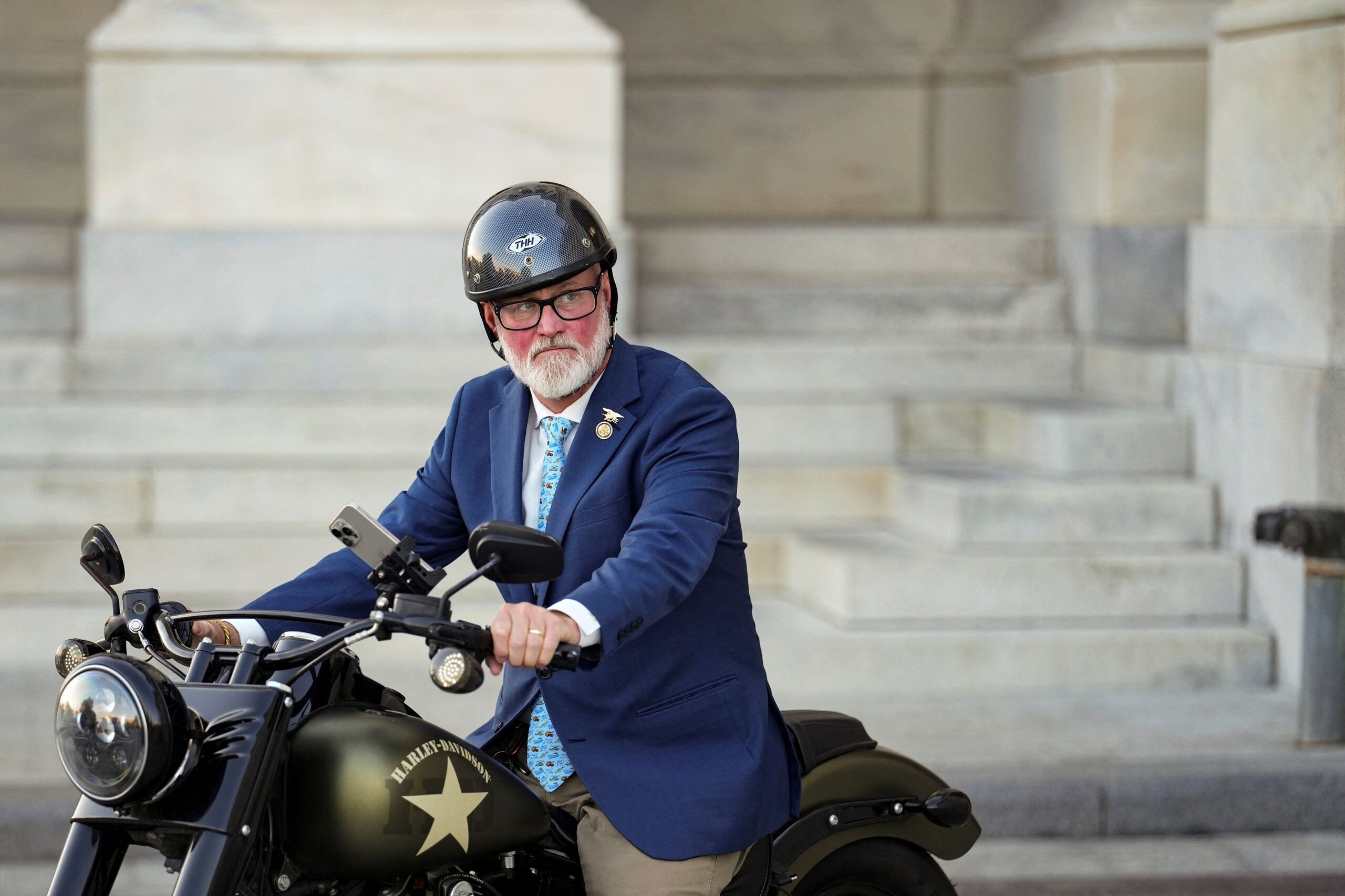
Two Republican lawmakers have introduced legislation that would prohibit Washington from requiring motorcyclists to wear a helmet, raising concerns among road safety experts and marking what some say is another attempt by federal lawmakers to interfere in D.C. affairs.
Rep. Derrick Van Orden (R-Wisconsin) and Sen. Tim Sheehy (R-Montana) introduced bills in the House and Senate Thursday that would overturn D.C.’s law requiring all motorcycle operators and passengers to wear a helmet, regardless of age. Forty-seven U.S. states have motorcycle helmet laws of some kind, 17 of which have universal helmet laws like D.C.’s, according to the Governors Highway Safety Association.
Van Orden — a Harley rider — wants to use his “Ride in Freedom Act” targeting D.C. as a starting point to try to roll back helmet requirements across the country, according to his spokeswoman, Grace Kim.
“D.C. is an important place to start,” Kim said. “If Congress can change the policy here, it opens the door to having a larger conversation about the federal government’s role in helmet mandates across the country.”
Safety experts said the move would have severe consequences.
Universal helmet laws are “one of the most effective, common-sense rules of the road for improving motorcycle safety,” according to Eric Teoh, director of statistical services at the Insurance Institute for Highway Safety. D.C’s helmet law is the current best practice, said Teoh, who researches motorcycle safety.
“Weakening that will result in people dying,” he said.
The proposed legislation comes as road deaths are up in Washington — and as Republican lawmakers have sought to exert more control over the city. In July, Rep. James Comer (R-Kentucky) introduced a bill that would require D.C. lawmakers to get congressional approval before raising or lowering taxes and fees, considered among the most severe threats to the city’s autonomy in recent memory.
Traffic fatalities in D.C. more than doubled during the first half of this year compared with the same period last year, according to city data. That was due, in part, to an uptick in fatal motorcycle crashes, according to the District Department of Transportation.
Riders face significant risks “because of higher operating speeds and the limited protection motorcycles provide in a crash,” DDOT said in a statement last month. Responding to the legislation, the agency said helmet requirements “are designed to protect roadway users and reduce the risk of serious injury.”
So far this year, six people have died in motorcycle crashes in D.C., compared to two in 2025 and 10 in 2024, according to city data. Since 2014, at least 67 people have died in motorcycle crashes in D.C. (The data does not say whether the motorcyclist was wearing a helmet.)
Council member Charles Allen (D-Ward 6), who chairs the D.C. Council’s transportation committee, called the legislation “an unserious and unsafe proposal.”
“A member of Congress from Wisconsin has nothing they can do to make life a little more affordable or a little bit better for their own constituents, so they spend their time writing helmet laws for people riding motorcycles in DC? I really think they can be better than this,” Allen said in a statement.
Sam Trumbull, a member of the D.C. Families for Safe Streets steering committee, a group focused on reducing traffic fatalities, said she doubted the bill would make it through the Senate. But she said she’s concerned it is “part of an enormous slate of attacks on D.C. and D.C.’s home rule.”
Motorcycles, beloved by their owners and impassioned advocates, are dramatically more dangerous than cars. In 2023, the U.S. Department of Transportation estimated that, per mile traveled that year, the number of deaths on motorcycles was nearly 28 times higher than cars.
In 2024, 6,228 motorcyclists died in crashes around the country, according to federal data. Those deaths accounted for 16 percent of all motor vehicle crash deaths that year and were about triple the number of motorcyclist deaths in 1997.
In the 1960s, the federal government required states to enact universal helmet laws to qualify for certain highway safety funds, according to the Governors Highway Safety Association. By 1975, all but three U.S. states had implemented universal helmet laws, which advocates said saved lives. But in 1976, after Congress revoked federal authority to issue penalties over the issue, the association said some states began to weaken helmet laws so they apply only to young or beginner riders.
In Wisconsin and Montana, helmets are required for motorcycle operators under the age of 18.
Van Orden believes that “a motorcycle is a symbol of freedom,” said Kim, his spokeswoman.
“The federal government has had a hand in helmet requirements going back to the Highway Safety Act, which used highway funding as leverage to get states to adopt helmet laws,” Kim said. “This is an issue he has heard directly from the people who ride and work in the motorcycle community.”
Sheehy’s office did not respond to a request for comment.
In Wisconsin, 102 motorcyclists were killed and 1,805 were injured as part of 2,148 motorcycle crashes in 2024, according to the state. That year there were 41 fatal motorcycle crashes in Montana, federal data show.
In states without universal helmet laws, 51 percent of motorcyclists killed in 2023 were not wearing helmets, according to federal safety data. In states with such mandates, just 10 percent of motorcyclists killed had no helmet.
Some motorcyclists feel strongly about having the liberty to decide for themselves whether they want to wear a helmet, according to Teoh, the motorcycle safety researcher.
“You need to also weigh the cost of what that means,” Teoh said, adding that the dangers are profound. “This is a very terrible cost for the freedom to ride with the wind in your hair.”