

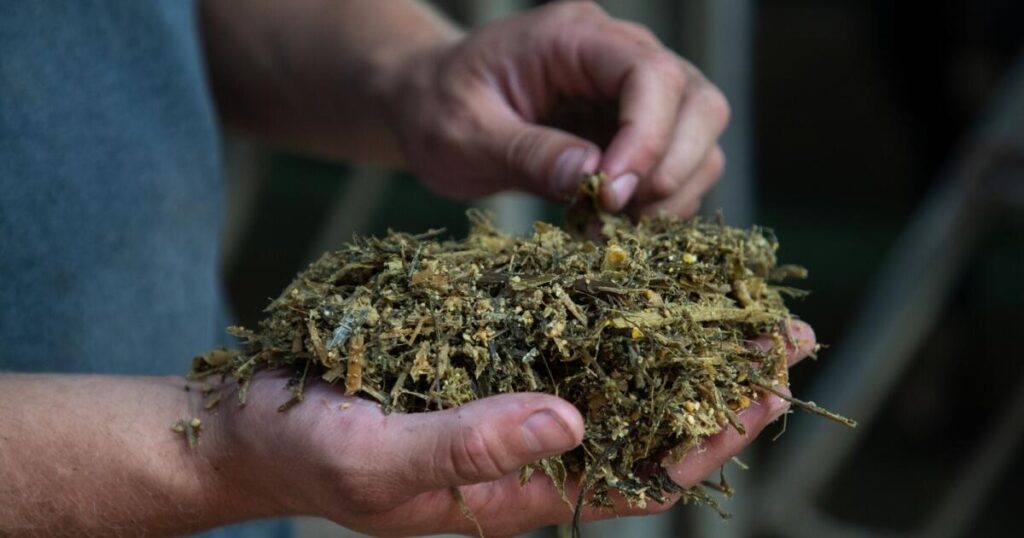
At Perkins Twin Creek Farm Inc., black-and-white Holsteins line up to munch on piles of a bespoke bran-colored feed.
This isn’t the usual cow chow made using commoditized soybeans trucked in from afar. Instead, it’s an upgraded mix including heart-healthy soybeans that were grown in a field right outside the barn, then roasted whole and ground just steps away.
Indiana dairy farmer Mitch Perkins said since his family switched their 450 dairy cows to the custom rations, the herd produces richer milk.
“I think they like it better,” Perkins said of the feed made with high oleic soybeans, so named for their elevated levels of the same heart-healthy fat found in olive oil. The cattle, he added, spend “more time with their head in the bowl.”
Perkins is one of many dairies in the Northeast and Midwest shifting to the premium beans. The burgeoning market is a new source of income for US soy farmers as exports increasingly get entangled in trade disputes with the top importer, China. The growing dairy demand and weaker pork sales have led cows to overtake hogs as the second-biggest source of feed use after poultry, according to the United Soybean Board.
“They cover so many bases nutritionally for a cow,” said Perkins, whose farm in Wolcottville, Indiana, produces enough high oleic soybeans to supply some to neighboring dairies.
Typically, mass-produced soybeans are sent to processing facilities where millions of bushels are crushed per day, and the oil is then separated out to be used in everything from salad dressing to Goodyear tires, biodiesel and Skechers’ shoe soles. The leftover meal is used for animal rations, though conventional soy is a simple feed ingredient that needs to be supplemented because most of the fat has been stripped out.
But high oleic soymeal is catching on.
Healthier Fat
The beans contain 70% or more oleic acid, a monounsaturated fat; commodity beans generally contain about 22%. Livestock get more healthy fat from the meal, meaning farmers spend less on costly additives. Perkins’ dairy has seen a roughly 30% drop in feed costs.
Soy growers also benefit as high oleic beans usually sell for a premium of about $1 per bushel above standard supplies.
That’s a boon when soybean prices for the last few years have been trading well below their all-time high of nearly $18 a bushel. For much of 2026, the commodity has hovered between $11 and $12 a bushel on the Chicago Board of Trade.
Selling specialty beans is also a way for farmers to insulate themselves against the US trade war. China, which has the world’s biggest hog herd, typically brings in about two-thirds of global soybean exports and can make or break a year for US farmers.
“We still need China. It’s still our biggest customer,” said Don Wyss, a grower in Fort Wayne, Indiana, who also serves on the United Soybean Board, which is funded by a government-mandated fee on farmers’ sales. The program funds soy marketing and has invested some $100 million in high oleic soybean research.
Flipping to Feed
Initially, the biggest push for high oleic soybeans was for human consumption.
Stop by an Indiana Colts or Indiana Fever game and the tater rings or the churro-style donut holes at concession stands might be deep fried in high oleic soybean oil. At Nestlé, it’s used to make non-dairy coffee creamers richer.
However, soy faces competition from a slew of other oils including sunflower, palm and corn oil. Soy’s use as a biofuel feedstock makes trading volatile and vulnerable to crude price swings — giving food producers reason to switch to other oils. For farmers, the dairy-feed sector is potentially a safer bet.
“It’s flipped in terms of a market breakdown,” according to Darren Moody, senior director of market development at the United Soybean Board. Nowadays, most high oleic soybeans are used for feed.
Still, only about 1 million soybean acres out of more than 85 million nationwide are of a high oleic variety this season, according to the industry group, which estimates the beans could reach 5 million to 7 million acres within a decade.
Meanwhile, seed supplier Corteva Inc. says it’s starting to see demand for high oleic beans spread to dairy facilities in the Northwest.
“It’s a new domestic demand source for soybeans and it’s a way for farmers to earn additional revenue or margin,” said Roger Theisen, Corteva’s marketing manager for specialty crops.
Roasting Boom
In Indiana, Steven Zimmerman’s roasting business, Miller’s Grain Roasting — which he took over from his father-in-law — used to be seasonal enough that he supplemented it with sandblasting gigs. These days, he has no time for the side-hustle.
“High oleic put roasting on steroids,” Zimmerman said on a recent Tuesday as he kept an eye on the temperature within his 800-bushel-an-hour Roast-A-Matic. The massive metal drums cook and cool several thousand bushels of beans just steps away from the corn fields and cow barns at Perkins dairy.
Some 40 miles north in southern Michigan, fourth-generation farmer Brian Preston said his family grows about a third of the high oleic soybeans that they feed their roughly 1,000 cows. After making the switch, their daily feed costs dropped by about 70 cents per cow, while the butterfat content of their milk rose from 4.4% to 4.8%, increasing its value.
The family uses an electric roaster they installed next to their dairy farm’s feed center to prep the beans.
New York soybean grower and roaster Todd Du Mond was among the first to start raising high oleic beans in the state a few years ago, swapping them for some of the commodity beans he’d been growing on his 6,500-acre farm. Now, thanks in large part to the premium the specialty beans command, he’s removing commodity soybeans, about 90% of which are genetically modified, entirely from his rotation.
“We don’t even consider doing GMO at this point,” Du Mond said.
Ailworth and Michael Hirtzer write for Bloomberg.