

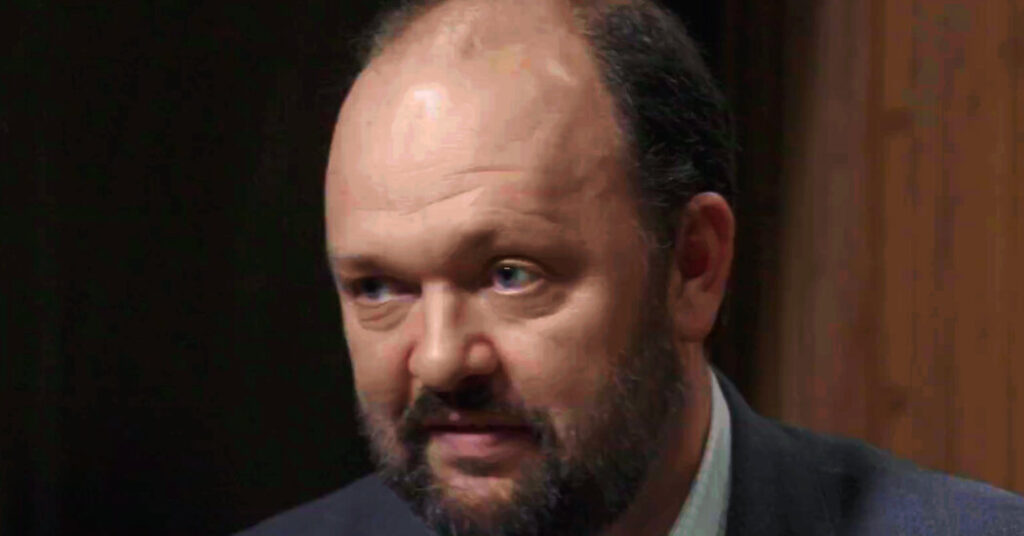
This is an edited transcript of “The Ezra Klein Show.” You can listen to the episode wherever you get your podcasts.
I’ve known Ross Douthat a long time.
We were bloggers back when the Earth was young. Then I watched him become a columnist here at New York Times Opinion in 2009, the youngest-ever New York Times Opinion columnist.
About a year ago, he launched “Interesting Times,” which has been a great fellow podcast here in Opinion. And then, breaking all of our hearts, Ross has announced he’s going to “60 Minutes,” where he’ll be a correspondent.
So I wanted to talk to Ross on his way out of here about how he has seen media change, how he has seen politics change and how, maybe, he believes it is changing again.
Ezra Klein: Ross Douthat, welcome back to the show.
Ross Douthat: Thanks for having me, Ezra. It’s a pleasure.
What the hell, man?
What do you mean?
Going to “60 Minutes”? You’re leaving us?
I mean, spiritually, you never leave any place that you love, and all things are gathered in by God for his — but yeah, I’m going to “60 Minutes.”
All right. We’re going to get to “going to ‘60 Minutes.’”
But we’re going to start with where you came from. Where do you locate your own spiritual origins as a journalist, as a commentator, a pundit?
I had always thought you were like me — an original blogger who gets absorbed by a media Borg.
Oh, yeah. No, it was the opposite.
Yeah, you’re the opposite. You started at The Atlantic and became a blogger.
You know, I was a junior, junior, junior editor. I edited the Letters section at The Atlantic for a while, and I did blogging on the side.
I think of myself as someone who was present for both the end of an old dispensation and the beginning of a new one.
So I had sort of parallel careers in my early 20s. I had the career inside The Atlantic, where I was doing junior editor work. I was trying to work my way up the masthead at an institution where you were still doing fact-checking and copy editing on these huge sheets of paper that would be printed out and circulate around the office, and 17 people would have red pen on them. It was very much a pre-internet magazine and a pre-internet journalistic experience.
And then, at the same time, sort of as a side hustle, I was blogging, doing freelance writing and participating in the world of the early 2000s internet. Those two things converged because what then happened, as you know, was that many, many traditional publications looked at that landscape and said: Ah, this is the future, and we need to co-opt it.
So at The Atlantic, that meant basically creating a mini editorial page, or opinion page, that consisted of prominent bloggers who The Atlantic had hired. So there was a period when they brought in Andrew Sullivan, who was then the biggest deal in blogging. But they also had Matthew Yglesias, Megan McArdle, Ta-Nehisi Coates and then me, because I was already on staff. And I can tell you that my own traffic numbers were somewhat lower than the others.
But that was sort of the path, as you know, in that era, because you followed it, too. It was to be a kind of outsider blogger-critic of the establishment, and then an establishment institution might hire you or buy your blog or bring you on board. It was just that, in my case, I was already on board when that happened.
So how would you describe to somebody who was not around for that — a young journalism student today — what blogging was?
What made it different? What made places like The Atlantic — and, eventually, The New York Times — think they needed to be part of it, too?
So there were a couple of cohorts of bloggers who became a big deal. The first wave was immediately after Sept. 11. And then in the run-up to the Iraq war, where you had a set of people who — some of them were former liberals who had moved right, some of them were just right-wingers — but they got called the “war bloggers.”
And these were people who were — I would say the simplest way to put it is that something crazy had happened, something world altering had happened, at the exact time that the internet was emerging as a force.
So there was a huge market, suddenly, of people who were on their web browsers, looking at a screen all day, who wanted to hear people talking about terrorism, Sept. 11, Islam in the Middle East, and then Afghanistan and Iraq and so on.
It’s not surprising that the people who filled that niche were mostly people who were in favor of the war on terror and then in favor of the war in Iraq. But I think it really was that the event and the demand — or the event and the technology — intersected to create this opening.
I remember being an intern at National Review in the summer before Sept. 11, so the summer of 2001, and I think Sullivan was blogging. There were two or three people who were — when did you start blogging?
In 2003.
OK.
I was a freshman at U.C. Santa Cruz.
Right. So in 2001, you had the internet, and you had a few bloggers. And I remember just sitting in the offices of, again, this 50-year-old magazine. I’m an intern, I have very little to do, and you just sort of hit refresh on Andrew Sullivan’s blog, and you see if he has posted something new. Mickey Kaus — Kausfiles was also probably one of the initial blogs at that point.
But then Sept. 11 happens, and suddenly, you just have a lot more people hitting refresh and having this kind of demand.
Well, I want to go before that.
One of the things that I find interesting about this period is that this is one of these places where, I think, media has changed more than people really realize. There just wasn’t a lot of political opinion accessible to most people.
I grew up in Orange County, Calif. My family subscribed to The Los Angeles Times. There’s an Op-Ed page in the L.A. Times that I would read sometimes. We were not a family that got small-circulation, D.C., political ——
The in-flight magazine of Air Force One.
Yeah, The New Republic.
The New Republic, yep.
The American Prospect; National Review, which is a conservative magazine that you’ve written a lot for; The Atlantic.
There was talk radio by that time, but even that had only been on the scene for so long, in its sort of post-Rush Limbaugh form.
Right.
When I was growing up, Fox News was beginning to roll out, but it wasn’t what it would eventually become. I remember MSNBC beginning, and ——
You had “Crossfire” ——
You had “Crossfire” on CNN ——
That was what you watched if you were into opinion.
You had MSNBC — originally as Microsoft NBC.
Yeah.
I remember there being — it was about tech primarily, and I remember watching a show with Soledad O’Brien where she had an animated co-host, like a clip-art co-host.
What I always saw blogging filling was an unmet demand for political opinion. And particularly after Sept. 11, when people were really, really interested in politics, really upset about what was happening, really uncertain about what was happening — and all of a sudden you can get a flood of it.
Now there is so much more opinion, between X and Instagram and Substack and everything else ——
Yep, it’s opinion all the way down.
And it’s the news that has been somewhat drowned out.
But then, it was somewhat revolutionary that, all of a sudden, you could be refreshing your browser, and throughout the day getting more and more and more commentary on what was going on.
But the other thing that was revolutionary was that it was opinion, but it was also just a very different kind of argument from what you would get reading Op-Ed pages and even small-circulation journals.
But early blogging was all about this ongoing, rolling debate, where you’d write 4,000 words, and someone else would come along and block-quote 500 words ——
Very few people would write 4,000 words on a blog. That might have been your thing. [Laughs.]
I mean — yeah, all right. Someone would write ——
Three hundred words.
I mean, but this was also it, right? You had more length.
There were people early on — maybe I’m thinking too much of the war bloggers. The war bloggers were all about: Let me give you 2,500 words on how this event in ancient Greek history totally explains George W. Bush’s brilliant plan to remake the Middle East. There was a lot of prolix content, but maybe some of it was just created by this structure of: You quote someone, and you say why they’re wrong.
But people did this back and forth to each other constantly. It was hostile, but it was also, I think, at its best, really interestingly respectful — because you were putting the other side’s words on your site.
Even if you were doing it just to show what a total idiot they were and how terrible they were, you were still saying: All right, here’s 200 words I’m quoting, and I’m going to go line by line, and I’m going to respond to every single line.
That was, I think, a really distinctive part of it — at least for the first few years.
I’ve thought a lot about why I think the blogosphere was healthier than what came after it, and whether or not that was just because I was in my 20s, and people liked what was happening when they were in their 20s. The music was better.
But I do think this was, to me, the reality of it. It was fundamentally conversational. You wrote things in the expectation that the people you were writing about would read them, and they would answer you.
And I don’t think that is how a lot of media works now. Instead of talking to the people you’re talking about, you talk about them on X or Twitter. You quote-tweet and dunk on them, and then you look for the hearts and the retweets. It has really changed the currency.
I remember — so I began my blog in 2003, and the only way you could get readership — I mean, there were no algorithms. You were not winning Google Search results.
Right.
The way you got readership was through these links back and forth. Right now, what happens is the reward, and the way that audience is secured is you get people who agree with you to retweet it, to restack it, whatever it might be.
But back then I actually wanted — I disagreed with Andrew Sullivan on all kinds of things. And it was good for me if Andrew Sullivan block-quoted me and then argued, and then I would block-quote him and argue back. And we would go back and forth.
And it wasn’t that it could never be disrespectful — it was often heated. But there was still a sense that you were in relationship. People talked about the blogosphere.
Right. You had a blog roll. And the people you put on your blog roll ——
You had these links — you had an ecosystem ——
Yep.
Well, so we’ve had a lot of arguments over the years in our days as bloggers. But I thought it would be fun to go back to one of them in particular, on what I think is fair to say is a forerunner to podcasting, which is Bloggingheads.tv, the Robert Wright project ——
I knew I was going to regret this. Yes, Robert Wright, who is older than us, a brilliant writer, and who basically invented podcasting without getting credit for it because the world was not quite ready.
Archival clip of Ross Douthat and Ezra Klein:
Ross Douthat: The story at the moment is: John McCain’s running the most disgraceful campaign in American history, possibly? Maybe world history?
Ezra Klein: I think global, planetary, universal history is where we’re at, basically.
Douthat: Right, so it’s been pretty disgraceful. So basically McCain has — there’s been a flurry of ads, statements, back and forth with him in different ways, from the McCain campaign. Shades of the truth or not shades of the truth; have been outright lies ——
Klein: “Redacted” is, I think, the word you’re looking for.
Douthat: Right, and ——
Klein: Often redacted the truth.
Douthat: And all the great and good observers, the sort of Joe Kleins and E.J. Dionnes and so on have weighed in with remarks. I think Richard Cohen is the latest today. He has a column. I think it basically says: You know, I used to be in the tank for McCain, but now he’s sold his soul to Satan, and I’m no longer in the tank. So it’s basically the final divorce between John McCain and the reporters who used to love him.
So I want to say, on behalf of myself, I’m being ironic in that commentary.
Yes. It’s a much simpler time.
And it is a simpler time where you, Ezra Klein, were part of a vast liberal conspiracy bent on portraying the war hero John McCain as the most dangerous politician in American history ——
I think we’re both being pretty skeptical there.
Whereas I, a champion — no, I don’t remember whether you were part of it or not, but, yeah.
It’s kind of amazing how different that moment is when you can imagine that there were huge eruptions over the level of negative campaigning from McCain to Obama. I always feel this way when people talk about the Obama-Romney campaigning, where it all just seems so banal compared to where we eventually went.
Right. But part of the argument of many of Donald Trump’s supporters is that it was precisely because liberals insisted that first McCain and then Mitt Romney were history’s greatest monsters that that’s how you got Trump.
But the right — it was so kind to Barack Obama. [Laughs.]
We don’t need to argue about this.
That was my office at The Atlantic. I think that is a copy of “Grand New Party” back there.
But again, the point was that this was somewhat extracurricular, and it was sort of to be Norman Mailer-esque. It’s sort of an advertisement for yourself.
That then, in theory, is supposed to cash out in promotions and new jobs at the existing institutions, which is what happened, again, to that cohort. Which is why I ended up here at The New York Times, and you ended up at The Washington Post.
So you are hired as the youngest-ever opinion columnist at The New York Times, I believe ——
Deep breath, yes.
I believe this is 2009.
Yes. This is 2009, yes.
But you’re also in a funny part of this. Throughout your career — I think it will continue to be the case — you are the more conservative voice at institutions that are understood as, broadly, more liberal. I think that’s true for The Atlantic. I think it’s true for the New York Times Opinion page, people would say.
I wrote the conservative column for The Harvard Crimson. So it goes all the way back.
I’m curious about that experience. Tell me what doing that for as many years — writing for liberal audiences as a conservative, pro-life Catholic.
Let’s start here: What did it teach you about liberals?
So, I like liberals.
That was a long pause after that. [Laughs.]
No, I’m, well — I mean, the first thing to be said is that I always regarded this kind of role as just an incredible opportunity, as a base line, where you write opinions in order to argue and persuade. That’s what opinion journalism, as far as I can see, is supposed to do.
And it’s an illusion to imagine that anyone has their whole worldview altered by an 800-word column or anything remotely like that. But still, on the margins at the very least, you’re trying to pull readers closer to your perspective, move people to some degree, expose people to ideas they wouldn’t otherwise cover. And in that sense, there’s just no better way to do it than to be the person at a given publication who has heterodox views relative to their audience.
And look, obviously there are lots of conservatives who read The Atlantic when I was there. There are lots and lots of conservatives who read The New York Times. So if you’re working for a big publication, you’re never exclusively speaking to people who disagree with you.
But, yeah, clearly I’m speaking to a lot of people who do disagree with me — and that’s a gift. And then you have to remember that it’s a gift, because it’s also a very stressful situation. The claims you make are going to be exactingly scrutinized in a way that is maybe less true of people who assume that the audience is going to be on their side.
Well, what have you learned about writing persuasively?
I mean, this is banal advice, but it’s still the fundamental thing: To argue effectively, you need to understand why people you disagree with hold the views that they do, and you need to start from a version of their argument that is high-minded rather than low-minded, and that is the best version of the perspective that they hold.
And that doesn’t mean that you can’t think that secretly or subconsciously they hold their opinion for bad or wicked reasons, or because they want to just destroy their enemies and salt the earth. You can believe that exists somewhere in their mind. But to argue with them, you have to actually engage with the version of the argument that they themselves would put forward as their own best defense.
So the obvious examples: I’ll pick one from the right and one from the left. So if you are pro-choice and you want to argue with pro-lifers, like actually argue with them, you cannot start from a description of the pro-life position that says: The point of pro-life politics is to subjugate women and punish them for sexual immorality.
You’re allowed to think that’s out there and is part of the socially conservative psyche. You’re allowed to think whatever you want. But you’re not going to get anywhere arguing unless you start with the fact that pro-life people think unborn human lives are human and worthy of legal protection in terms of being human. That’s just where you have to start.
And then to take an issue from the other direction: If you are a conservative opponent of liberal views on immigration, you’re allowed to think that liberals are politically Machiavellian cynics who are bringing in lots of illegal immigrants to vote Democratic. But you’re never going to get anywhere arguing unless you start with what liberals themselves would say, which is that immigration is a humanitarian and economic benefit to immigrants and to the country that receives them.
That’s where you have to start. That’s it. That’s the whole secret. And again, how effective the arguments are that you end up making from that starting point, I don’t know. But I do think, generally, that the act of sustained, attempted good-faith interaction does, even in totally polarized environments, yield a kind of reasonably favorable response.
It’s not the case that you can’t talk across partisan divides. It’s challenging and difficult, and sometimes exhausting, but people are open to it.
I think relatively few opinion writers are actually engaged in ongoing efforts at persuasion. I think, typically, people who think they’re doing that are engaged in ongoing efforts at affirmation, and there are things around the edges where they’re sort of putting their spin on it. But it starts from a kind of locus of major agreement, and then you’re shifting it in one direction or another.
What I think has been interesting to watch across your career is that you actually have been engaged in a very, very long effort at persuasion. You are almost always in relationship with an audience that mostly doesn’t share your views ——
A profoundly successful exercise in persuasion.
Where would you say you’ve been most successful? What would you say you feel you have been most persuasive about?
I don’t honestly know exactly how to judge that.
So, all right, on the one hand, there’s a bunch of things that have happened since I took the Times job that fulfilled my expectations, to some degree, about what was going to happen in American politics and where certain things would go.
Above all, the populist, nationalist transformation of the Republican Party.
It’s worth noting here for people who don’t know: You and your former co-blogger, Reihan Salam, had written a book called “Grand New Party.”
We wrote a book, but beyond the book, we were just involved.
So this wasn’t persuasion directed at liberals, honestly. This was persuasion directed more at our fellow conservatives and saying: Look, the tectonic plates under the Republican Party are shifting. The party has to deal with the fact that it has a more working-class coalition. It has to adapt its policy and rhetoric, all of these kinds of things.
But, in fact, that vision was fulfilled in a way that had absolutely nothing to do with us. It was not the case that we wrote a bunch of columns, persuaded a bunch of Republicans to become more populist, and lo and behold, a populist version of Marco Rubio was elected president in 2016.
No. Obviously our prophecies were fulfilled by Donald Trump, and the whole Trump phenomenon was, and for the most part remains, pretty disconnected from the work of opinion-mongers and would-be intellectuals.
So there’s that. That’s one area of success of a kind, but not the success that I looked for. I think that ——
Well, stop there for a second. In what way was it not right? Put some flesh on that.
So you wrote this book. You’re sort of involved in an effort to say the Republican Party should not be as doctrinally libertarian. It shouldn’t be all about cutting Medicare and cutting Social Security. It had this opportunity, at a time when it did not win majorities of working-class voters, to shift its policies in a way that would make it more appealing to them.
And the kinds of shifts that you and Reihan advocated for had to do with things like immigration, had to do with things like tax credits for kids, had to do with shifting it more pro-family — more concerned with the problems of working-class families from, I would say, a more traditionalist perspective maybe than the left’s.
So how do you describe what happened with that — and then what happened that created the working-class shift? Because Republicans do now win majorities of working-class voters — or Trump, at least, does.
What drove that, that maybe was not in your prescription?
Well, so one: Part of what drove it was just that Trump picked or intuited a different set of issues to focus on than Reihan and I would have favored.
But, generally, we were focused on family policy, wage subsidies, these kinds of things. And Trump was focused on, obviously, trade tariffs and reindustrialization in a way that — I don’t think we fully anticipated how much some of those arguments would resonate in 2016.
I don’t know how much they resonate now. But in 2016, I think a big part of the country was still getting over the shock of the opening to China, and there was just a real percentage of votes for Trump’s flying around the Midwest, going to places that had been hammered and saying: I’m just going to bring back your jobs.
Archival clip of Donald Trump: We’re going to stop businesses from leaving our country. They are being drained out of our country — our jobs, our money, our base and our factories. We are going to stop it.
And that was, again, a different message from saying: We need to use government policy to help people form families ——
And I’m genuinely angry at the people who took it.
Well, that, too, right. So then there’s a more substantial anger, there’s more substantial scapegoating.
Archival clip of Trump: They’re moving to other places. A lot of them are moving to Mexico — don’t underestimate. It’s like the new China on a smaller level — but like the new China.
So our view wasn’t that you should never cut Medicare and Social Security. It was more that if you’re going to cut Medicare or reform Medicare, you should be doing it not just to pass a new upper-bracket tax cut but to free up more money to help working families, would be how the argument would go.
And Trump just said: No, we’re never cutting these things. And so he outflanked all of his Republican primary opponents by realizing that a big part of the Republican base wasn’t on board with Mitt Romney and Paul Ryan.
But what that did was basically create a more popular but much more fiscally unsustainable — and in the end, I think, unproductive — policy mix on the right, where the right defines itself as defenders of old people’s entitlements rather than people who are eager to cut it. And then it has no space left for a lot of the policy ideas that we would have favored.
So that’s part of what happened. The other thing that happened is that we were trying to craft — I think you used the word “traditional.” I would have said a kind of moderate social conservatism that was compatible with the Republican Party’s religious base and pro-life commitments and so on — but tried to start from there and broaden into broader support for two-parent families and marriage and these kinds of things.
What actually happened was that for about 10 years, social conservatism was just routed in the U.S. It lost the argument over same-sex marriage, most prominently, but it lost a lot of different arguments — if you just look at the trends in the 2010s, on all kinds of questions, from drug use all the way to polyamory. Not that the country is universally pro-polyamory, but you can see that leftward shift all over. It ends up showing up on abortion, too.
Trump comes in, on the one hand, as someone who speaks to that, who says to embattled social conservatives and religious conservatives: You’re losing the culture, and you need to live with that and just have me as the tough guy who will defend you.
But then the other thing that happens is that liberalism and progressivism, having won those victories, then radicalize further and say: Well, what happened on same-sex marriage, where we shifted the country completely in our direction in an incredible amount of time, and then declared that the other side are bigots, and we don’t need to talk to them anymore — we can do that with a lot of other issues, too.
And that gets you the woke era, and then it gets you the backlash against the woke era. But the backlash against the woke era is very far removed from a kind of stable, social conservatism building something. I mean, the backlash against the woke era is then — everybody from Catholic traditionalists to pot-smoking libertarians don’t like the woke.
But I don’t know. It’s not a coherent basis for governing the country in ways that I think have become totally apparent in the second Trump term.
Well, you have this famous 2016 tweet. You write: “A thought sent back in time to the theocracy panic of 2005.”
Right.
You seem like you’re enjoying this interview.
You wrote: “If you dislike the religious right, wait till you meet the post-religious right.”
Unpack both sides of that. I mean, for people maybe who don’t really remember what you’re calling the “theocracy panic of 2005,” what was that?
But also, the religious right versus the post-religious right, I think, is actually quite a significant thing. I just did this big “Odyssey” essay, which I would say is very much about that question in a way.
So the theocracy panic was just that George W. Bush won re-election in 2004 with the support of lots and lots of white evangelicals. Liberals were not expecting Bush to win. A bunch of liberals became obsessed with the idea that evangelicalism was taking over America and was going to build a kind of Gilead-esque evangelical theocracy. I thought that was ludicrous at the time and wrote a bunch of essays about it.
And then by the time you get to the mid-2010s, and Trump is winning while being conspicuously nonevangelical, conspicuously non-Christian. It seems like you’re in a world where everything that liberals hated and feared about George W. Bush becomes something they’re nostalgic for. And they see that as you de-Christianize conservatism, you get more bigotry, xenophobia, these kinds of things. That was 10 years ago.
There are a lot of different forms: A post-religious right could be — and you see versions of this — not a terrifying fascist formation, but just a right-wing politics of libertine indifference and proud amoralism.
And again, this is part of Trump’s coalition — people who just hate moralistic arguments and want to do whatever they want to do, and ended up seeing Trump as an avatar for that. Which is, I think, quite different from the part of the post-religious right that is literally people trying to revive a pagan, non-Christian, fascist politics.
But both of those things have existed as phenomena in the last 10 years.
Tell me what you think leads to the phenomenon of the more pagan formation.
So the first time I heard this description of it was actually in an interview that Louise Perry, the British conservative critic of modern feminism, did with your new boss, Bari Weiss. And she was making this distinction between Jordan Peterson and Andrew Tate.
Archival clip of Louise Perry: So you know the really crucial difference between Jordan Peterson and Andrew Tate — there are obviously lots of differences, but the one that I think is most salient to this issue is: Jordan Peterson is basically preaching a Christian message, and Andrew Tate is not. The more I think about it, the more I think that, actually, that’s really the key dividing line if you’re thinking about American culture, in particular.
And that a lot of the fights on the right — she made this argument — are going to begin to come down to this: Are you pushing toward what can be called here, at least in certain forms, a Christian ethic? Or is it about strength, about dominance, about hierarchy?
Obviously, Christianity is a big phenomenon. As is Islam and Judaism. All these religions have many, many different political manifestations.
It’s a complicated world ——
So I don’t want to overly — probably pagans, too — but I do think there’s something to that.
Well, the issue there, though, is that Jordan Peterson is not a Christian. Andrew Tate: That is a right-wing politics that formally rejects Christianity. Jordan Peterson embodies a post-Christian, right-wing politics that is trying.
I mean, he’s been ill for a while, and I don’t want to characterize where he is right now. But generally, he’s engaged in this constant wrestling with the text of the Old Testament and the Christian story and so on, and saying: These are incredibly important, and we need to preserve them — without ever actually committing to Christian belief.
And conservatism, generally, I think, as Christianity has declined, has ended up in this weird place where it’s trying to find some kind of category that includes Christianity, includes traditional religion, but isn’t reducible to it.
So it’s like: Well, we’re defending Western civilization. You’ll hear that a lot from people on the right, and often that language is associated with people on the right who are not themselves formally committed to Christianity.
So Tate is an extreme — but even Peterson himself is navigating in the post-Christian landscape in his own way.
So tell me a bit of how you understand the story. How do we go from the front-facing Christianity of conservatism in the Bush era to this much more post-Christian assemblage? That includes Christians, as you’re saying, but I would say it’s fair to say Christian ethics and virtue are not demanded as a ——
Right. So two things happened. One is, at the mass level, Christianity just declines. It declines sharply between the late 1990s and 2020. And that means that, inevitably, the kinds of appeals and rhetoric and arguments that are normative on the right, when lots of people are going to church, are less normative when fewer people are going to church.
And that’s a very simple story, but I think it does a lot of explanatory work. As a culture gets less formally Christian, it’s not surprising that its leadership would get less formally Christian.
Trump is, again, an extreme case. He takes a trend to an extreme, where he is just nakedly transactional in his relationship to Christianity and doesn’t even necessarily mouth the pieties.
But then at the intellectual level: So let’s say you are a writer or thinker or would-be elite on the right looking at this landscape, looking at not just the decline of Christianity but this sweeping victory for social liberalism that I just described.
Well, you’re going to look at that and say: OK, we had an evangelical president in George W. Bush, we had sort of a Catholic-evangelical alliance defining Republican politics, and what did we get from it? We got secularization and the triumph of social liberalism — so something went wrong here.
And a lot of the controversy and argument and debate among younger conservatives, especially, but all over the place, is this wrestling with: Well, why did we fail?
And there are just a lot of different impulses at work there. You have people who want to leave Christianity behind entirely and say: The problem is just this religion is weak, and its leaders are hapless and effete and soft, and you need a harsh masculine force and so on. That’s a pretty narrow group.
I think what’s more common is a desire among people who are connected to Christianity, who are Christian and so on, to say: Well, where can we find greater strength? Where can we find greater toughness? How can we be more effective political actors? How can we defeat our enemies instead of having them vanquish us?
You could call it a reaching for pagan energy that doesn’t go all the way to actually becoming pagan. And look, the truth is that if you go back and look ——
But Stephen Miller is not a Wiccan. [Laughs.]
Well, Stephen Miller’s not a Wiccan, right.
But I mean, the desire is for strength and toughness and a politics of enmity. There are various versions of this that show up.
And they’re connected, also, to the reality that if you look, obviously, historically, at the expressions of political Christianity in the Western world, they are very comfortable with fighting wars and conquering enemies and all of these kinds of things.
So conservative Christians today who ask: What happened to the crusading spirit? Or something like that. They are not wrong. That has been part of Christian culture in the West for a long time.
But you see this in the debate about “The Odyssey,” for instance, where Christopher Nolan takes “The Odyssey,” and some people have said he Christianizes it.
This is debatable, but he certainly makes the moral vision of the story more compatible with Christianity, where it’s like: OK, Odysseus has committed sins and feels guilt. And he doesn’t glory in war, he doesn’t sleep with Calypso and Circe and so on.
But then there’s clearly a group, not just of would-be neo-pagans but conservative Christians on the internet, who don’t like that and are like: Where’s the war? This is losing the core of the story.
And I think that partially reflects this desire to find something that doesn’t seem present in late-20th-century public Christianity, the compassionate conservatism of George W. Bush — to find some kind of fighting spirit in the theory that’s what you need to overcome liberalism.
It’s funny — it’s an odd take on George W. Bush, in a way, that what he lacked was a fighting spirit. Bush, who won two elections in a row against the Democrats but also launched a large number of wars.
Yes, there were some wars.
Some of this is a creative, or a convenient, misremembering by the right, where you have young nationalists on the right — young would-be nationalists — who will say: The one thing we can’t do is go back to the feckless liberal internationalism of George W. Bush.
But if you look at the things written in the run-up to the Iraq war, and this is maybe where my war blogger reference at the start is actually relevant: They had a lot in common with populist nationalist arguments today.
There’s this recurring idea that the West has gotten soft, and radical Islam has taken advantage of our liberal weakness. We need to show strength and make a friend-enemy distinction in the battle for the Middle East — the whole “national greatness” conservatism.
And history is filled with these fun ironies. There were a bunch of people who were associated with what got called “national greatness” conservatism, which was basically a pretty hawkish form of Republican politics — people like neoconservative writer Bill Kristol — who then end up as the great critics of Trumpism ——
Our former colleague David Brooks ——
Right, our former colleague, David Brooks. He’s a less extreme example.
It’s just really striking. If you go back — nobody hates Bill Kristol more than Trumpists, and Bill Kristol hates Trumpists. But if you go back and read the way Kristol wrote about politics and war and all these things in the late ’90s and early 2000s, he has a lot in common with the way the young nationalists spoiling for a fight write about politics today. It’s just the focus is different.
So why do you think that ended up being such a major split?
Because I agree that is one of the places where you tend to see a lot of split between Trumpists and never-Trumpers — people associated with “national greatness” conservatism. That was an aggressive, muscular conservatism.
Yep.
That was a “We need to defend Western civilization” version of conservatism. And for all the talk about not launching new wars, it does not turn out to be the case that is so central to Donald Trump’s conception ——
Apparently not ——
Of how MAGA works. So why do you think that became such a cut in the Republican coalition?
Well, it was partially a cut, because even though Trump has ended up starting a new war in the Middle East, he really did, pretty strongly, repudiate elements of neoconservative and hawkish foreign policy.
And to the extent that, if you were committed to the idea that the Iraq war had been a good idea, then Trump in 2016 was not your guy. So there was that as a specific breaking point.
Then there was also, to make the case for the Never Trump side, a clear characterological argument where you could say, in the early 2000s, that a politics of “national greatness” only made sense if it was founded on character and virtue in your leaders.
And I don’t think George W. Bush was a paragon of every single virtue, but it’s fair to say that he was a more personally virtuous guy in various ways than Trump. So there were people who had committed to that idea for good reasons, for whom it was just like: OK, I don’t care how muscular Trump is or how into “national greatness” he is. He is just a bad guy, and I’m not going to support him.
And then for younger people, especially after 2016 — once Trump wins, then he just resets the landscape. I feel like with younger people on both the left and the right, the world where we had arguments about the character of American politicians, the world where Bill Clinton’s adultery was something to be litigated — all of these things are just a lost world. And so it’s ——
I think it might be rediscovered soon.
It might be.
I think in the turning of the wheel on this.
Oh, yeah. Right. The next cohort — I mean, yeah, we’re old now, so you can see that each cohort will have a different perspective, and there may be a renewed interest in character.
There’s another fascinating shift, at least to me, that has taken place, which is: We’ve described a couple times here the centrality of evangelical Christianity to politics in, say, 2005.
And now Catholics seem much more central to politics — Catholic thinkers. You have a lot of Catholic converts at the top of Republican Party politics, including Vice President JD Vance, who was just on your show, who just released a book about his Catholic conversion.
Albeit one with a Protestant church on the cover.
It is an odd design choice, I agree.
Sort of. I mean it actually is a design choice that makes a lot of sense, but we can get into that. Go on.
What have you made of that? What does that move from the form of Christianity that seems to be driving right-wing politics — it was evangelical Christianity to now Catholic thinking. What is that?
I don’t know. So one, I don’t know how much Catholic thinking can be said to be driving Republican politics. I would not look at the second Trump administration ——
Right-wing intellectual trends, maybe?
But, yeah, I think it’s very important in right-wing intellectual culture.
In the last five years, generally, after a long period of secularization, there is a renewed interest in arguments about religion, religious ideas, that extends beyond conservatism — maybe even extends to you, right, Ezra? We’ve talked about this on this show before.
And I think my own work has been, in this period, well-suited to that moment. I’ve felt more in tune with the times than I usually do, in that sense.
But the way that has manifested in right-wing intellectual culture is that Catholicism — which has, I think it’s fair to say, a stronger and deeper intellectual tradition than evangelical Christianity in the U.S. — has just become a natural attractor for a lot of people who are looking for a harbor, looking for a place to land, looking to convert or revert or anything else.
But then the other thing is that Catholicism is still struggling as a mass institutional religion. And evangelicalism is still thriving relative to Catholicism.
One argument you could make is that under sort of digital conditions, under sort of internet conditions, which are hard on things that don’t have a clear definition, that are sort of just based on kind of loose ancestral loyalties.
So they’ve been really hard on denominational Protestantism, on people who are like: Well, I’m a Methodist because my parents were a Methodist. Or: I’m a Presbyterian because I like the pastor. And so on. And they’ve been good for, in different ways, sort of stronger brands.
And in a way, Christianity polarizes into the strong brand of liturgical religion, of which Catholicism is the strongest expression, and then the strong brand of mass-market, seeker-sensitive, “Come for our amazing praise music concert.” And those are the two strongest forms, but the Catholic form is stronger at the elite level, and the evangelical form seems stronger at the mass level.
That was a very long comment, but it’s something, obviously, that I think about a lot. But yeah, I don’t know where it goes from there.
Do we just have a world where it’s natural, if you’re in the elite, to be Catholic the way it would have once been natural to be an Episcopalian? But that’s somehow separate from what’s happening in mass trends in religion?
Does an elite turn to Catholicism eventually trickle down and revitalize the wider Catholic institutions? I have no idea.
Do you think the relationship between the left and religion has changed?
Yes. I think that, again, I’m not sure where this goes, but I feel like the post-Christian left is having its own kind of existential crisis of pessimism.
But I feel like there was a period when, on the left, it was: We are leaving traditional, patriarchal, cis-heteronormative Christianity behind, and we’re going to be great. We’re going to enter the broad sunlit uplands of science. We’re going to trust the science in this house and so on.
And then somewhere between Covid and Trump returning and the rise of A.I. and various other unsettling things, I think the left started to feel like they were missing something.
Did you watch the last “Knives Out” movie?
I did.
Right. So the prior “Knives Out” movie was a movie about how Elon Musk and billionaires are bad and evil. And the latest “Knives Out” movie was a movie about how there are really awful forms of religion, and there are also really good forms of religion, and we should want the really good forms to survive.
And it’s just one movie, but I thought it had an interesting sense of a groping around in liberal culture for some kind of religious or spiritual point of connection that, again, I think also shows up in post-Christian spirituality — interest in New Age pagan stuff, too.
There’s a lot of groping, I would say.
Well, I think you can see a couple of things happening that are at least interesting. So I agree, “Knives Out” is one of them. We were talking about “The Odyssey.”
But you have Democratic Senate nominee James Talarico, of Texas, who became a kind of phenom candidate — one of the mainstream liberal candidates who has been a big attentional phenom of the moment.
Yep.
And does it by wrapping a pretty straightforward progressive politics in a very, very moralistically Christian framework.
Archival clip of James Talarico: What would Jesus do about a justice system that incarcerates more people than any other country on Earth? And what would Jesus do about an economic system that prioritizes profits over the health of our planet? Would he stay in his room and pray? Or would he walk into the seat of power and flip over the tables of injustice?
And I think people have found that exciting. It has given them a way to talk about the moment that I think feels deeper, and it has tapped into something very real.
I think if you’re watching some of the other people coming up — this would include Georgia Senator Raphael Warnock and Senator Jon Ossoff, in Georgia, as well — they’re also much more comfortable in that grammar.
Archival clip of Raphael Warnock: They got together, the speaker of the House held hands with other legislators, prayed a prayer, and then they went and cut $1 trillion out of Medicaid — $1 trillion. They kicked 15 million people off their health care. They kicked veterans and seniors and children off SNAP. And I don’t understand how you read the book that I read. I’m a Matthew 25 Christian.
Archival clip of Jon Ossoff: A government transformed into a tool of one man’s vengeance and enrichment. A spiritually broken president who digs the moral pit deeper and deeper. But Proverbs says: Whoever digs a pit will fall into it. Scripture is full of kings brought low by their own arrogance.
So in my view, something is happening. It’s not necessarily that the left is becoming believers in a new way, but there is a desire to reconnect, I think, to traditions.
Well, I mean, there was a way in which, from my perspective as a skeptical outsider, that the whole Great Awokening was this fascinating attempt to do religious energy without metaphysical commitment.
It really was the case that there was the energy that you associate with a moralistic revival at work in antiracism and everything associated with that. You have iconoclasm, you have people enforcing new moral norms. These are things that we associate with periods of spiritual ferment.
But quite self-consciously, the antiracist cause was detached from the Black church in various ways. And you had, again, my former Atlantic colleague Ta-Nehisi Coates as a kind of prophet who very explicitly rejected cosmic hope. If anything, he carried a kind of cosmic despair around with him.
I think that combination doesn’t work well. You end up with a kind of politics of guilt without the possibility of redemption. It’s a pretty dark perspective on the world. And I think wokeness, for all its revolutionary zeal, ends up, itself, in some dark places — again, independent of what’s happening with Trump or on the right or anything else.
So some of it might be just a reaction to that, too. A sense that: OK, we can’t moralize at people if we’re also telling them that the universe is empty and meaningless, except for the meaning we impose on it through ideological categories or something. If you’re going to have progressive moralism, you need to be able to claim that it corresponds to something out there in the cosmos that’s real.
I don’t totally agree with that.
Maybe one way to ground that disagreement is with Pope Leo’s A.I. encyclical.
One of the things that struck me reading it was, without agreeing with his metaphysics — I am not a Catholic; my vision of the world and its cosmology is not Catholic — I found it to be a really beautiful and moving articulation of what I would otherwise describe as liberal values. All the way down to ways of practicing politics — approaches to pluralism, approaches to the human being.
So now you could say, and I think this would be true — I mean, I come out of Jewish tradition, and I probably have a lot of that in the way I look at the world. But I do think there is something about the emphasis there on a certain kind of human dignity, and a certain kind of treatment between people, that Trump has thrown into relief.
So maybe it looks more explicitly connected to a politics I am interested in trying to create than it would have if he had written the same thing but Jeb Bush was president.
Yes, maybe at this point we have moved through the Trump era to a point where liberals are saying: OK, Trump is so corrupt and such a rotten person in all these ways, and so what if we counterpose a kind of beautiful politics of human dignity against him?
But that’s after trying, for many years, saying — and again, not you personally, maybe, but some people: Trump is rotten and corrupt, and his rottenness and corruption reveals the dark racist heart of America and the fact that we’re all still in thrall to Confederate patriarchal values, and what we need is a total moral reckoning with all the deep, profound evils of the United States. Those are different messages.
And I think the left ran with the second message for a while, and, again, I think ended up in some cul-de-sacs and dark places. And so now it’s like: OK, now maybe we like that Pope Leo is linking his critique of A.I. to a vision of human dignity — rather than a purely dark vision where it’s: A.I. is bad because it is controlled by the evil, ruthless tech bros or something. I don’t know. Or: A.I. is bad because it’s part of the horrifying structures of capitalism, which are a nightmare from which we’re struggling to awake.
So I want to go back to a question I asked you a bit ago.
I’d asked you what being the conservative in many liberal institutions has taught you about liberals. You sort of answered that ——
I don’t know if I did answer that ——
But what about the media? You’ve been inside the media for a long time.
What has it made you think about what the media does well and what it does poorly?
When I was coming up, the media had its self-conception where it was like: We’re just telling you the truth about the world. That’s it. We’re just reporting the truth, and we’re not partisan, and we won’t even tell you if we voted for Republicans or Democrats. We’re just in the truth business.
And then people in our cohort came along and challenged that. And obviously, the right had been challenging it for a long time. Parts of the far left — Noam Chomsky and so on — had always had this critique.
But the internet helped make those critiques much more powerful, and there was just a sense: OK, we are moving into a landscape that is more opinion driven, as you said earlier, where we’re going to acknowledge biases.
We’re going to accept that The New York Times seems to have a pretty liberal audience, and a lot of liberals work for it. It’s not just a view from nowhere. And Fox News, it’s going to be explicitly conservative.
And that a future where the American media looks a bit more like the British newspaper business did — where you know that The Guardian is the liberal newspaper and The Telegraph is a more conservative newspaper — that was sort of where America was going to go, and it was OK. It was OK to have competing media institutions that own their biases in various ways.
But we’ve lived in that kind of world, I think, for a while now.
But I don’t know — the Trump era, the A.I. era, the Covid era and so on, I feel like they have really undermined my own sense of knowing who I think the good guys and bad guys are in any particular circumstance. And the less you feel certain about knowing who the good guys and bad guys are, the more you feel the benefit of just setting out every day to just try to describe the world — and maybe become less of a persuader.
I feel like I write more columns like that these days. As the world gets weirder, journalism needs people and institutions that refocus on just saying: We’re trying to figure out what’s happening here. Because I’m struggling to figure out exactly what’s happening in a way that I don’t think I was when Mitt Romney and Barack Obama were running against each other.
And maybe this leads to — you wanted to ask me about going to “60 Minutes.”
You’re going to “60 Minutes,” which is the first place you have worked in media that — The Atlantic is a magazine that is opinionated at its core. It was launched, initially, as an abolitionist magazine. You worked on the Times Opinion page.
But “60 Minutes” is different, although it’s now under the management of Bari Weiss — your former colleague here. I never overlapped with Weiss here.
But is that — I’ll ask the question straight: Is that part of why you’re going to “60 Minutes”?
I think that — so you have been doing interview podcasts for a long time.
Yeah.
I’ve only been doing it for less than two years. But presumably I’m going to be doing a lot of interviewing. That’s my hope. And I find interviewing — I don’t know how you find interviewing, but I find it very difficult relative to writing. Writing just comes easier and more naturally to me than interviewing does.
But I have found interviewing just very helpful at a moment when what is actually going on in the world seems more opaque to me. And so, yeah, one reason to take a job at “60 Minutes” is just an opportunity to do more of that for a somewhat different audience than The Times has — although, of course, there’s overlap.
And yeah, this seems like a good time to ask questions a little bit in an open-ended way. And that’s what we’ve both been doing with our shows, but that’s what I’m thinking I’ll be doing there.
Obviously, you’re talking here in the way you often do to an audience that is more liberal than you ——
Despite reading my columns all these years, Ezra, my work of persuasion ——
And who is maybe concerned about what they think Bari Weiss wants to do with “60 Minutes,” and what it means that you’re one of the first big-name hires there.
What did they say they wanted? What is your sense of what “60 Minutes” is trying to become with launching with you as a marquee name?
I mean, look — again, you would need to get Bari to come on your podcast to get her answer to that question. Again, I see what I want to do at “60 Minutes,” in the show itself, I think is in keeping with what the show has always done incredibly well. Which is to help people understand what’s really happening in the world and get an accurate sense of reality itself through interviews, investigations and so on.
I think, if you had Bari here, she would say that is her formal goal — that lots and lots of media institutions have lost the trust of people who aren’t politically liberal or progressive. And so there’s a way to try to have a more balanced view of the world and try to get those people back.
My own primary sense of what “60 Minutes” can do is more to just capture the full messy reality of the world in 2026. And if you get that right, then exactly how many Republicans versus Democrats you’re reaching — that will follow from success at the basic project of describing the world.
You mentioned a minute ago the other big change in this, which is you’re moving from writing to on-camera interviewing, which you’ve already done a bit with “Interesting Times,” your podcast.
This is another big shift from when you and I started — there is a lot of movement now toward video. There are a lot of people who talk about a return to more orality in culture.
But is that part of it for you? I mean, do you have the sense that the center of what journalism is, the way people are understanding the world, is moving away from the written word?
Yes. I think there’s clearly some way in which internet conditions, digital conditions and whatever the hell is going to happen with A.I. are weakening the hold of the written word.
I’ve certainly kept writing while doing my show at The Times, and I intend to find ways to keep writing while I’m working for CBS. That part of journalism is very important to me.
But, yeah — it’s not only podcasts and audio. If you look at what people engage with at The New York Times, they also engage with written dialogues. They love the feature that our colleagues Bret Stephens and Gail Collins, or David Brooks and Gail Collins, did, of a conversation back and forth. They really like the features that my longtime editor John Guida does, where he’ll interview someone in a written form, where you’re writing and people are writing in response.
Yeah, the transcripts of our shows.
Yeah — and some of it, I think, is that people want to see the person underneath the writing, and maybe this becomes more the case in the age of A.I.
Economist Tyler Cowen, who — you know his work well — one of his arguments about A.I. is that it basically is just going to increase the premium, for instance, of live performance. The value of the ability to speak in public and engage with questions and all these kinds of human things will go up as A.I. can generate more writing.
And I think dialogue and conversation are versions of that. Places where writers and thinkers show their own humanities, maybe, a little bit more than you do in a voice-from-the-mountaintop column.
And then again, maybe this is just me projecting my own perspective onto the world, but I also think people like these things because, like me, they’re a little uncertain about what’s happening in reality, and the conversational form is a way into the news and what’s going on in the world that doesn’t require you to accept a single, authoritative take, and leaves room for uncertainty and ambiguity while also introducing you to perspectives that you might not have considered.
That’s the positive case for it. I can also make the negative case and say that a world where people read less and are less literate has various negative repercussions. I’m not trying to be too Pollyanna-ish about this change. At the very least, it’s a real shift, I think.
Do you think with the reporting resources of “60 Minutes” behind you, you’ll finally be able to crack ——
The U.F.O.s ——
What the U.A.P.s are?
Yeah, I mean, look: This is obviously the No. 1 goal. And I’ve said if I can’t break the U.F.O. story in — I don’t want to make any promises. [Laughs.] But yes, the subject of U.F.O.s has come up once or twice, maybe only from my end, in conversations about stories that the media should be interested in going forward.
You talked here about the messy edges of reality and your sense of not knowing — of being less certain than you’ve been at other times.
And I bring up the U.F.O. thing not totally in jest. I think it actually has become an important part of your work — and to me, that and a deeper skepticism of knowing who to trust, of knowing what kind of information to trust, that has begun to characterize your work.
When you think about navigating the boundaries of a reality whose boundaries seem less certain to you, how do you think about ——
How do I think about journalism?
So when I thought of the U.F.O. story as just a story about people who have weird experiences in the woods and come back and claim to have been abducted by U.F.O.s — that story is interesting, but it’s not intensely interesting because it’s so personalized.
It’s sort of like analyzing someone’s religious experience. It’s really interesting to do, but you’re not going to get a final, decisive answer. If someone describes their religious experience, there’s no journalistic trick that can tell you: Was that really God or not?
But with U.F.O.s, there are concrete claims made about objects that operate in physical reality that are observed by, let’s say, Navy aviators, and there are other concrete claims about supposed secret programs that the federal government has, and those are questions that journalists should be able to answer.
So I’m interested in the U.F.O. story, in particular, but also other questions, like the debates that we’re already having about A.I. consciousness, these kinds of things. Not because I think they are unknowable, but because I think that they actually do, presumably, have answers.
Maybe the A.I. consciousness debate will never be resolved or something. But the question of how dangerous A.I. is going to be, how transformative A.I. is going to be — guess what? We’re going to find out.
I know people — smart people in Silicon Valley — who talk about all human timelines now in terms of three years. They’re like: Oh, if you don’t do it in the next three years, you’re not going to do it because the singularity is coming.
Now I’m skeptical of that argument, but we’re going to find out over the next three years whether those singularity believers are right or not.
So yes, I’m interested in zones of uncertainty and questions that don’t have immediate and obvious answers and questions that touch on the supernatural or the metaphysical and so on. But as a journalist, I’m only interested in them insofar as you can figure out what the hell is going on.
Well, I hope you do.
Ross, it’s been a pleasure working alongside you.
It’s been a pleasure, Ezra.
And reading you for many, many, many years.
I’ll continue to watch you.
I imagine we will encounter one another again after this conversation.
In the singularity.
God, I hope not.
And then always, our final question: Even in this postliterate age, what are three books you’d recommend to the audience?
I forgot about the three books question.
I have been reading “Speak, Memory” by Vladimir Nabokov, which is his memoir mostly of his boyhood as a Russian aristocrat before the Russian Revolution. I would recommend that to people who don’t want to be postliterate, who want to be very, very literate, indeed.
I will recommend Julian Jackson’s biography of Charles de Gaulle, on general principles. I haven’t read it recently, but just a strong recommend there.
And I will finally recommend the most recent book that I read to my children, which is Robert Louis Stevenson’s “Treasure Island.”
So those are three solid recommendations, and I’m happy to leave you with them.
Ross Douthat, thank you very much.
Ezra Klein, thank you.
You can listen to this conversation by following “The Ezra Klein Show” on the NYTimes app, Apple, Spotify, Amazon Music, YouTube, iHeartRadio or wherever you get your podcasts. View a list of book recommendations from our guests here.
This episode of “The Ezra Klein Show” was produced by Annie Galvin, Marie Cascione and Rollin Hu. Fact-checking by Kate Sinclair, Mary Marge Locker and Julie Beer. Our senior engineer is Jeff Geld, with additional mixing by Johnny Simon. Our recording engineer is Johnny Simon. Cinematography by Marina King. Video editing by Arpita Aneja and Julian Hackney. Our executive producer is Claire Gordon. The show’s production team also includes Jack McCordick, Kristin Lin and Emma Kehlbeck. Original music by Pat McCusker. Audience strategy by Shannon Busta. The director of New York Times Opinion Shows is Annie-Rose Strasser. Transcript editing by Kate Wilkinson and Marlaine Glicksman.
The Times is committed to publishing a diversity of letters to the editor. We’d like to hear what you think about this or any of our articles. Here are some tips. And here’s our email: [email protected].
Follow the New York Times Opinion section on Facebook, Instagram, TikTok, Bluesky, WhatsApp and Threads.